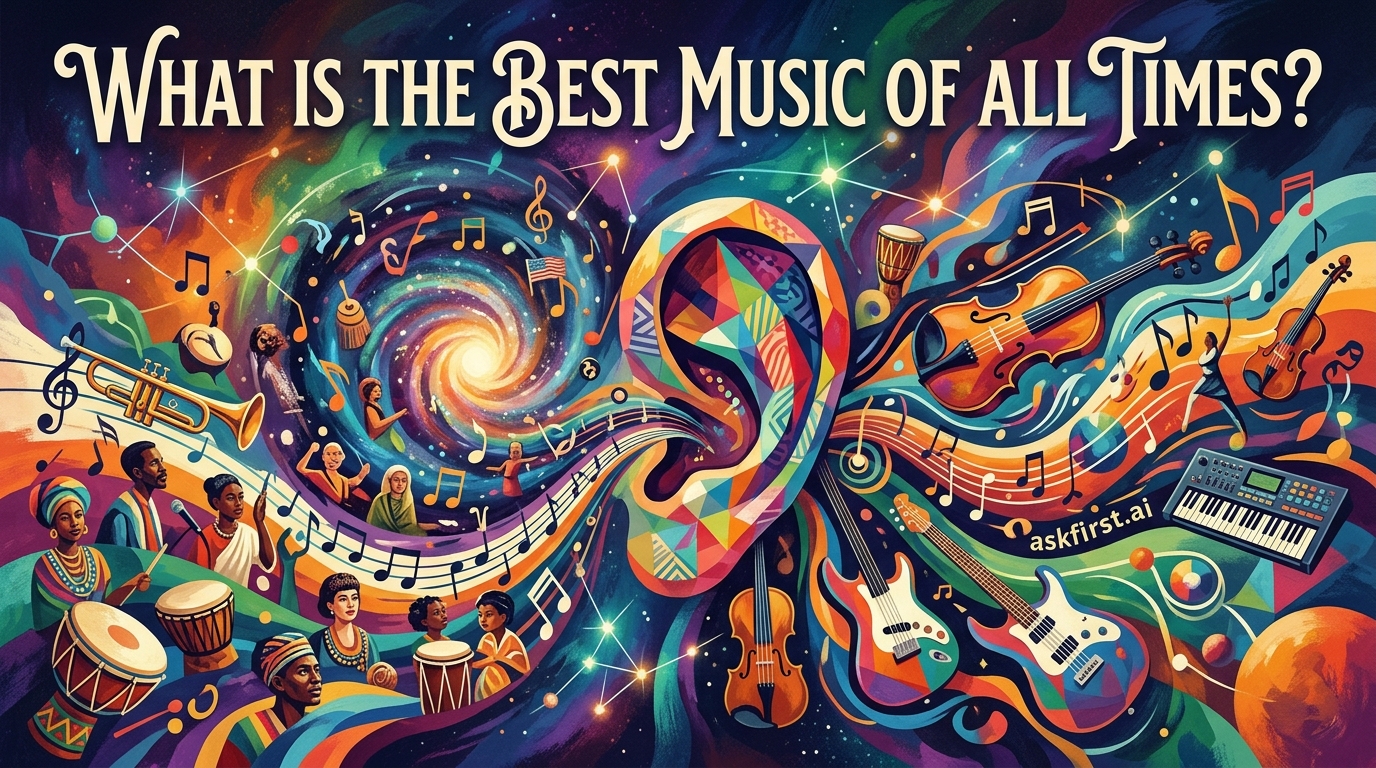
Determining the "best" music of all time is a subjective endeavor that bridges the gap between mathematical precision, cultural resonance, and emotional impact. Music, as a universal language, transcends borders and eras, yet its "greatness" is often measured by its innovation, its influence on subsequent generations, and its ability to capture the zeitgeist of human experience. To identify the pinnacles of musical achievement, one must look at works that fundamentally altered the trajectory of sound.
The Architectonics of Classical Mastery
If we define "best" through the lens of structural complexity and enduring influence, the works of Johann Sebastian Bach stand unrivaled. In his seminal work, The Well-Tempered Clavier, Bach essentially codified the system of Western tonal harmony. Musicologist Christoph Wolff in his authoritative biography, Johann Sebastian Bach: The Learned Musician, argues that Bach’s mastery of counterpoint provides a logical, almost architectural framework that remains the foundation for all Western music education.
When discussing the absolute peak of compositional genius, one cannot overlook Ludwig van Beethoven’s Ninth Symphony. Premiered in 1824, it marked a paradigm shift from the restrained classicism of the 18th century to the raw, emotive power of the Romantic era. By incorporating a full choir and vocal soloists into a symphonic structure—a move detailed in Jan Swafford’s Beethoven: Anguish and Triumph—Beethoven expanded the scope of what music could express, transforming it from entertainment into a profound philosophical statement on human brotherhood.
The Revolution of Jazz and Improvisation
Moving into the 20th century, the "best" music is defined by the liberation of rhythm and the democratization of expression. Miles Davis’s Kind of Blue (1959) is widely considered the greatest jazz album of all time. As noted by Ashley Kahn in Kind of Blue: The Making of the Miles Davis Masterpiece, this record moved away from the frantic, chord-heavy bebop of the era toward "modal jazz." By stripping away rigid structures, Davis allowed his ensemble—featuring legends like John Coltrane and Bill Evans—to explore space, silence, and melodic nuance in a way that had never been captured on tape before. It is not merely an album; it is a masterclass in spontaneous composition.
The Pop and Rock Paradigm Shift
In the realm of popular music, the conversation inevitably centers on The Beatles. Their 1967 album, Sgt. Pepper's Lonely Hearts Club Band, is frequently cited by critics and historians as the moment popular music transformed into "high art." Ian MacDonald, in his exhaustive study Revolution in the Head, explains how the band utilized the studio as an instrument itself, experimenting with tape loops, orchestral arrangements, and non-Western scales.
This era validated the album format as a cohesive artistic statement rather than a mere collection of singles. The influence of this period can be traced directly to modern production techniques. If you listen to the layering on A Day in the Life, you are hearing the blueprint for the complex, multi-tracked soundscapes that define contemporary pop and electronic music production today.
The Cultural Impact of Soul and Funk
No discussion of musical greatness is complete without acknowledging the visceral power of soul. Aretha Franklin’s I Never Loved a Man the Way I Love You (1967) or Marvin Gaye’s What’s Going On (1971) redefined the relationship between the artist and the social landscape. As Peter Guralnick notes in Sweet Soul Music, these artists brought the fervor of the gospel tradition into the secular sphere, giving voice to the civil rights movement and the internal struggles of the human heart. These works proved that music does not just reflect culture; it can actively shape political and social consciousness.
Why "The Best" Remains Elusive
Ultimately, the "best" music is a moving target because the listener’s context is constantly shifting. Music is a dialogue between the creator and the receiver. A piece of music that provides solace to one individual during a crisis—perhaps a Chopin nocturne or a Bob Dylan folk ballad—holds more "value" to that person than any critically acclaimed masterpiece.
The objective greatness of these works lies in their timelessness. They possess a structural or emotional integrity that allows them to be interpreted anew by every generation. Whether it is the mathematical perfection of Bach, the improvisational brilliance of Davis, or the studio wizardry of The Beatles, these works have achieved a state of permanence. They are not merely "hits" that faded with the seasons; they are cultural artifacts that define the boundaries of human creativity.
In conclusion, while there is no single objective "best," the music that stands the test of time is that which combines technical mastery with profound emotional truth. Whether you are listening to the intricate fugues of the Baroque era or the expansive, genre-defying sounds of the late 20th century, you are participating in a tradition of excellence that continues to define what it means to be human. To explore these works is to engage with the very best of our collective history.