The history of online entertainment is a fascinating journey that tracks the evolution of computer networking from its academic, text-based origins to the high-bandwidth, immersive multimedia landscape we inhabit today. While many assume that the "online" era began with the World Wide Web in the early 1990s, the roots of digital entertainment were planted much earlier, within the closed circuits of mainframe computers and university research networks.
The Dawn of Multi-User Dungeons (MUDs)
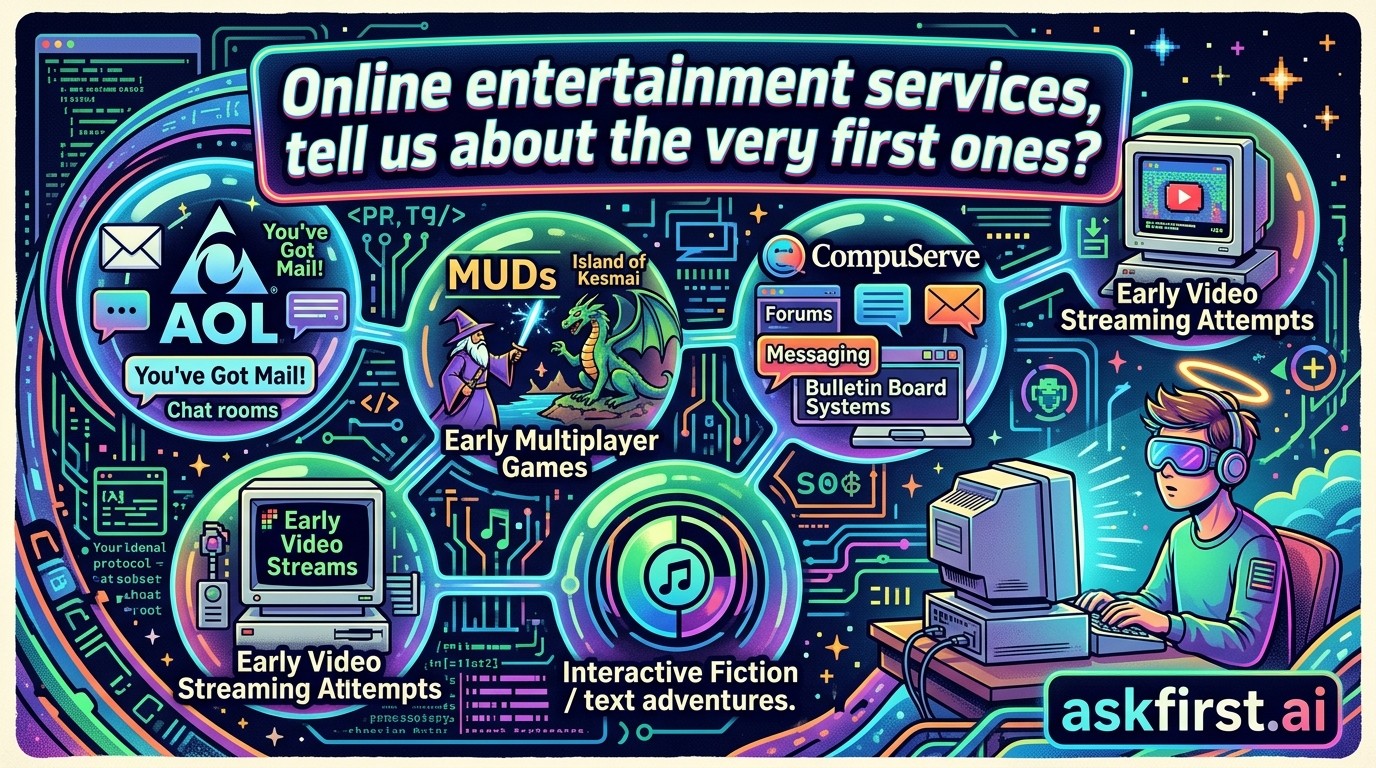
Long before the advent of graphical user interfaces or high-speed broadband, the first true online entertainment services were text-based virtual worlds known as Multi-User Dungeons (MUDs). The progenitor of this genre, simply titled MUD1, was created in 1978 by Roy Trubshaw and Richard Bartle at the University of Essex.
Running on a DEC PDP-10 mainframe, MUD1 allowed multiple users to connect via dial-up terminals to navigate a shared fantasy environment. Players typed commands such as "go north," "get sword," or "attack dragon," receiving descriptive text back from the system. This was the first time in history that people from disparate locations could share a persistent, simulated reality. As noted by Richard Bartle in his seminal book, Designing Virtual Worlds (New Riders, 2003), these early systems established the foundational social dynamics of online gaming, including player-versus-player conflict, team-based cooperation, and the concept of "leveling up."
The Rise of Commercial Online Services: PLATO and CompuServe
While MUDs were born in academia, the 1980s saw the emergence of commercial services that brought connectivity to the home. The PLATO system, developed by the University of Illinois and later commercialized by Control Data Corporation, was a pioneer in early online education and entertainment. It featured sophisticated multiplayer games like Empire (a space strategy game) and Avatar (an early graphical RPG) as early as the mid-1970s.
However, it was CompuServe and Quantum Link (Q-Link) that truly brought online entertainment to the masses. CompuServe, which launched its Information Service in 1979, provided users with access to "CB Simulator," the first real-time chat service. For many, this was their first experience with "online socializing." Users would adopt handles and converse in digital rooms, marking the birth of modern online communities.
Q-Link, which was specifically designed for the Commodore 64, is perhaps the most significant ancestor of modern online services. It featured a graphical interface, downloadable software, and early online games like Habitat, which was developed by Lucasfilm Games. Habitat is widely cited by historians—such as Julian Dibbell in his work My Tiny Life—as the first large-scale attempt at a Graphical Multi-User Environment (GMUE), setting the stage for what we now recognize as the metaverse.
The Bulletin Board System (BBS) Phenomenon
Parallel to these corporate services, the 1980s saw the proliferation of the Bulletin Board System (BBS). These were not centralized services but rather localized hubs hosted on individual computers. A user would use a modem to dial directly into another person’s home computer.
BBS culture was a vibrant, underground ecosystem of entertainment. Users would log in to leave messages, participate in forums, and—most importantly—download and upload "shareware" games. The BBS era introduced the concept of "door games," which were external programs that a user could run while connected to the board. Games like Legend of the Red Dragon (LORD) became legendary, utilizing the persistent, turn-based nature of the BBS to allow players to interact with a shared world that evolved over days and weeks. These systems fostered a "DIY" spirit that defined the pre-internet digital culture.
Prodigy and the Graphical Revolution
In the late 1980s and early 1990s, Prodigy changed the landscape by offering a more visually appealing experience than its text-heavy competitors. Utilizing the NAPLPS (North American Presentation Level Protocol Syntax) standard, Prodigy provided a colorful, graphical interface for news, shopping, and, crucially, interactive games. It was here that many users first encountered the idea of an "online service" that felt like a cohesive, curated environment rather than a collection of disparate data nodes.
By the time America Online (AOL) rose to dominance in the mid-1990s, the blueprint for online entertainment had been solidified. AOL consolidated the best elements of its predecessors: the social connectivity of chat rooms, the structured content of commercial services, and the ease of access that made the "Information Superhighway" accessible to non-technical users.
Conclusion
The first online entertainment services were not defined by high-definition graphics or cinematic soundscapes, but by the revolutionary capacity to bridge distance. From the text-based escapism of MUD1 to the localized, communal forums of the BBS era, these early pioneers established the essential pillars of modern digital culture: real-time communication, persistent virtual worlds, and the democratization of content distribution. Understanding these origins—as documented in histories like The Silicon Boys by David Kaplan or the archives of the Computer History Museum—reveals that the core of online entertainment has always been about human connection, regardless of the technology used to facilitate it. We have simply transitioned from reading the story to living within it.