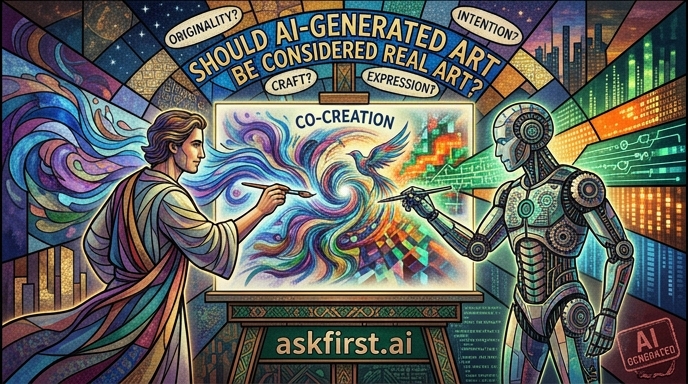
The question of whether AI-generated imagery constitutes "real art" is currently one of the most contentious debates in the creative world, sitting at the intersection of philosophy, legal theory, and aesthetic history. To evaluate this, one must move past the surface-level novelty of the technology and examine the fundamental definitions of art, authorship, and intent.
The Philosophical Definition of Art
Historically, art has been defined by the presence of human intent and the expression of the human condition. From the Renaissance masters to the Abstract Expressionists, the value of a piece of art has often been tethered to the "human spark"—the specific, lived experience of the creator that is encoded into the work.
When we view a painting, we are not merely looking at pigment on canvas; we are engaging in a silent dialogue with the artist’s choices, struggles, and subconscious motivations. Critics of AI-generated imagery argue that because a machine lacks consciousness, emotions, and a physical body, it cannot engage in this dialogue. By this definition, AI art is a sophisticated simulation of aesthetics rather than an authentic expression of humanity. It produces "art-like" output, but lacks the internal necessity that drives human creativity.
The Evolution of Tools and Technique
Conversely, proponents of AI art argue that the definition of art has always evolved alongside technology. When photography was first introduced in the 19th century, painters and critics dismissed it as a mechanical process that "stole" the role of the artist. They argued that because a camera captured reality automatically, it required no skill and therefore possessed no soul.
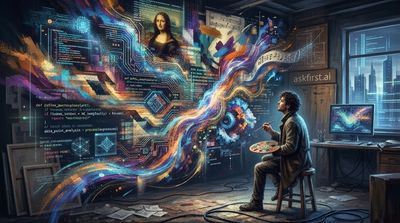
Today, we recognize photography as a profound medium of fine art. The argument here is that AI acts as an extension of the artist’s will—a tool, much like a brush, a camera, or a digital tablet. In this view, the "art" does not reside in the machine’s processing power, but in the human’s ability to curate, prompt, iterate, and refine. The artist becomes a director or a curator, selecting from a vast field of possibilities to manifest a specific vision. The complexity of the prompt engineering and the iterative process of "in-painting" or "out-painting" represent a new form of technical mastery that is distinct from, but not necessarily inferior to, traditional draftsmanship.
The Problem of Authorship and Data
A critical point of friction in this debate is the provenance of the training data. Unlike a human artist who draws inspiration from the world and their predecessors, AI models are trained on millions of existing images, many of which are copyrighted works created by human artists without their explicit consent.
This raises a significant ethical concern: if an AI generates an image in the style of a living artist, is that an act of creation or an act of algorithmic plagiarism? If the "art" is essentially a statistical synthesis of human-made works, its claim to originality is deeply compromised. Many argue that until the systems are trained on ethical, licensed datasets, the output cannot be considered "real" art because it is fundamentally a derivative product of human labor rather than a synthesis of human experience.
Aesthetic Value and the "Viewer's Share"
Perhaps the most pragmatic way to settle the debate is to consider the "Viewer’s Share." This art-historical concept suggests that a significant portion of an artwork's meaning is created by the observer. If a viewer gazes upon an AI-generated landscape and feels a genuine sense of awe, nostalgia, or melancholy, does the origin of that image matter?
If art is defined as a communicative act—a bridge between a creator and an audience—then AI-generated images function as art whenever they successfully elicit an emotional or intellectual response. In this context, the machine acts as a conduit for the viewer’s own projections. If the image successfully evokes a human response, it serves the function of art, regardless of whether a human hand held the brush.
Conclusion: A New Category of Creation
Ultimately, categorizing AI-generated imagery as "real art" may be the wrong approach. It is perhaps more accurate to view it as a distinct, new category of visual media. Just as digital photography did not replace painting, and film did not replace theater, AI will likely exist alongside human-made art as a parallel discipline.
The value of human-made art will likely increase as AI output becomes more ubiquitous, precisely because of the human struggle, time, and physical presence involved in its creation. Meanwhile, AI art will continue to democratize the ability to visualize complex ideas, enabling people who lack traditional technical skills to participate in the visual culture of our time. Whether we label it "art" or "synthetic media," the technology has permanently altered the landscape of human expression, forcing us to redefine what we value in the objects we create and consume.