The Paradox of Prosperity: Deconstructing the Financial-Wellbeing Link
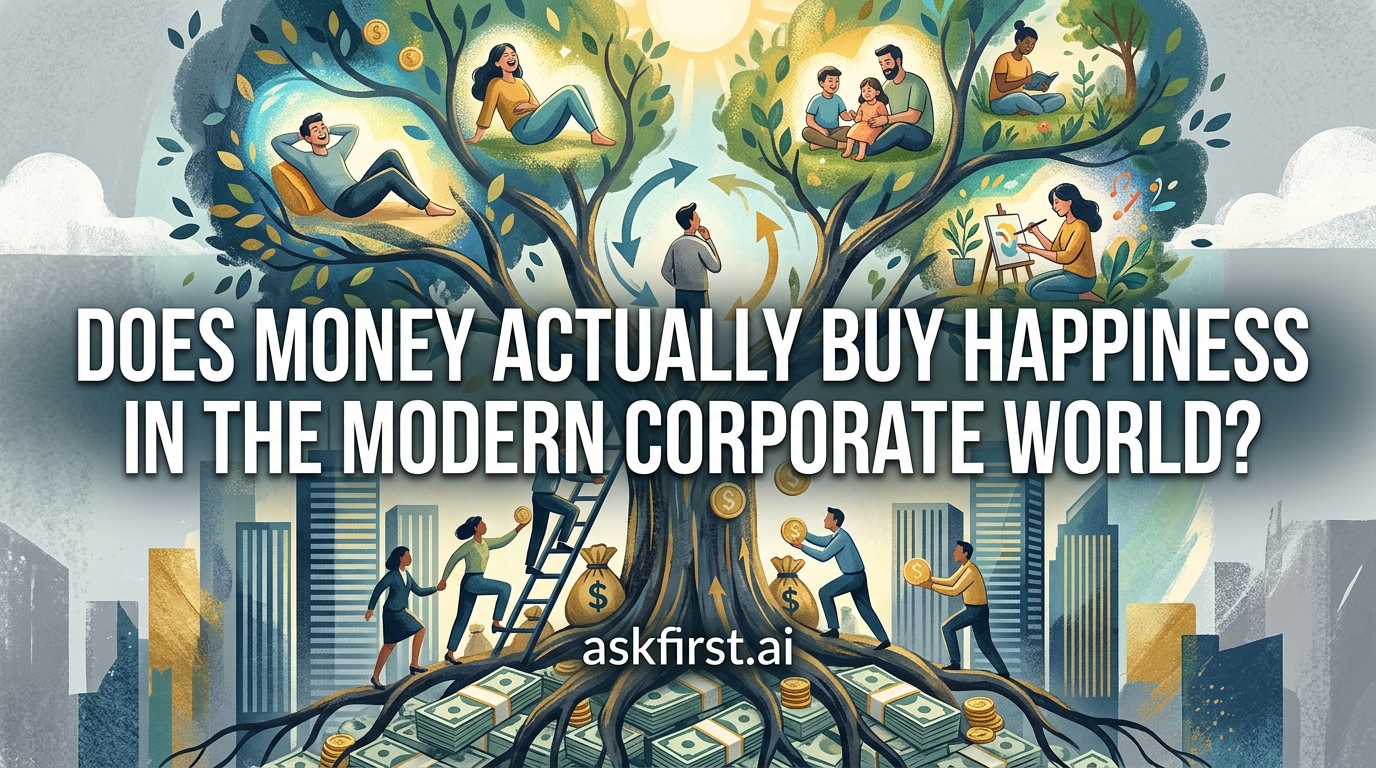
The relationship between capital accumulation and human flourishing has remained a subject of intense academic scrutiny for decades. In the modern corporate landscape, where compensation packages are often conflated with personal value, the question of whether money buys happiness requires a nuanced dissection of behavioral economics, psychological thresholds, and the distinction between evaluative and experiential wellbeing.
The Easterlin Paradox and the Threshold Effect
Economist Richard Easterlin famously proposed that while higher income correlates with increased life satisfaction at a singular point in time, long-term national economic growth does not necessarily translate into a rise in societal happiness. This is known as the Easterlin Paradox. The psychological mechanism at play is 'hedonic adaptation'—the human tendency to return to a relatively stable level of happiness despite major positive or negative events. As salary increases, lifestyle inflation typically follows, effectively neutralizing the long-term psychological 'boost' that a pay raise initially provides.
Research published by Nobel laureates Daniel Kahneman and Angus Deaton introduced a critical distinction: the 'satiation point.' Their data suggested that emotional wellbeing increases with income up to a certain plateau—historically cited around $75,000 annually in US-based studies—beyond which further income has a diminishing marginal return on daily mood. While more recent studies have suggested this plateau might be higher or non-existent in terms of 'life evaluation,' it remains universally true that money provides security, not necessarily spontaneous joy.
The Three Pillars of Financial Contentment
To understand the corporate reality, one must view money through three distinct functional lenses:
- Security (The Foundation): Money is highly effective at eliminating sources of misery. It alleviates the existential dread associated with debt, inadequate healthcare, and housing instability. In the corporate world, this manifests as the 'peace of mind' component of a high salary.
- Autonomy (The Currency of Freedom): Perhaps the greatest utility of capital is the ability to exercise agency. Wealth allows individuals to curate their environment, opt out of toxic professional settings, and reclaim time—the scarcest resource of all. When employees use wealth to buy back their time, happiness correlates positively with income.
- Comparison (The Social Trap): Corporate environments often encourage status competition. Happiness here is sabotaged by 'relative deprivation.' If an individual earns significantly more than their peers, they may experience temporary satisfaction. However, if their social circle is even wealthier, the subjective experience of that same income often feels inadequate. Happiness becomes a moving target tethered to others' success rather than personal fulfillment.
The Corporate Illusion: Meaning vs. Maintenance
Corporate success is frequently conflated with financial compensation, yet research into the 'meaning of work' indicates that intrinsic motivators—autonomy, mastery, and purpose—are stronger predictors of long-term job satisfaction than base salary. High compensation can lead to 'golden handcuffs,' where the fear of losing a high-paying role forces individuals to endure environments that erode their mental health. When money is the primary driver for staying in an unfulfilling role, it acts as a suppressant to happiness rather than a facilitator.
Strategies for Financial-Emotional Harmony
For the modern professional, the objective is not to reject money, but to optimize its utility. To ensure money contributes to a high-quality life, consider these evidence-based approaches:
- Invest in Experiences, Not Assets: Empirical data consistently shows that the psychological 'glow' from experiential spending—travel, learning, or social gatherings—outlasts the utility of material consumption, which is prone to rapid sensory habituation.
- Purchase Time, Not Things: Using salary to outsource repetitive, time-consuming tasks (like cleaning, administrative chores, or transport) is one of the most reliable ways to increase happiness. It grants the individual space to pursue hobbies and social connection.
- Prosocial Spending: Studies indicate that spending money on others or contributing to causes outside of oneself creates a sustained increase in subjective wellbeing that personal consumption cannot replicate.
Conclusion: The Final Verdict
Money is not a catalyst for happiness; it is a tool for infrastructure. In the modern corporate world, money buys the absence of stress and the presence of options. It secures the environment where happiness can occur, but it does not generate happiness itself. If an individual relies solely on their paycheck to derive satisfaction, they will inevitably enter the cycle of hedonic adaptation. True professional and personal satisfaction is found when financial security is treated as a foundational platform, allowing the individual the freedom to pursue the non-monetary elements—purpose, relationships, and growth—that actually compose a flourishing life.