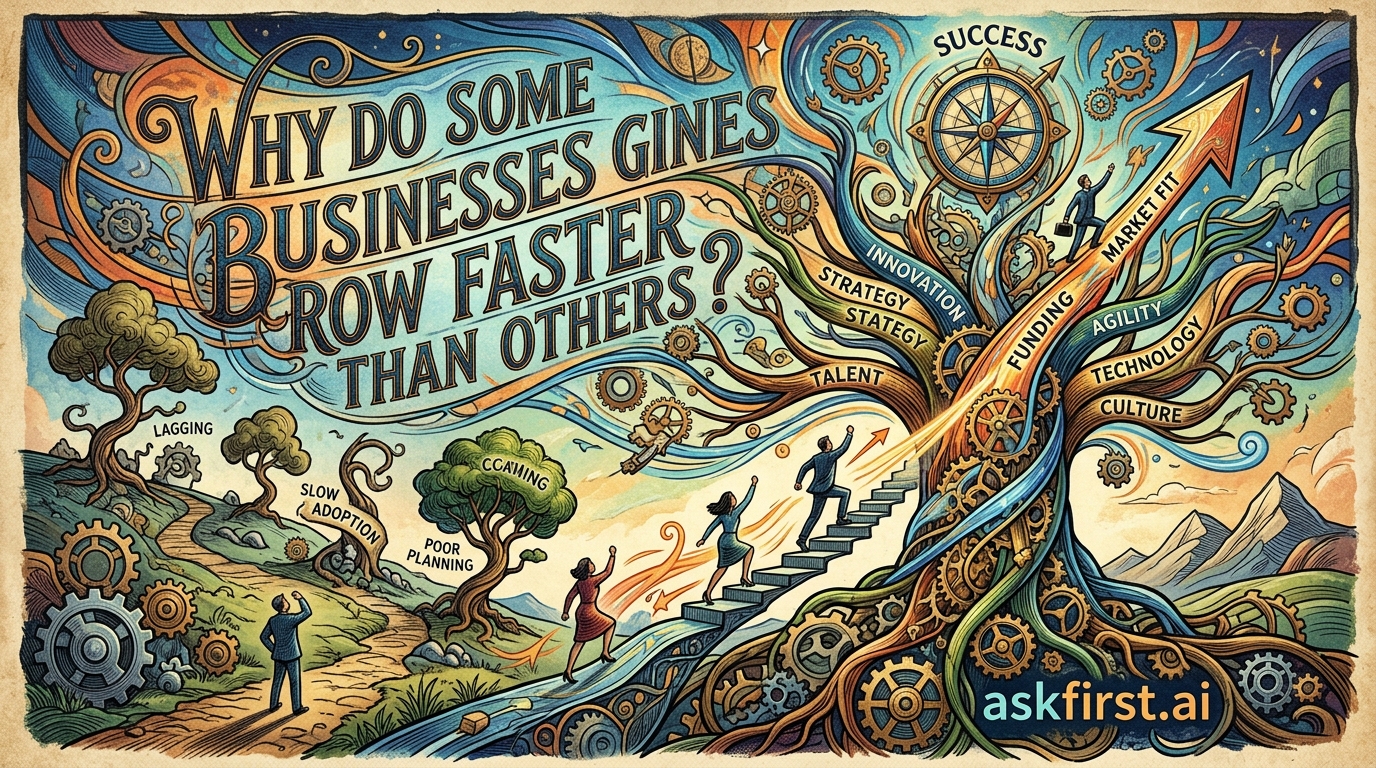
The phenomenon of rapid business growth—often referred to in management literature as "scaling"—is rarely the result of a single lucky break. Instead, it is the product of a deliberate alignment between internal operational efficiency and external market demand. While many companies remain stagnant, the "gazelles" of the business world (a term popularized by economist David Birch in his 1987 book, Job Creation in America) possess a distinct set of characteristics that allow them to outpace their competitors consistently.
The Power of Product-Market Fit
The foundation of any high-growth enterprise is an uncompromising adherence to "Product-Market Fit," a concept formalized by venture capitalist Marc Andreessen. Businesses that grow faster than their peers have identified a specific, painful problem in the market and solved it in a way that is ten times better than the existing alternatives.
Consider the trajectory of Slack. In its early days, the company did not simply market a chat tool; it marketed a solution to the "email overload" crisis that plagued modern offices. By focusing on the specific friction points of corporate communication, Slack achieved rapid adoption. Companies that grow fast do not just sell a product; they solve a critical need that causes customers to act as evangelists, effectively lowering the company’s Customer Acquisition Cost (CAC) through word-of-mouth growth.
Scalable Business Models and Marginal Costs
A primary differentiator between slow-growth and fast-growth companies is the relationship between revenue and costs. High-growth firms typically operate on models with low marginal costs. Software-as-a-Service (SaaS) companies, for example, can add a thousand new users with negligible incremental infrastructure costs.
In contrast, service-based businesses or those reliant on physical manufacturing often face "linear scaling" hurdles, where growing revenue requires a proportional increase in headcount or raw materials. According to Geoffrey Moore in his seminal work, Crossing the Chasm, businesses that break through the growth ceiling are those that transition from bespoke, high-touch services to repeatable, industrialized processes. They automate the mundane, allowing their human talent to focus on high-value innovation rather than repetitive operational tasks.
The Role of Network Effects
Fast-growing businesses often leverage "network effects," a phenomenon where the value of a product increases as more people use it. This is the engine behind the success of platforms like Airbnb or Uber. As more hosts joined Airbnb, the selection for travelers improved, which in turn attracted more guests, creating a flywheel effect.
This concept, extensively detailed by authors such as Nir Eyal in Hooked: How to Build Habit-Forming Products, explains why some companies achieve exponential growth rather than linear growth. Once a company reaches a critical mass, the market begins to work for the business, rather than the business having to work for every incremental customer. This creates a "moat" around the company, protecting it from competitors while simultaneously accelerating its reach.
Data-Driven Decision Making and Agility
Speed is a competitive advantage in itself. High-growth companies foster a culture of rapid experimentation. They utilize A/B testing, cohort analysis, and real-time feedback loops to iterate on their offerings constantly. While traditional firms might spend months planning a product launch, fast-growth firms operate in "sprints," a methodology central to the Agile framework.
In their book The Lean Startup, Eric Ries argues that the fastest-growing companies are those that prioritize "validated learning" over long-term strategic planning. By launching a Minimum Viable Product (MVP), measuring user response, and pivoting based on data, these companies minimize wasted effort and maximize their time-to-market. They treat their business strategy as a living document, adjusting their trajectory based on what the market actually does, rather than what they hope it will do.
Talent Density and Cultural Alignment
Finally, growth is limited by the quality of the people within an organization. Reed Hastings, the co-founder of Netflix, famously emphasized "talent density" in his book No Rules Rules. Fast-growing companies tend to hire "top-tier" talent—individuals who are not only highly skilled but also possess a high degree of autonomy.
When a company grows, bureaucracy often sets in, slowing down decision-making. High-growth firms combat this by maintaining a culture of radical transparency and decentralized decision-making. They empower individual teams to take ownership of their outcomes. When every employee understands the company’s "North Star" metric—the single most important indicator of success—the entire organization moves in unison, preventing the misalignment that typically causes growth to plateau.
Conclusion
The divergence in growth rates between companies is not a mystery of luck; it is a manifestation of strategic choices. Fast-growing businesses prioritize scalable models, lean into network effects, leverage data to iterate faster than their competitors, and cultivate a culture of high talent density. By focusing on these pillars, these companies do not merely exist within their markets; they define them. The successful enterprise of the future is one that views growth not as a destination, but as a deliberate, repeatable process of solving problems at scale.