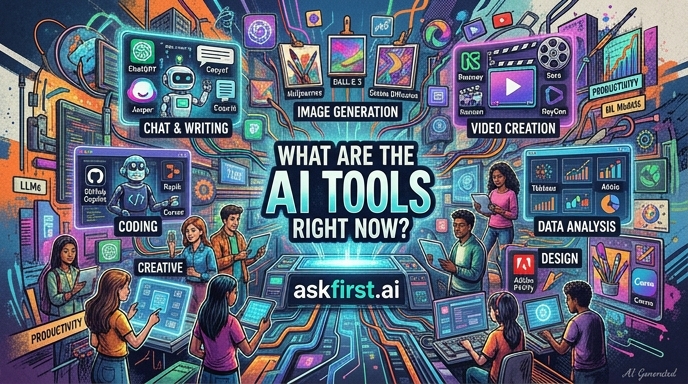
The landscape of artificial intelligence tools in mid-2026 has matured from experimental prototypes into deeply integrated productivity engines. Choosing the "best" tools depends entirely on your specific workflow, whether you are coding, creating visual media, analyzing complex datasets, or managing enterprise-scale operations. As of May 2026, the market is dominated by a few key players that offer superior reasoning, multimodal capabilities, and ecosystem integration.
1. Advanced Large Language Models (LLMs) and Reasoning Engines
For pure intellectual heavy lifting, coding, and complex content generation, three platforms currently define the gold standard:
- GPT-5 (OpenAI): As of May 2026, GPT-5 remains the industry benchmark for complex reasoning and human-like nuance. Its ability to maintain long-context windows allows for the processing of entire technical manuals or multi-hundred-page legal documents without losing coherence. It is the preferred tool for high-level strategy, complex software architecture, and nuanced creative writing.
- Claude 3.5 Opus (Anthropic): Claude continues to be favored by researchers and developers for its "constitutional AI" approach, which results in more predictable, safer, and less "hallucinatory" outputs. Its coding capabilities are arguably the most precise in the industry, making it the primary companion for software engineers who require robust debugging and architectural suggestions.
- Gemini Ultra 1.5 (Google): Gemini's primary strength lies in its native multimodal integration. Because it was trained from the ground up on video, audio, and text simultaneously, it is the best tool for analyzing long-form video content or complex data visualization. Its deep integration with the Google Workspace ecosystem makes it indispensable for enterprise users who live within Docs, Sheets, and Drive.
2. Generative Visual and Multimedia Tools
The visual AI space has moved beyond simple image generation into the realm of professional-grade cinematography and design:
- Midjourney v7: This remains the undisputed king of artistic fidelity. Its latest iteration handles text-within-images and complex lighting compositions with a level of control that rivals professional graphic design software. It is the go-to tool for concept art, advertising materials, and high-end digital imagery.
- Sora Pro (OpenAI): The gold standard for text-to-video generation. Sora Pro has revolutionized the pre-production phase of filmmaking, allowing directors to generate photorealistic storyboards and complex motion sequences that were previously impossible to visualize without massive budgets.
- Runway Gen-3 Alpha: While Sora excels at realism, Runway remains the leader for editors and motion designers. Its "Motion Brush" and advanced temporal controls offer a level of granular manipulation that allows professionals to integrate AI-generated assets into existing video projects seamlessly.
3. Developer-Centric and Productivity Tools
Coding has been fundamentally transformed by AI-assisted environments that act as "pair programmers" rather than mere autocomplete engines:
- Cursor: This code editor has become the standard for modern development. By integrating LLMs directly into the IDE, Cursor allows developers to refactor entire codebases, write complex unit tests, and diagnose architectural flaws with a single prompt. It bridges the gap between high-level logic and low-level syntax better than any other tool.
- GitHub Copilot Workspace: This tool has shifted from a snippet suggestion engine to a project-planning powerhouse. It can now take a natural language feature request and translate it into a series of actionable tasks, creating a plan and implementing the code across multiple files in a repository.
4. Data Analysis and Business Intelligence
For professionals dealing with "big data," the best tools are those that can perform statistical analysis without requiring the user to be a data scientist:
- Perplexity Pro: Perplexity has evolved into the definitive research engine. By synthesizing real-time data from across the web and citing its sources with high accuracy, it has replaced traditional search engines for many professionals. Its "Pages" feature allows for the rapid creation of structured reports based on live research.
- NotebookLM (Google): This tool is unparalleled for document synthesis. You can upload a folder of PDFs, transcripts, or research notes, and it acts as an expert consultant on that specific data. It is the ultimate tool for consultants, students, and analysts who need to synthesize disparate sources of information into a cohesive narrative.
How to Choose Your Stack
When selecting your tools, prioritize interoperability. The best AI experience in 2026 is not found in a single tool, but in a "stack" that complements your existing software.
- For Research: Use Perplexity Pro to gather information and NotebookLM to synthesize it into a report.
- For Development: Utilize Cursor as your primary IDE with Claude 3.5 Opus as your reasoning backend.
- For Content Production: Use GPT-5 for drafting and strategy, Midjourney for visuals, and Runway for motion assets.
The rapid pace of development means that the "best" tool can change in a matter of weeks. However, by focusing on tools that prioritize reasoning, data integrity, and workflow integration, you ensure that your professional output remains at the cutting edge of what is humanly and artificially possible. Always test these tools against your specific pain points; the best AI is the one that saves you the most time while requiring the least amount of "prompt engineering" maintenance.