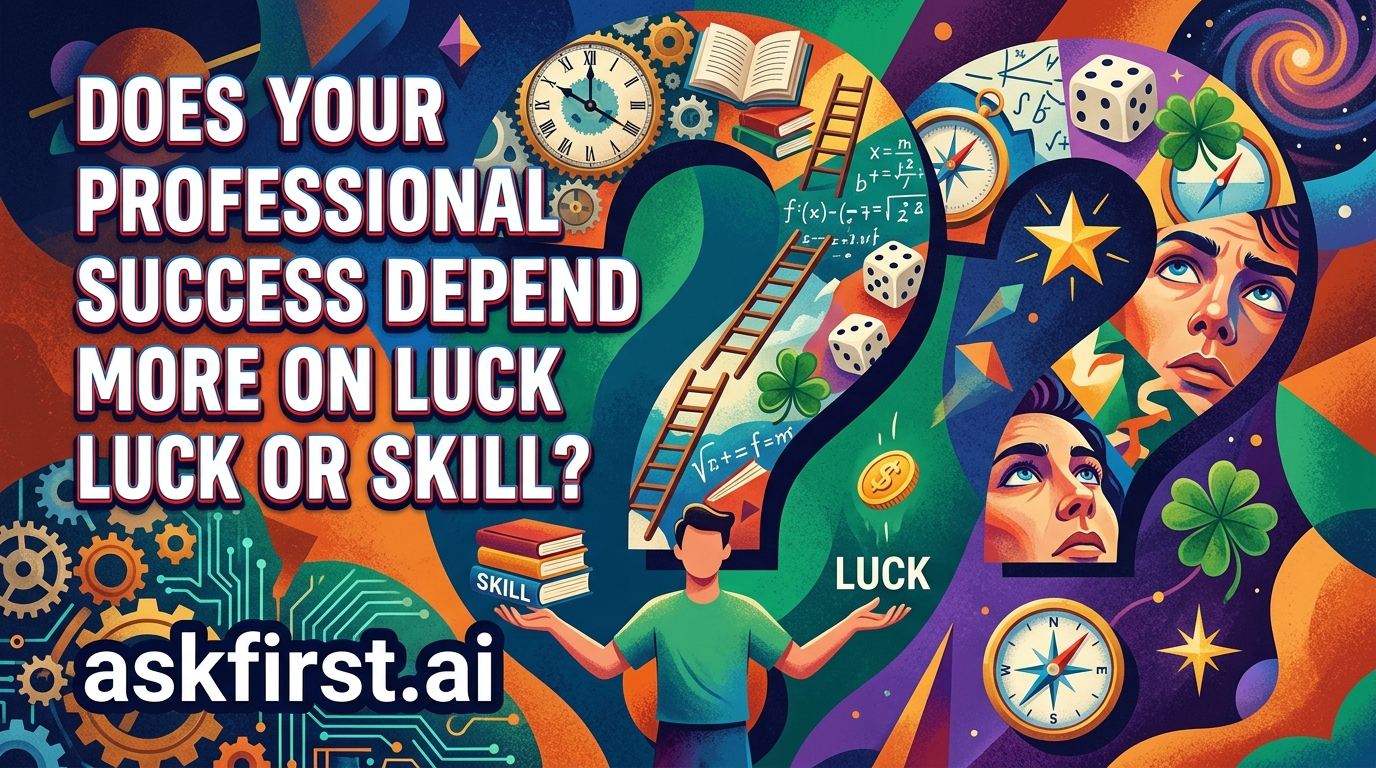
The Great Debate: Agency versus Chance in Professional Trajectories
For decades, observers of human achievement have attempted to quantify the relative contributions of individual merit versus serendipitous environmental factors. The question of whether success is a result of calculated skill or unpredictable luck remains one of the most provocative inquiries in behavioral economics and professional psychology. To understand this dichotomy, one must dissect the mechanisms that govern growth and the statistical realities of outliers.
The Illusion of Control and the Meritocracy Myth
Society is built upon the foundational narrative of meritocracy: the belief that talent, coupled with hard work, inevitably results in reward. However, research into complex systems suggests that this narrative often overlooks the 'Matthew Effect'—a term coined by sociologist Robert K. Merton—which posits that success begets success. Initial advantages, often born of luck (such as being born in a specific region or possessing a specific genetic predisposition), compound over time.
- The Starting Line Advantage: Being born into a stable environment or a well-resourced family provides a buffer that allows for the development of skills. Without this foundational 'luck,' the development of 'skill' is inherently more difficult.
- The Timing Window: Many successful individuals benefited from being at the right place at the right time. For example, software moguls in the 1970s did not merely possess superior programming skills; they had access to hardware that was largely unavailable to the rest of the world.
Why Skill is the Necessary Multiplier
While luck initiates the opportunity, skill acts as the multiplier. Without the cultivation of expertise, the advantages provided by luck are frequently squandered. Consider the 'Lucky Strike' phenomenon: an individual might stumble into a high-visibility project, but if that individual lacks the technical competence to deliver, the opportunity results in professional embarrassment rather than advancement. Skill is the mechanism that converts random potential into sustainable output.
The Science of 'Surface Area'
Perhaps the most compelling synthesis of these two forces is the concept of 'luck surface area.' This idea suggests that while one cannot control the frequency or intensity of lucky events, one can significantly increase the probability of encountering them through intentional action. Skill-building increases this surface area in several ways:
- Network Expansion: Deepening expertise creates a reputation, which attracts connections. These connections often act as conduits for 'lucky' opportunities.
- Recognition Capability: A skilled individual is far more likely to identify a 'lucky' opening when it presents itself. The amateur perceives a blank wall, while the expert sees an open door.
- Resilience: Skill provides a safety net. When a situation is dictated by bad luck, the highly skilled individual possesses the adaptive capacity to pivot, whereas the unskilled individual is often forced to withdraw.
Statistical Variance and Outliers
In fields characterized by extreme competition, such as athletics or entertainment, the margin between the top 1% and the rest of the pack is often minuscule. In these scenarios, the influence of luck is statistically undeniable. Nassim Taleb, in his extensive work on randomness, argues that history is largely a record of 'survivorship bias.' When we look at successful individuals, we ignore the thousands of others who applied the exact same skills but were undone by a minor, unlucky variable. Understanding this helps depersonalize failure and prevents the hubris associated with success.
Cultivating Agency in a Random World
If luck plays such a significant role, does effort become meaningless? Absolutely not. While the outcome of any single endeavor is subject to the volatility of chance, the distribution of outcomes over a long-term career is heavily skewed toward those who maintain high levels of skill. By focusing on variables within one's control—such as the continuous refinement of craft, the development of emotional intelligence, and the cultivation of intellectual curiosity—professionals effectively hedge against the randomness of the world.
Conclusion: The Synthesis of Excellence
Professional success is best viewed not as a binary choice between luck and skill, but as a dynamic interplay. Luck serves as the spark, while skill acts as the fuel. To chase success effectively, one must maximize their skill set to take advantage of whatever luck might appear, while simultaneously acknowledging that humility is required to navigate the randomness of the professional landscape. Those who thrive are those who prepare as if everything depends on their skill, while remaining cognizant that success is a gift often delivered by the winds of fortune.