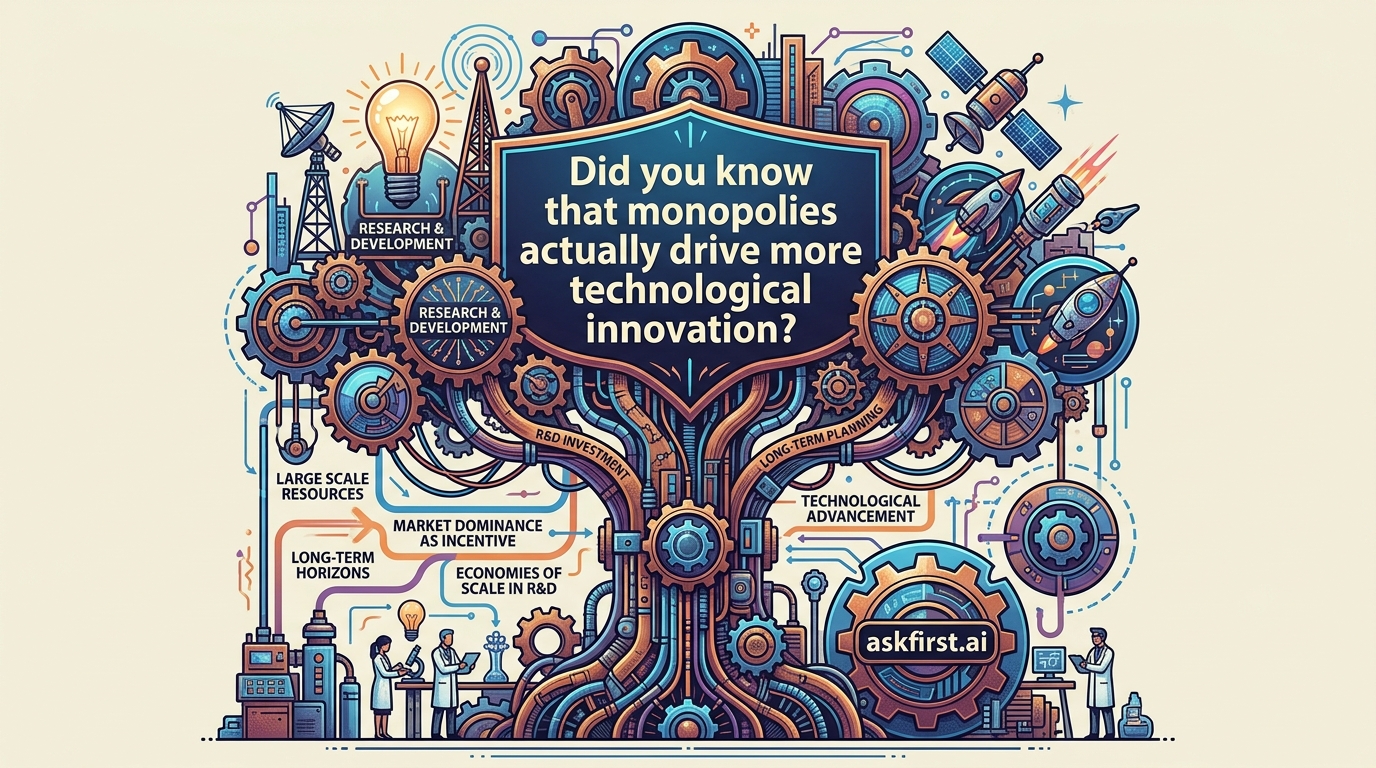
The Paradox of Monopolies and Innovation
For decades, economic theory has preached the gospel of competition as the primary engine for progress. However, a compelling and often overlooked perspective—famously championed by Peter Thiel in 'Zero to One'—argues that monopolies, when functioning correctly, actually serve as the most potent engines for sustained technological advancement. This counter-intuitive reality suggests that while perfect competition creates a race to the bottom in terms of margins and innovation, monopolies possess the stability and capital to fund long-term, high-risk research.
The Destructive Nature of Perfect Competition
In a state of perfect competition, companies operate under such immense pressure to lower prices and survive that they are rarely able to invest in radical breakthroughs. When profit margins are thin, firms focus on incremental improvements and defensive cost-cutting rather than disruptive innovation. In this market structure, the commodity nature of goods makes it impossible for any individual firm to capture the value created by a new invention, leading to stagnation. Because any competitive advantage is quickly mimicked or eroded by rivals, there is a fundamental disincentive to spend millions on long-term R&D.
Why Monopolies Enable Breakthroughs
Monopolies, by definition, operate without the immediate threat of market erosion. This position provides three distinct advantages that act as catalysts for technological leaps:
- Capital Surplus: Monopolies generate the significant financial resources necessary to fund expensive, multi-year projects that a smaller, competitive firm would never dare to finance.
- Long-term Planning Horizon: Without the daily scrutiny of quarterly margin-focused competitors, a monopolist can afford to think in terms of decades rather than months, enabling investment in 'moonshot' projects.
- Value Capture: A monopolist can confidently invest in innovation because they know that if they succeed, they will be the sole beneficiary of that invention, allowing them to recapture their initial research investment.
Historical and Contemporary Evidence
History provides several examples where monopolistic structures fostered unparalleled technological progress. Consider the era of Bell Labs under AT&T. Because AT&T held a government-sanctioned monopoly on telecommunications, it could channel massive resources into pure research. This environment led to the invention of the transistor, the solar cell, and the foundation of modern computing—inventions that a fragmented, competitive market might never have achieved because the risk-to-reward ratio for any single small firm would have been prohibitive.
Similarly, modern 'tech giants' often function as effective monopolies in specific sectors. This market dominance allows these organizations to invest billions into Artificial Intelligence, quantum computing, and space exploration. These are ventures where the return on investment is not guaranteed and may be years away. The ability to endure these 'innovation deserts' is a trait unique to firms that have reached a scale of monopolistic stability.
Balancing Innovation and Regulation
Critics often point to the risk of stagnation inherent in monopolies—the idea that once a company becomes a monopoly, it will stop innovating because it no longer fears competition. While this is a genuine risk (often called 'The Innovator’s Dilemma'), it is often mitigated by the threat of 'creative destruction.' Even a monopolist knows that if they stop providing value, they become vulnerable to a completely different type of disruption or technological replacement.
The Essential Trade-off
The fundamental lesson here is that competition is not an end in itself; it is a mechanism that should serve the goal of progress. If a market structure is so fiercely competitive that no one has the resources to invent the next paradigm-shifting technology, then the competitive nature of that market is actually working against the interests of society.
To drive the future, organizations need the freedom and the resources that come from a lack of immediate competitive pressure. By fostering an environment where a firm can establish a monopoly based on superior technology, we create the very conditions that allow for the funding of the next generation of breakthroughs. The narrative that we should always prefer a crowded, competitive market over a successful, innovative monopoly is a myth that may be stifling the very progress we seek to accelerate. Understanding this balance is key to comprehending the evolution of global technology and the future of industrial progress.