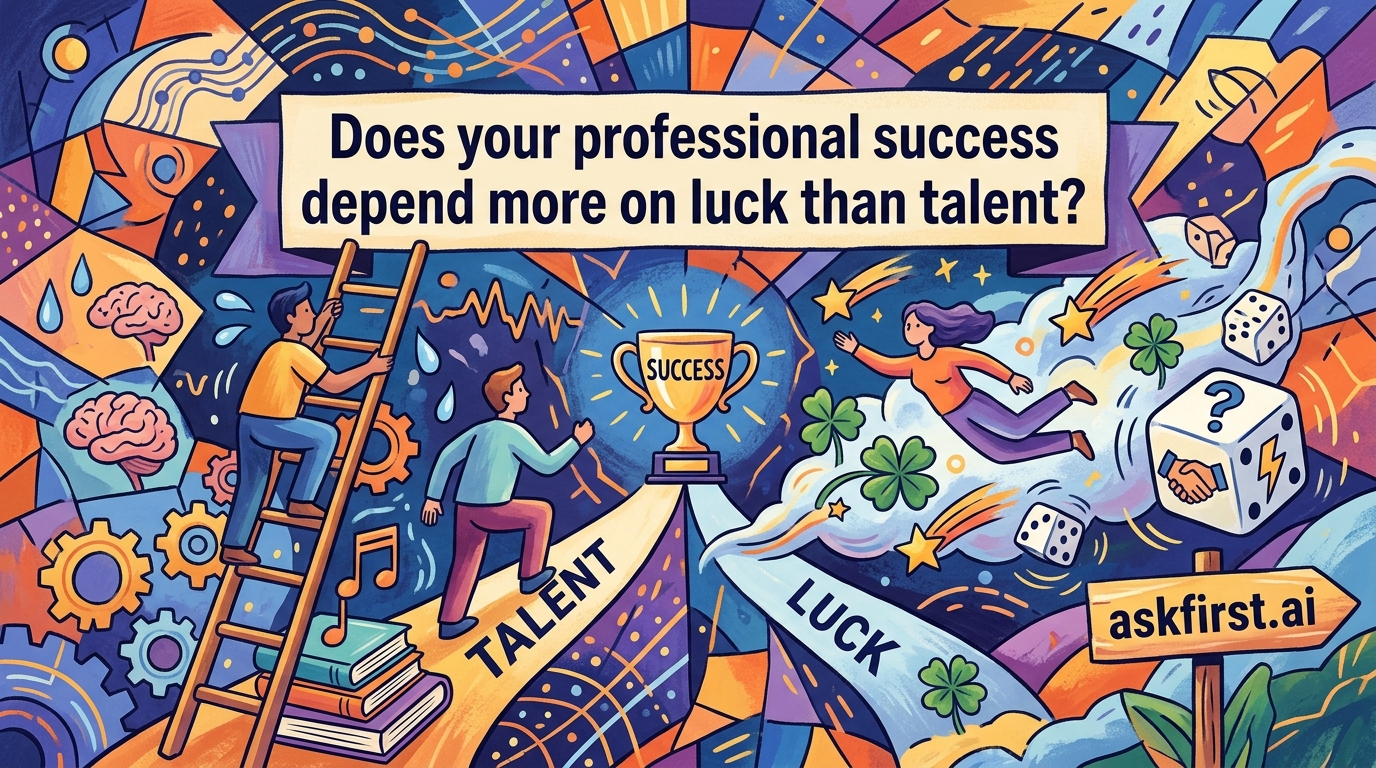
The Great Dichotomy: Skill Versus Serendipity
The debate regarding professional success often centers on a false dichotomy: is one an architect of their own destiny through sheer talent and tireless work, or is one merely a passenger on a boat steered by the invisible currents of luck? In reality, professional trajectories are complex ecosystems where skill acts as the fuel and luck serves as the wind. Understanding how these forces interact is essential for those seeking long-term sustainable growth.
The Role of Talent: The Foundation of Readiness
Talent, defined as the innate aptitude or acquired proficiency in a specific domain, acts as the foundational requirement. It is the 'readiness' factor. According to the research conducted by psychologists like K. Anders Ericsson, high levels of achievement are almost always associated with 'deliberate practice.' Talent is not a fixed state but a muscle that strengthens through repetition, feedback, and refinement. Without this baseline competency, an individual is rarely in a position to capitalize on lucky breaks. When an opportunity arrives, it is the prepared mind—the one that has mastered its craft—that can effectively translate that opportunity into a tangible outcome.
The Anatomy of Luck: Types of Serendipity
Sociologists often categorize luck into distinct forms to help demystify its role in career development:
- Blind Luck: Events completely outside of an individual’s control, such as being born into a specific family, country, or era of technological innovation. While this sets the starting line, it does not determine the finish line.
- Active Luck: This involves putting oneself in positions where 'lucky' events are statistically more likely to occur. By attending industry events, publishing research, or networking across disciplines, an individual increases their 'luck surface area.'
- Recognitive Luck: The ability to notice an opportunity that others overlook. This is where talent and luck intersect. It is the capacity to synthesize information and see value where others see noise.
The Matthew Effect and Cumulative Advantage
Named by sociologist Robert K. Merton, the 'Matthew Effect' suggests that success tends to breed more success. In competitive fields, early advantages—whether due to talent or a small stroke of luck—accumulate over time. This is often observed in the 'winner-take-all' markets where the top performers receive a disproportionate amount of rewards. This phenomenon illustrates why luck at the beginning of a career can be a massive multiplier, creating a feedback loop of resources, reputation, and access that further amplifies talent.
Strategy for Success: The Convergence Model
Rather than viewing success as a binary choice between luck and talent, top performers adopt a convergence strategy. This model suggests that while one cannot control the frequency or intensity of lucky events, one can absolutely control the probability of encountering them and the readiness to exploit them.
- Optimize for Optionality: Create multiple career pathways. When one door closes, the presence of alternatives keeps the momentum alive.
- Cultivate Exposure: Proactively seek environments that facilitate chance encounters. Diversity of thought and network is a proven catalyst for serendipitous breakthroughs.
- Hone Adaptability: In a world of increasing complexity, the ability to pivot when 'luck' shifts the landscape is more valuable than static expertise.
Conclusion: Moving Beyond the Myth
To argue that success is purely the result of individual effort is a dangerous delusion that ignores the systemic reality of the world. However, to argue that success is purely luck is a disempowering mindset that negates the necessity of human agency. The most successful professionals acknowledge the role of fortune while maintaining an obsessive focus on excellence. They understand that while they cannot summon luck on command, they can build the ships that catch the wind. By focusing on skill acquisition while simultaneously broadening one's horizon for opportunity, individuals can effectively turn the chaotic forces of probability into a structured path toward professional mastery. Luck may provide the spark, but talent and hard work are the vessels that sustain the flame for a lifetime.