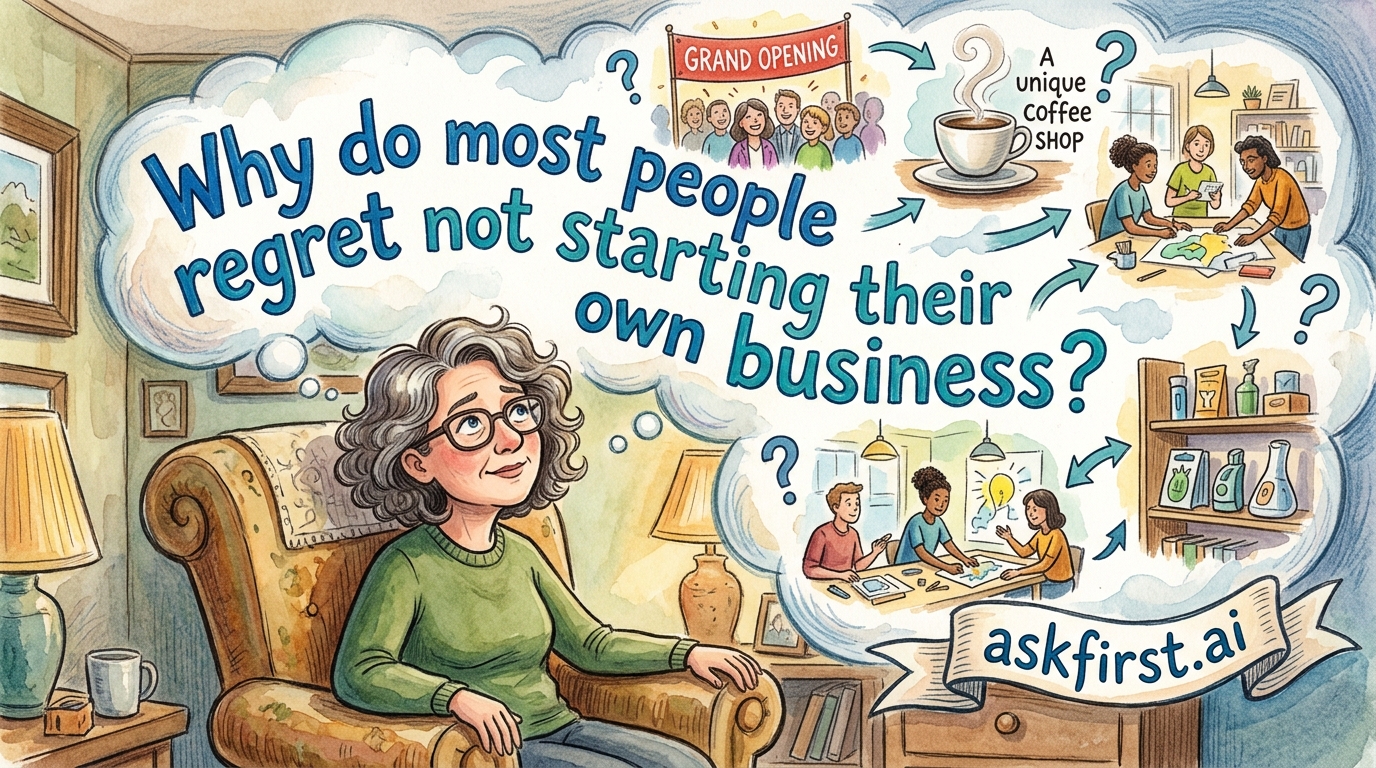
The Psychology of Regret: Why the Road Not Taken Looms Large
The phenomenon of regret regarding entrepreneurship is a deeply rooted psychological condition that transcends borders and generations. Behavioral economists, such as Thomas Gilovich, have extensively studied the 'omission bias'—the human tendency to regret the actions not taken far more profoundly than the actions taken, particularly in the long term. When individuals look back on their careers, the pain of a 'failed' startup is often viewed as a lesson, whereas the safety of an unfulfilled dream of business ownership becomes a source of chronic, unresolved longing.
1. The Erosion of Potentiality
Human beings possess an innate desire for autonomy. Starting a business represents the ultimate manifestation of personal agency. When an individual remains in traditional employment, they often trade this agency for security. Over time, the realization that one has built someone else’s dream instead of their own leads to a sense of existential stagnation. This is not merely about money; it is about the self-actualization described in Maslow’s hierarchy of needs. The 'what if' factor grows larger as the window of opportunity feels like it is closing, leading to a profound sense of wasted talent.
2. The Myth of the "Safe" Path
For decades, society perpetuated the myth that a 9-to-5 job is a bastion of safety. However, the 21st-century economy has shifted; the rise of automation, outsourcing, and artificial intelligence has proven that traditional jobs are subject to external forces beyond the employee's control. Those who avoided starting businesses to stay 'safe' eventually realize that they held no actual security. They lacked the leverage of owning an asset, a customer base, or a intellectual property. Recognizing this reality retrospectively induces a feeling of betrayal—not by an employer, but by the conventional wisdom that steered them away from risk-taking.
3. Financial Legacy vs. Monthly Wages
While wages provide immediate sustenance, business ownership provides equity. Equity is the vehicle for generational wealth. The regret often manifests when an individual realizes that no matter how hard they worked as an employee, their personal financial growth had a ceiling. A business owner, conversely, possesses an asset that can be sold, scaled, or passed down. The frustration of observing others who started small, weathered the storms, and eventually built lasting wealth acts as a catalyst for deep-seated regret.
4. The Intellectual Stimulation Gap
Entrepreneurship forces an individual to engage with every facet of reality: finance, marketing, human psychology, product design, and operations. This multifaceted engagement stimulates the brain and fosters a unique form of problem-solving intelligence. In a specialized corporate role, the scope of intellectual stimulation is often confined. Entrepreneurs look back and realize that they missed out on the 'great game' of business—the excitement of creating something from nothing and the intellectual satisfaction that comes from solving real-world problems.
How to Transform Potential Regret into Action
To avoid this cycle of retrospective sadness, it is essential to reframe how risk is perceived. Consider the following strategies for those currently hesitating:
- Conduct a "Regret Minimization Framework" analysis: Imagine yourself at age 80. Will you regret not starting this business, even if it might fail? Usually, the answer is yes. This visualization clarifies decision-making.
- Embrace Incrementalism: You do not need to quit your job tomorrow. The most successful entrepreneurs often build their ventures as side projects, validating their ideas while maintaining their current income.
- Redefine Failure: In the startup world, failure is not an end; it is a data point. Even if a business venture does not result in a global empire, the skills gained—sales, leadership, and resilience—are transferrable and highly valuable.
- Focus on Value Creation: Start by solving a specific, nagging problem. When the focus shifts from 'I need to make money' to 'I need to provide value,' the fear of starting dissipates because the mission becomes bigger than the ego.
Ultimately, the regret of not starting a business is a regret of missed contribution. Humans are inherently designed to build, create, and iterate. When that biological and psychological urge is stifled by the comfort of the status quo, the soul feels the lack of output. By understanding these psychological triggers, one can move past the fear and recognize that the time to start is not when conditions are perfect, but when the drive to build becomes louder than the fear of the unknown.