The Foundation of Persuasion: The Paradox of Choice and Social Proof
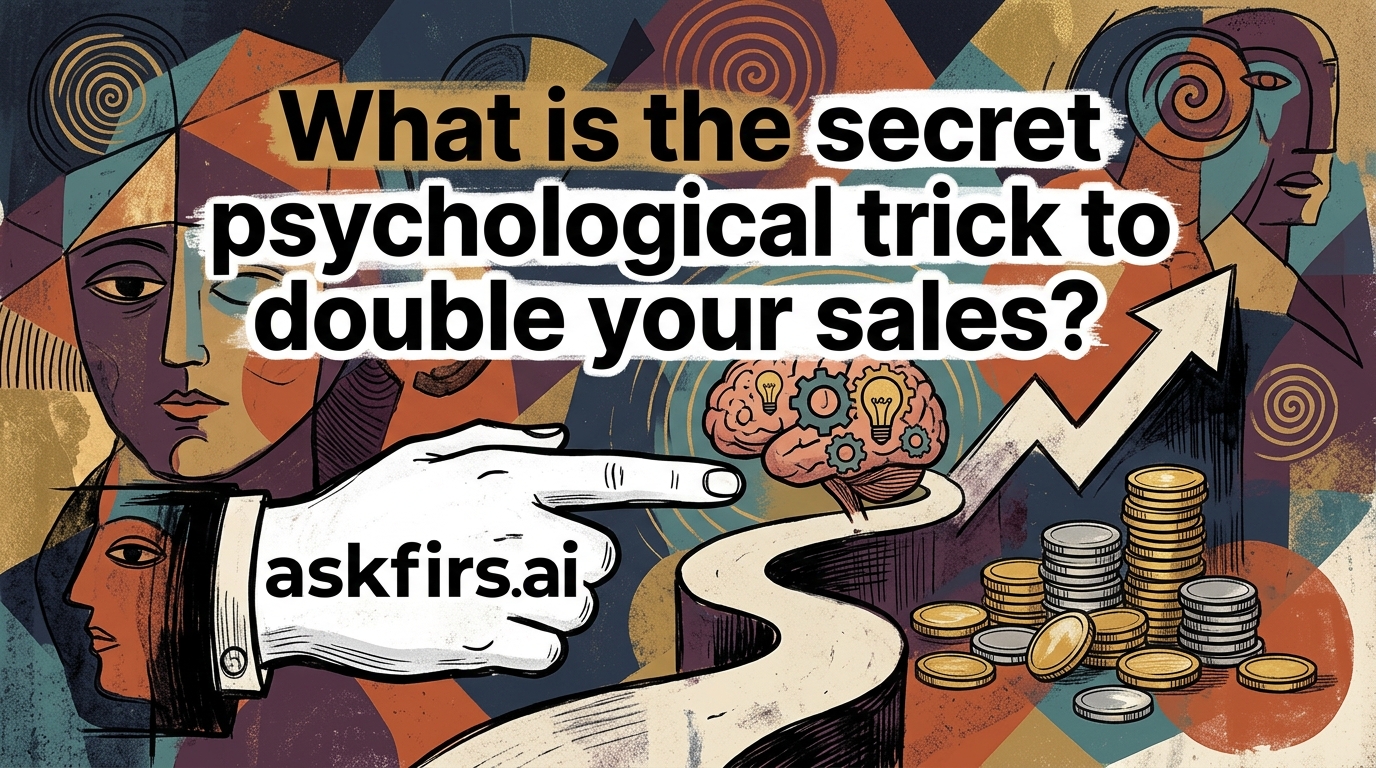
To understand the mechanism behind doubling sales, one must first look at the psychological phenomenon known as the Paradox of Choice. Often, sales professionals believe that offering more options leads to higher satisfaction and more conversions. However, research pioneered by Sheena Iyengar at Columbia University demonstrates that the human brain experiences 'analysis paralysis' when presented with too many options. When the consumer is overwhelmed, they default to non-action. The secret to doubling sales lies in simplifying the decision-making path. By reducing the cognitive load on the prospect, the likelihood of a 'yes' increases exponentially.
The Power of Scarcity and Urgency
Human biology is hardwired to fear loss more than it is motivated by gain—a psychological principle known as Loss Aversion, as famously documented by Nobel laureate Daniel Kahneman. When a product is framed as 'abundant,' the subconscious mind sees no reason to act immediately. Conversely, when scarcity is introduced—either through limited time or limited supply—the perceived value of the object spikes. This is the 'fear of missing out' (FOMO). To leverage this ethically, businesses must move away from artificial scarcity and focus on authentic constraints. Providing honest reasons for limited inventory or time-bound bonuses triggers a visceral reaction that encourages closing the deal without further deliberation.
Building Trust Through Reciprocity
Reciprocity is one of the most potent weapons in behavioral economics. When an individual receives something of value without an immediate demand for repayment, a strong psychological pressure is created to 'repay' that kindness. In a sales context, this manifests as providing massive value upfront—free consultations, white papers, or trial periods. This is not merely a marketing tactic; it is the establishment of a relationship foundation. Customers who receive value before being asked for a purchase are significantly more likely to commit because the psychological debt generated fosters a sense of loyalty and mutual investment that standard transactional models cannot replicate.
The Framing Effect: Context is Everything
How an offer is presented is far more important than the offer itself. This is known as the Framing Effect. Consider the difference between 'this product has a 20% failure rate' and 'this product is 80% successful.' The information is identical, yet the psychological perception varies wildly. To double sales, master the art of value-anchoring. By presenting a higher-priced 'anchor' item first, subsequent lower-priced options appear to be significantly better bargains. This anchoring effect resets the consumer's internal valuation, making the ultimate purchase feel like a strategic win rather than a cost.
Authority and Social Proof
Consumers constantly look for cues from others to determine if a decision is safe. This is the Social Proof principle. If potential buyers see that others within their industry or social circle have already made the leap, the perceived risk drops to near zero. Incorporating testimonials, case studies, and user-generated content acts as a psychological shortcut, bypassing the buyer's natural skepticism. To maximize this, focus on 'identifiable' social proof—case studies that mirror the specific pain points and demographics of the prospect. When the customer sees a version of themselves succeeding through the product, the psychological barrier to entry dissolves.
Implementing the 'Commitment and Consistency' Loop
The final layer of this psychological puzzle is the drive for Commitment and Consistency. Humans strive to be consistent with their previous actions. A large request is often met with resistance; however, a series of small, low-stakes agreements leads the prospect down a 'yes-ladder.' Start by asking for a minor commitment, such as signing up for a newsletter or answering a diagnostic question. Once the prospect has committed to this small step, their internal self-identity shifts to 'I am someone who is interested in this solution.' This subtle shift in self-perception makes them far more likely to accept a larger commitment, such as a major purchase later in the sales funnel.
Summary of Strategy
To effectively double sales, you must synthesize these triggers into a cohesive ecosystem:
- Simplify: Reduce choice to eliminate analysis paralysis.
- Anchor: Set high-value benchmarks to make your core offering seem like a bargain.
- Reciprocate: Provide disproportionate value to trigger the biological drive to return the favor.
- Verify: Use targeted social proof to mitigate the fear of the unknown.
- Step-Ladder: Convert cold prospects into long-term customers through incremental, small-scale commitments.
By systematically applying these psychological principles, the sales process transitions from a high-pressure persuasion attempt into a fluid, logical progression that respects the consumer's cognitive processes. This is not about manipulation; it is about aligning your sales strategy with the way the human brain naturally functions. When the friction is removed and the psychological incentives are aligned, sales volume does not just grow—it scales.