The Founder’s Blind Spot: Understanding Confirmation Bias
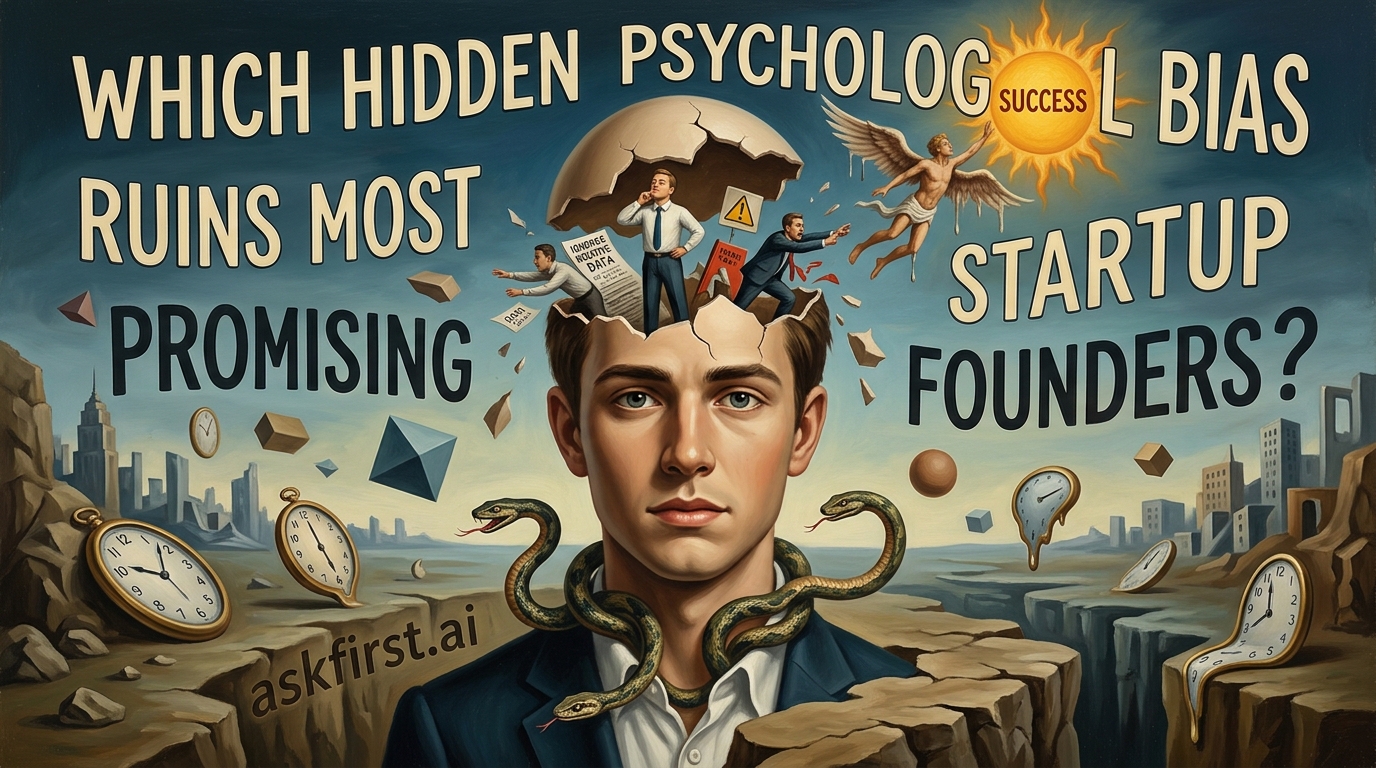
In the high-stakes world of entrepreneurship, intelligence and technical skill are often secondary to the psychological architecture of the decision-maker. The most pervasive and destructive cognitive trap that ruins promising startup founders is Confirmation Bias. This is the psychological tendency to search for, interpret, favor, and recall information in a way that confirms or supports one’s prior beliefs or values. While it feels like a simple shortcut, it acts as a silent executioner for innovation.
The Mechanics of the Trap
Confirmation bias functions as an intellectual filter. When a founder becomes enamored with a product vision, they instinctively gravitate toward data points that validate their assumptions. Conversely, they subconsciously marginalize, ignore, or explain away 'dissonant' data—customer feedback suggesting the product is unneeded, metrics showing poor retention, or market analysis indicating a lack of demand. This creates a dangerous feedback loop where the founder becomes increasingly confident in a failing hypothesis simply because they are only consuming the information that supports it.
Why It Is Catastrophic for Startups
The 'Echo Chamber' Effect: Founders often surround themselves with like-minded individuals, such as early employees or advisors who are socially incentivized to agree with the vision. This groupthink reinforces the bias, making it impossible to see the flaws in the business model until the runway is gone.
Slow Pivoting: Successful startups are defined by their ability to adapt. When a founder is suffering from confirmation bias, the necessity to pivot is viewed as a sign of failure or a personal attack on their identity. Consequently, they stick to a sinking ship for months or years, burning capital that could have been preserved for a better iteration.
Customer Development Sabotage: In the early stages, founders are taught to talk to customers. However, under the influence of confirmation bias, they tend to ask leading questions. Instead of asking, 'How do you solve this problem?' they ask, 'Wouldn't it be great if you had an app that solved this specific problem?' This yields biased data that feels like validation but is actually useless noise.
Strategies for Mitigation
To transcend this bias, founders must adopt a framework of 'Active Falsification', a concept rooted in the scientific method advocated by Karl Popper. Instead of trying to prove the business idea is correct, the founder must actively try to prove it is wrong. If the idea survives the most rigorous attempts to disprove it, the founder can proceed with significantly higher confidence.
Implement 'Red Teaming': Designate an internal or external person to play the devil's advocate. This individual's sole responsibility is to identify weaknesses in the product-market fit and challenge the core assumptions of the team.
Prioritize Quantitative Disconfirming Evidence: Create a system where the most critical metrics are reviewed by people who have no emotional investment in the startup. Objective, third-party data is harder to ignore than personal anecdotes.
Ask Open-Ended Questions: When conducting customer interviews, focus on the problem, not the solution. Avoid mentioning the product entirely. Acknowledge that the 'solution' might be flawed, and remain open to the fact that the actual problem faced by the customer may be completely different from what was initially assumed.
The Culture of Intellectual Humility
Building a resilient startup requires a culture of intellectual humility. This does not mean a lack of conviction; rather, it means having the courage to update one's beliefs in the face of new evidence. The most successful entrepreneurs in history, such as those who led companies like Amazon or Netflix, have demonstrated this by embracing the 'Day 1' philosophy, which demands that a company always act as if it is a startup, constantly questioning its foundations. By treating the business strategy as a series of experiments rather than a rigid destiny, founders can mitigate the effects of confirmation bias and turn their intellectual blind spots into clear vision. Mastery over one’s own mind is the final, essential competitive advantage that distinguishes the enduring companies from the momentary flashes of hope.