The Hidden Cost of Delay: Why Early Entrepreneurship Matters
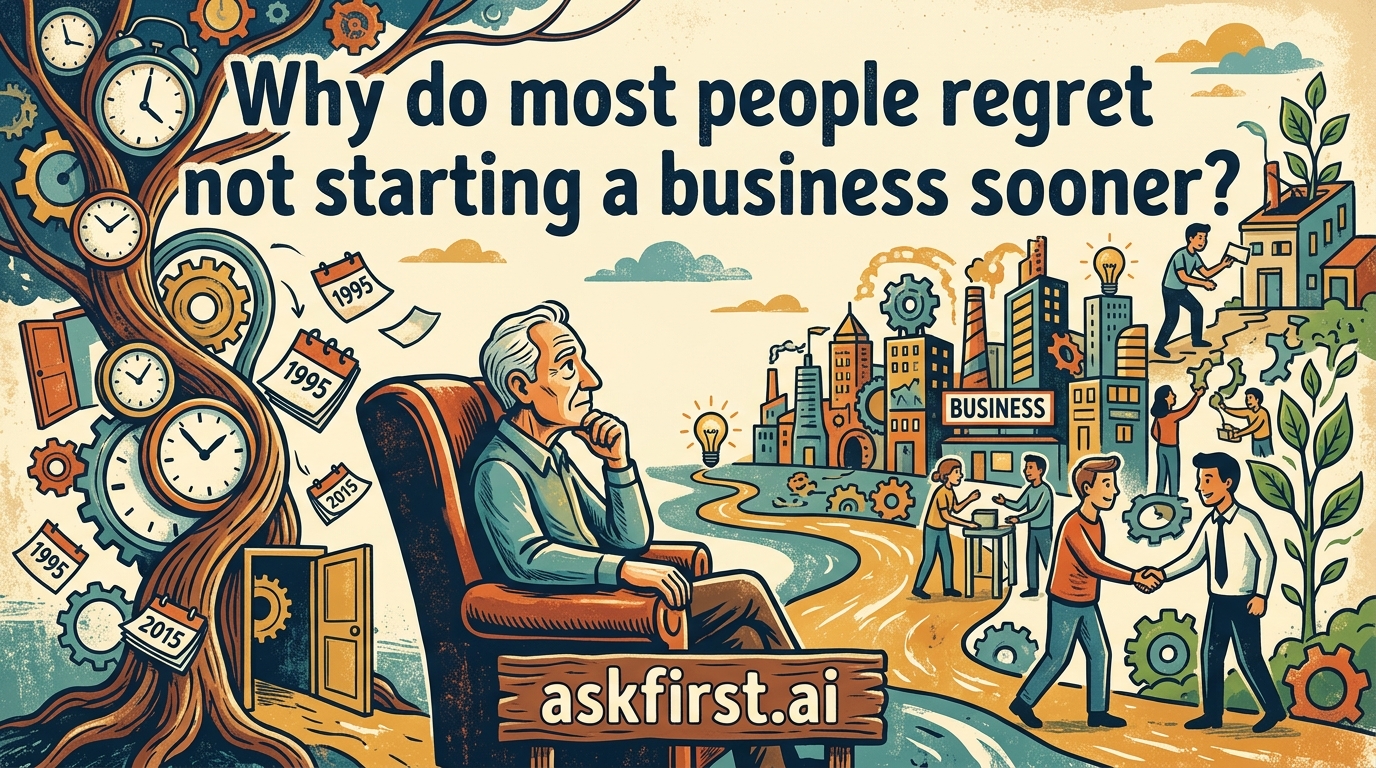
Starting a business is frequently viewed through the lens of risk, financial instability, and the daunting prospect of failure. However, an overwhelming majority of seasoned entrepreneurs report a singular, pervasive regret: waiting too long to begin. This phenomenon is not merely anecdotal; it is rooted in the intersection of psychology, compound interest, and the unique lifecycle of skill acquisition. Understanding why this regret is so universal offers a profound roadmap for those standing on the precipice of their own venture.
The Compound Effect of Experience
The primary reason for this deep-seated regret is the realization that entrepreneurship is a skill that compounds over time. Just as financial interest builds wealth, entrepreneurial experience builds 'market intuition.' Those who start earlier gain a massive head start in understanding the mechanics of value creation, failure recovery, and team dynamics.
- Rapid Iteration Cycles: Early mistakes are cheaper. An entrepreneur in their twenties or thirties often has fewer overheads, less rigid social commitments, and a higher threshold for trial and error compared to someone attempting a mid-life pivot.
- The Feedback Loop: Entrepreneurship is essentially an applied science of market feedback. The more loops one completes, the sharper the intuition becomes. Those who wait often lament that they were 'practicing' their life in a corporate role where feedback is slow and filtered, rather than in the raw, direct, and immediate environment of a startup.
Psychological Freedom and Identity
Many individuals delay starting a business due to the 'safety trap' of traditional employment. This comfort zone can act as a golden handcuff, gradually eroding the risk tolerance necessary for innovation. As psychologists note, the 'Status Quo Bias' keeps people in situations that are stable but dissatisfying. When people finally do make the leap, they often find that the uncertainty they once feared is actually the catalyst for personal growth. The regret stems from the realization that the security they were protecting was, in fact, an illusion.
The Myth of 'The Right Time'
A common myth is that there is an ideal moment to start a business—perhaps when one has more savings, better connections, or 'the perfect idea.' History shows that this ideal moment never arrives. The most successful entrepreneurs often start with limited resources, which forces them to innovate rather than outsource.
- Resourcefulness over Resources: Scarcity often drives creativity. Those who start sooner learn to build lean organizations, a skill that remains a massive competitive advantage regardless of how much capital is later injected into the company.
- The Elasticity of Time: As responsibilities increase with age, the 'cost of failure' can shift in perception, even if the financial risk is actually manageable. Starting early allows individuals to fail while their internal and external obligations are lower, providing a 'fail-forward' education that is invaluable.
Building Human Capital
The business world rewards those who have developed a diverse network and a broad skillset early. By starting a business, one is essentially fast-tracking their personal development. Whether the business flourishes or requires a pivot, the entrepreneur emerges with a portfolio of capabilities—sales, negotiation, product management, and leadership—that are simply not taught in a classroom. Those who start later often find themselves playing catch-up in these domains, wishing they had the decades of 'on-the-job' training that their peers who started early now possess.
Conclusion: The Asymmetry of Risk
The regret of not starting a business sooner is ultimately a recognition of the 'asymmetry of risk.' In a traditional career, the potential for upward mobility is often capped and linear. In entrepreneurship, the risk is front-loaded, but the upside is potentially exponential. By the time many individuals reach the peak of their corporate careers, they often see the 'entrepreneurial gap' they left behind—a decade or more where they could have been iterating, building, and owning their own outcomes rather than serving another person's vision.
Ultimately, the regret is not about money; it is about the autonomy and the accelerated path of self-discovery that only the journey of building a business can provide. For anyone contemplating this path, the realization is clear: the cost of inaction consistently outweighs the risk of the attempt. The best time to start is when the vision is clear enough to articulate and the courage is sufficient to act, regardless of the calendar.