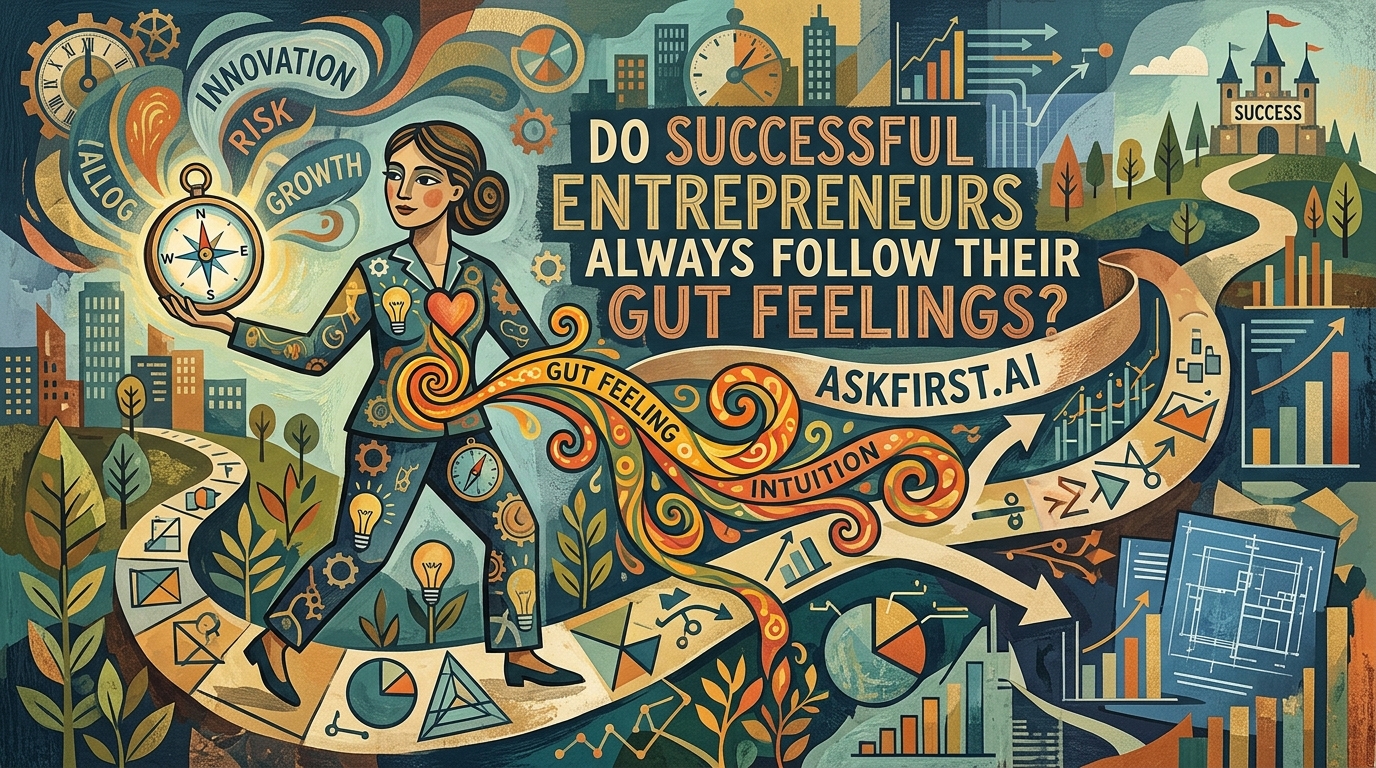
The image of the visionary entrepreneur, making earth-shattering decisions based solely on a mysterious 'gut feeling,' is one of the most persistent myths in the business world. While intuition often plays a role in the entrepreneurial journey, it is rarely the sole driver of success. In reality, the most enduring business empires are built at the intersection of instinct and rigorous, data-driven analysis. To understand why successful founders rarely rely exclusively on gut feeling, one must explore the nuance of decision-making under uncertainty. ### The Myth of the Intuitive Genius The narrative of the 'gut-led' founder is compelling because it simplifies complex processes into a heroic story. It suggests that if one has enough confidence or 'inner vision,' success is inevitable. However, cognitive science offers a different perspective. Intuition is essentially high-speed pattern recognition. When an experienced investor or founder 'feels' that a project will succeed, they are often subconsciously processing years of data, past failures, and market observation. It is not magic; it is experience synthesized into a snap judgment. Relying on this without validation is a dangerous strategy for anyone who lacks an extensive track record. ### The Role of Data-Driven Decision Making High-growth startups and mature corporations alike operate on feedback loops. Relying purely on gut instinct creates a blind spot that data can illuminate. Modern entrepreneurship relies on several pillars of objective analysis:
- Customer Discovery: Engaging in rigorous interviews and surveys to validate hypotheses rather than assuming one knows what the market wants.
- A/B Testing: Utilizing empirical data to determine which messaging, pricing, or product design yields better conversion rates.
- Financial Modeling: Projections and stress tests provide a quantitative safety net against overly optimistic assumptions.
- Cohort Analysis: Examining how specific groups of customers behave over time to identify retention trends that are invisible to the naked eye.
By grounding business strategy in these methods, entrepreneurs convert subjective guesses into calculated risks. Even if the 'gut' suggests a path, a successful founder will often task their team with proving that path correct through a pilot or a minimal viable product (MVP) test. ### When Intuition Actually Wins While data is paramount, there are moments where it falls short. This is known as the 'Knightian Uncertainty'—situations where the future is so unpredictable that historical data provides no guide. This occurs during:
- Paradigm-Shifting Innovation: When a product creates an entirely new category (like the personal computer or the smartphone), market research often fails because customers cannot articulate a need for something they have never seen.
- Rapid Crisis Management: When a business faces an existential threat that evolves in real-time, waiting for a statistically significant data set may lead to paralysis and ruin.
In these high-stakes, low-data scenarios, intuition becomes the best available tool. Experts argue that in these moments, the 'gut' acts as an heuristic—a shortcut for dealing with complexity when a full analytical breakdown is impossible. ### The Synthesis Strategy The most successful entrepreneurs employ a balanced synthesis. They utilize intuition to identify the potential 'Big Ideas' and form the initial hypothesis. They then switch to an analytical mode to stress-test those ideas, iterate, and build. This duality prevents the two most common causes of startup death: the 'Paralysis by Analysis' (too much data, no action) and the 'Intuitive Trap' (arrogance masquerading as vision). ### Cultivating Informed Intuition Because intuition is rooted in pattern recognition, it can be cultivated. Founders who read widely, study diverse industries, and practice deliberate reflection are constantly training their subconscious to spot opportunities faster. As noted in 'Thinking, Fast and Slow' by Daniel Kahneman, true expertise allows individuals to rely on their 'System 1' (fast, automatic) thinking for complex tasks because that system has been trained by years of 'System 2' (slow, deliberate) effort.
In conclusion, successful entrepreneurs do not merely follow their gut; they refine their gut through years of intense data gathering and learning. They treat their intuition as a starting hypothesis rather than an infallible conclusion. By embracing both the analytical rigor of the scientist and the boldness of the visionary, they manage to navigate the complexities of the global market. Success is not found by ignoring the facts in favor of a hunch, but by using facts to build a map that makes the hunch worth pursuing.