The Paradox of Zero-Price Valuation
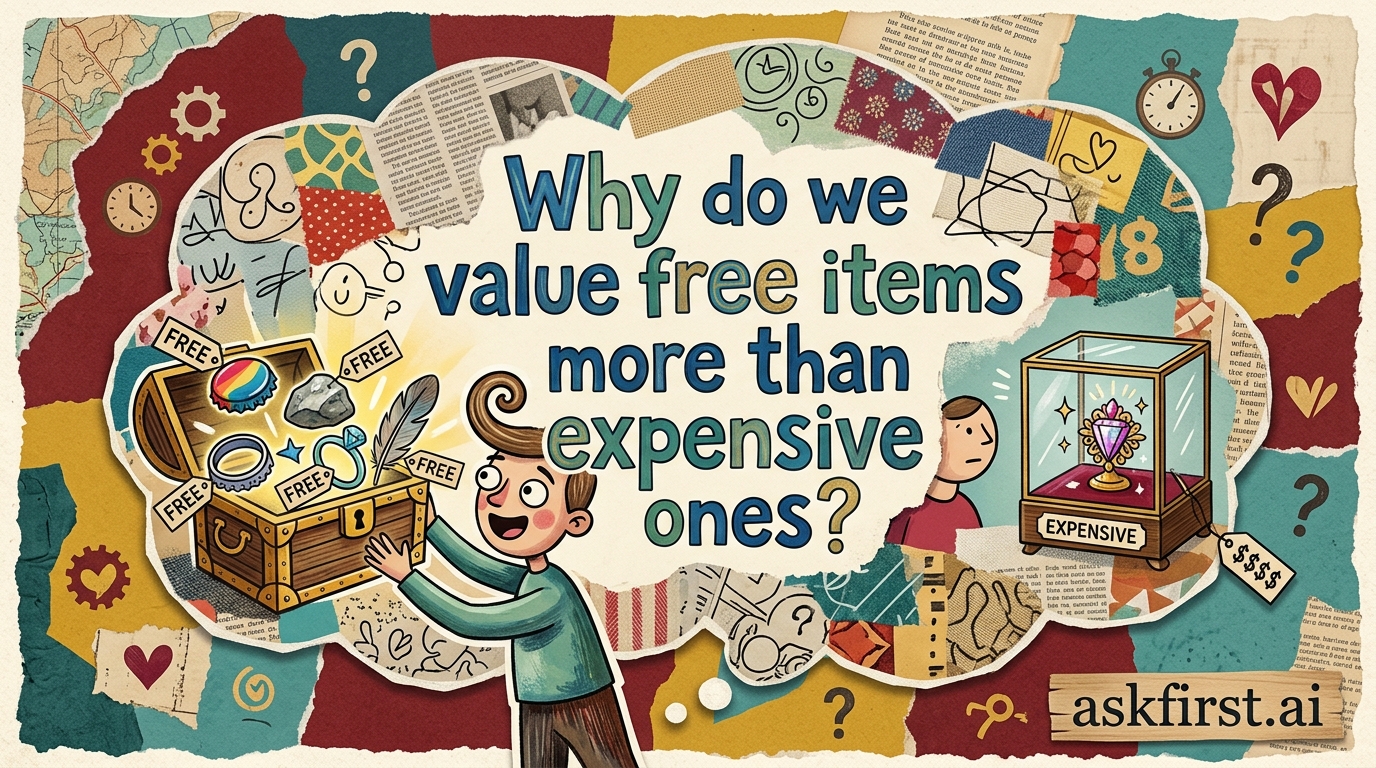
The phenomenon where individuals perceive a disproportionately higher value in items that are free is a well-documented curiosity in behavioral economics. This is often referred to as the 'Zero-Price Effect.' While conventional economic theory dictates that a rational agent should evaluate an item based solely on its utility, the introduction of a zero-price tag triggers a distinct psychological shift. This shift bypasses standard cost-benefit analysis, replacing it with an emotional reaction that transforms a simple transaction into a perceived 'gain.'
The Psychology of 'Gain Framing'
At the heart of this phenomenon lies the principle of Loss Aversion, famously championed by Daniel Kahneman and Amos Tversky. Humans are inherently programmed to fear loss more than they desire equivalent gains. When an item has a price tag, the act of acquisition is framed as a trade; one must relinquish money to gain the item. This 'losing' of currency triggers a cognitive friction. However, when an item is free, the 'loss' component of the transaction is entirely eliminated. The acquisition is perceived purely as a gain. Because the brain experiences zero cost, the psychological barrier to ownership evaporates, making the item feel more desirable.
The Heuristic of Emotional Satisfaction
Beyond simple loss aversion, there is an intrinsic emotional reward tied to getting something for free. This is essentially the 'treasure hunter' heuristic. When individuals encounter a free item, they experience a small surge of dopamine associated with the discovery of a 'deal.' The brain associates the acquisition of free goods with low-risk survival advantages, a remnant of evolutionary pressures where finding resources without energy expenditure was the ultimate optimization of survival. Consequently, the value of the object is inflated by the excitement of the acquisition process itself.
Why Free Often Trumps Expensive
Interestingly, when humans compare a free item to a modestly priced item, the perceived value gap between 'free' and 'one cent' is often greater than the gap between 'one cent' and 'ten dollars.' This non-linear valuation creates a massive psychological trap. Consider these driving forces:
- Elimination of Cognitive Load: When an item is free, the consumer stops evaluating whether the item is 'worth the price.' The decision-making process shifts from analytical (Is this worth ten dollars?) to impulsive (It is free, therefore I should take it).
- The Power of Framing: Marketing campaigns often leverage this by offering 'Free Shipping' or 'Buy One Get One Free.' Even if the initial item is overpriced, the perception of the free component overrides the logical assessment of the total cost.
- Social Proof and Availability: Free items often create a sense of urgency. The 'fear of missing out' (FOMO) is amplified when a product is free, as individuals feel they must acquire the object before the supply vanishes, further cementing its perceived importance.
Practical Implications and Examples
This behavior is not merely limited to physical goods. It is rampant in the digital economy. The 'Freemium' model—used by platforms like Spotify or mobile games—relies entirely on this psychological trigger. By allowing users to access the core service for free, companies bypass the initial resistance of payment. Once the user is anchored to the product through free usage, their perception of the product's value increases, often leading to later monetization. Even when a user could pay for an upgrade, the memory of the 'free' status makes them perceive the platform as a higher-value ecosystem than a purely paid service.
Expert Insights on Decision Making
Studies led by researchers such as Kristina Shampanier have demonstrated that if a person has to choose between a premium chocolate for a low price or a standard chocolate for free, they often choose the free option. This indicates that 'zero' is not just a price; it is a powerful emotional state. It shifts the consumer's mindset from 'What do I lose?' to 'What do I get?'. This positive-sum bias is a fundamental shortcut the brain uses to navigate a world of infinite choices.
Conclusion
Understanding the zero-price effect is essential for navigating the modern consumer landscape. It highlights that value is not an objective quality inherent in an object, but a subjective interpretation influenced by the context of acquisition. By recognizing that free items frequently manipulate our internal reward systems, individuals can begin to distinguish between the actual utility of an object and the fleeting satisfaction of obtaining something for nothing. Ultimately, we value free items more because they provide the dopamine of a bargain without the pain of expenditure, a combination that remains one of the most potent triggers in human psychology.