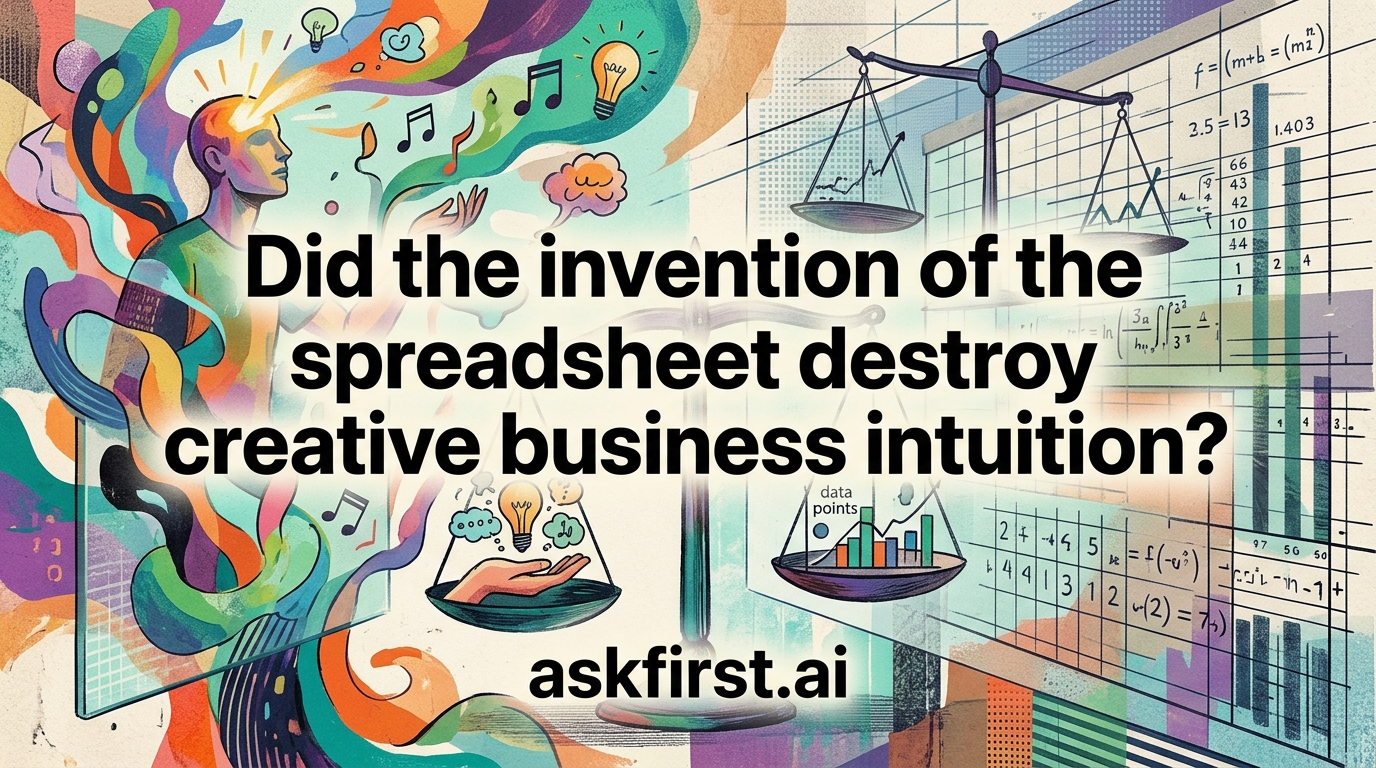
The debate surrounding the impact of the electronic spreadsheet—most notably VisiCalc, launched in 1979, and subsequently Microsoft Excel—on managerial decision-making is one of the most profound inquiries in modern business history. To ask whether the spreadsheet "destroyed" creative intuition is to grapple with the tension between algorithmic precision and the messy, nonlinear nature of human insight.
The Tyranny of the Grid: The Quantification of Strategy
When Dan Bricklin and Bob Frankston developed VisiCalc for the Apple II, they revolutionized the back-office workflow. Before this, financial modeling was a laborious, manual process performed on large ledger sheets. If a variable changed, an entire matrix had to be recalculated by hand. The spreadsheet turned these static documents into dynamic, interactive sandboxes.
However, as business scholar Clayton Christensen noted in his seminal work The Innovator’s Dilemma (Harvard Business School Press, 1997), the reliance on analytical tools can create a "blind spot" for disruptive innovation. Spreadsheets excel at optimization—improving what is already known—but they are notoriously poor at predicting the trajectory of entirely new markets. By forcing every business opportunity into a grid of rows and columns, managers began to prioritize "quantifiable certainty" over "qualitative vision." This shift meant that if a project could not be justified by a Net Present Value (NPV) calculation, it was often discarded, regardless of its long-term strategic potential.
The Erosion of "Gut Feeling" and Heuristic Reasoning
Creative business intuition is not merely a "hunch"; it is the brain’s ability to synthesize vast amounts of pattern recognition, emotional intelligence, and historical context—data points that are often invisible to a spreadsheet. In his book Thinking, Fast and Slow (Farrar, Straus and Giroux, 2011), Nobel laureate Daniel Kahneman explains the difference between System 1 (intuitive) and System 2 (analytical) thinking.
The spreadsheet is the ultimate tool for System 2 thinking. While it prevents the "sunk cost fallacy" by forcing clear calculations, it also encourages a dangerous form of "analysis paralysis." When managers spend 90% of their time tweaking cells to achieve a specific bottom-line target, they lose the cognitive bandwidth required for the messy, observational work of true innovation. We see this in the decline of "management by walking around"—a concept championed by Tom Peters and Robert Waterman in In Search of Excellence (Harper & Row, 1982). When leaders spend their days staring at a monitor rather than engaging with customers or frontline employees, they lose the sensory input necessary for genuine intuition.
The Illusion of Precision and the "Excel Trap"
A primary danger of the spreadsheet is the "illusion of precision." Because a cell can display a number to six decimal places, humans tend to imbue that number with an authority it does not deserve. In reality, a spreadsheet is only as good as its assumptions. If the underlying logic is flawed, the spreadsheet merely acts as a high-speed engine for error.
This phenomenon, often called "spreadsheet risk," was highlighted by Ray Panko, a professor at the University of Hawaii, who conducted extensive research on the frequency of errors in corporate financial models. His findings suggested that nearly 90% of large spreadsheets contain significant errors. Yet, because the interface looks professional and consistent, executives often treat these outputs as gospel. This reliance discourages the "creative friction" that occurs when teams debate subjective strategies, opting instead for a false consensus dictated by a formula.
Reclaiming Intuition in the Age of Analytics
Has the spreadsheet destroyed intuition? Not entirely, but it has certainly marginalized it. The most successful organizations today are those that use spreadsheets as a support mechanism rather than a decision-making mechanism.
Take, for example, the approach of Jeff Bezos at Amazon. In his various shareholder letters, Bezos frequently distinguishes between "Type 1" and "Type 2" decisions. Type 1 decisions are irreversible and consequential; they require deep intuition and judgment. Type 2 decisions are reversible and can be made with speed and data. The failure of many modern businesses lies in treating all decisions as if they were Type 2, attempting to "spreadsheet" their way through irreversible, high-stakes strategic shifts.
Conclusion
The spreadsheet is an extraordinary tool for efficiency, but it is a poor substitute for the human capacity to imagine the future. Creativity in business requires the ability to see beyond the current data set. The invention of the spreadsheet did not destroy business intuition, but it did create a culture that rewards the appearance of rigor over the exercise of judgment. To thrive in the coming decade, leaders must learn to close their laptops, step away from the cells, and re-engage with the qualitative, human-centric observations that no algorithm can replicate. Intuition is not the opposite of analysis; it is the necessary context that makes analysis meaningful.