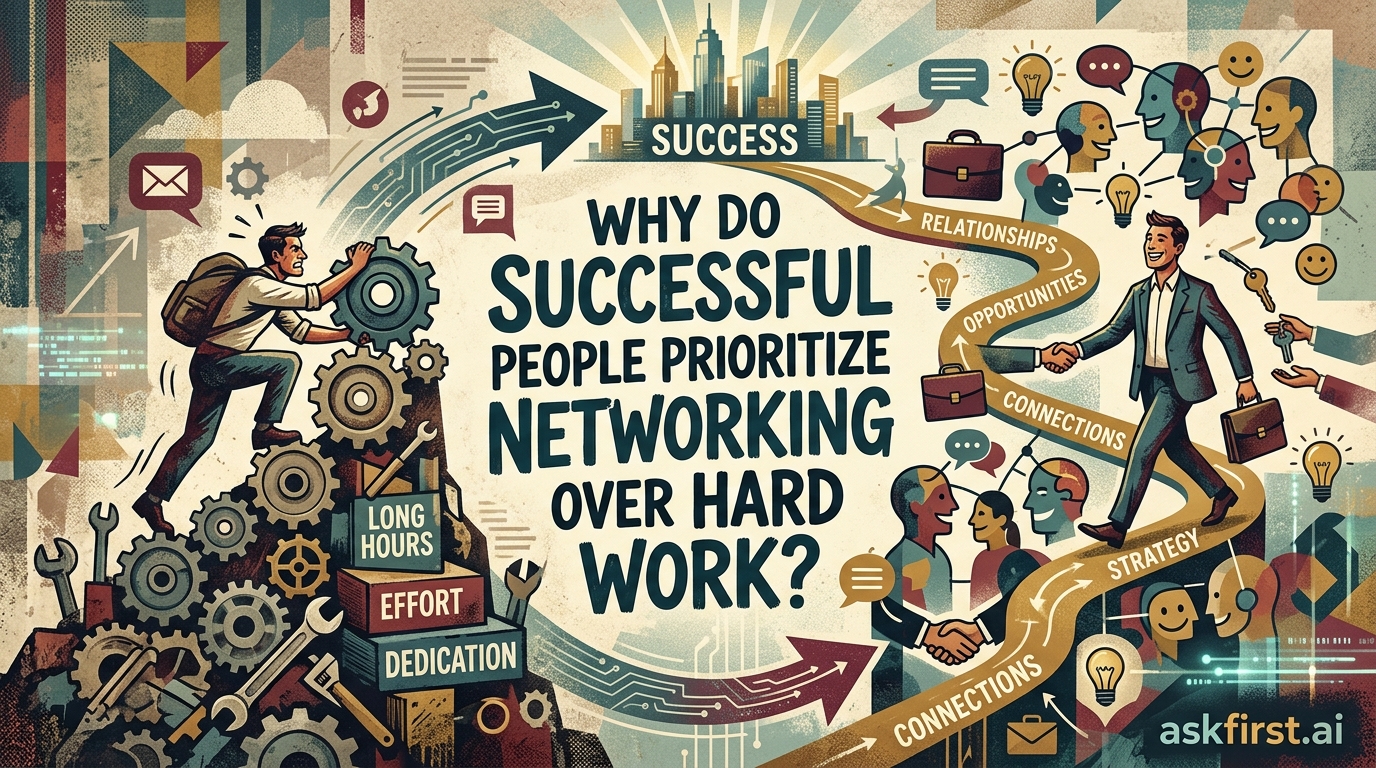
The Networking Paradox: Why Relationships Outweigh Effort
In the traditional narrative of career success, the prevailing wisdom dictates that hard work is the primary currency of achievement. Conventional advice suggests that if one puts their head down, works long hours, and demonstrates technical excellence, the world will eventually take notice and reward that effort. However, empirical observations of the highest tiers of global success suggest a startlingly different reality: high-level achievers frequently prioritize strategic networking over raw output. This article explores the mechanics behind this paradigm shift and why the most influential individuals view relationships as a force multiplier rather than a secondary task.
The Law of Diminishing Returns on Solitary Labor
Hard work exhibits a law of diminishing returns. Once an individual reaches a certain baseline of proficiency, additional hours spent in isolation often yield only incremental gains. Conversely, networking operates on an exponential scale. A single introduction, partnership, or insight gained through a high-level contact can bypass years of tedious, solitary labor. This is not to suggest that hard work is irrelevant; rather, it is a foundational prerequisite. However, networking is the catalyst that determines whether that hard work is applied to a dead-end street or a highway to massive scale.
Access and Asymmetric Information
One of the most profound advantages of elite networking is the access to asymmetric information. Much of the most valuable data—emerging market trends, unadvertised investment opportunities, or upcoming organizational shifts—is never published in trade journals or mass media. It exists within closed loops of conversation. Individuals who prioritize networking position themselves within these information silos, allowing them to make decisions based on high-fidelity data that others do not possess. This structural advantage makes them appear prescient, while in reality, they are merely better informed due to their human connections.
The Power of Social Capital and Trust
In modern, hyper-complex economies, trust is the ultimate bottleneck. Organizations and investors rarely bet on ideas alone; they bet on people. Networking builds social capital, which acts as a proxy for reliability. When an individual is recommended by a trusted node in a professional network, the vetting cost for the employer or partner is drastically reduced. This 'social signaling' is far more effective than any resume or portfolio, as it leverages the reputation of the referrer. By focusing on relationships, successful people effectively outsource their initial credibility verification to the network itself.
Leveraging Leverage: The Force Multiplier Effect
Successful individuals recognize that they have a finite amount of time and energy. To achieve outsized results, they must utilize leverage. Networking serves as one of the most powerful forms of leverage available.
- Resource Aggregation: Networking allows individuals to pool resources, such as capital, expertise, and infrastructure, that would be impossible to accumulate solo.
- Collaborative Innovation: By bringing together diverse perspectives, high-level networks foster interdisciplinary solutions that a singular focused effort could never replicate.
- Risk Mitigation: Having a strong, supportive peer group allows for faster pivots when market conditions change. A network acts as an early warning system against potential pitfalls.
Reframing 'Hard Work' as 'Smart Distribution'
When observers claim successful people 'work less' while networking, they often mistake the nature of the labor. Maintaining high-value relationships requires intense cognitive effort, emotional intelligence, and strategic planning. It is a different kind of 'hard work'—one characterized by active listening, strategic generosity, and consistent value creation for others. Unlike solitary tasks, networking is inherently social, requiring the individual to manage the complexities of human dynamics. Those who excel at this realize that the goal is not to work the hardest, but to ensure that the work performed has the highest possible impact.
Conclusion: The Strategic Integration
To view networking as an alternative to hard work is a false dichotomy. The most successful individuals understand that hard work is the fuel, but networking is the engine that directs that energy toward the most productive destination. They do not neglect their professional output; instead, they curate their efforts so that they are continuously amplified by the people around them. By prioritizing the human element of business, they ensure that their individual contributions are never confined to their own personal limitations, but are instead integrated into a broader, more powerful ecosystem of collective intelligence and opportunity.