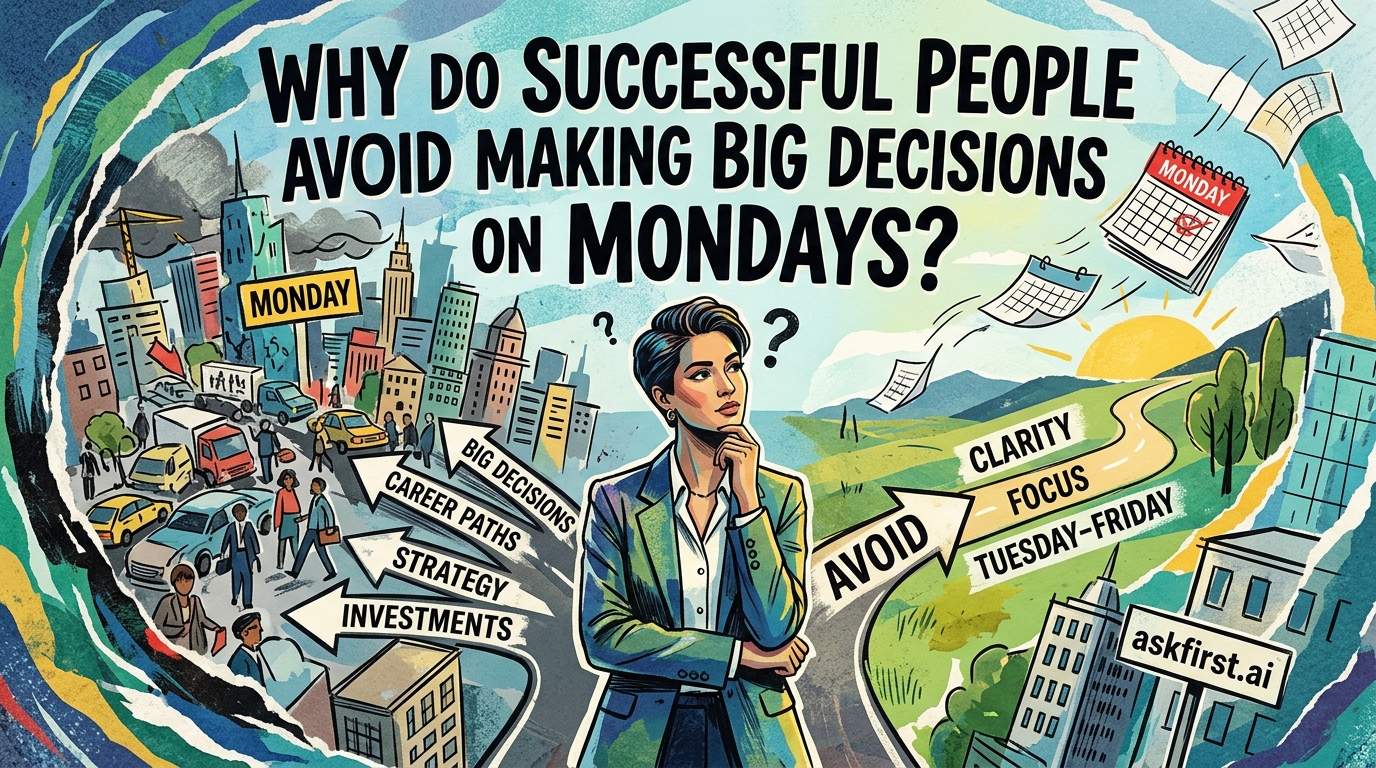
The Monday Decision Paradox: Why Peak Performance Demands Strategic Scheduling
Successful individuals, from global CEOs to elite athletes, often treat Mondays as a protected sanctuary for organization rather than a theater for high-stakes decision-making. This counter-intuitive habit is grounded in cognitive science and energy management theory. The core rationale centers on the concept of Decision Fatigue and the physiological reality of the human circadian rhythm after a weekend transition.
The Science of Decision Fatigue
Decision fatigue is a phenomenon where the quality of choices deteriorates after a long session of decision-making. Research popularized by psychologist Roy Baumeister suggests that willpower and the mental energy required for complex executive functions are finite resources. By the time Monday morning arrives, an individual often experiences a 're-entry shock.' The brain must immediately navigate a massive influx of emails, project status updates, and team demands. If a high-stakes, life-altering choice is introduced into this chaotic environment, the brain is forced to process it using depleted cognitive reserves. Successful people recognize that their mental bandwidth is too precious to spend on foundational decisions when their cognitive load is already near capacity.
The Weekend Transition Effect
Human cognition is sensitive to environmental shifts. The transition from the relaxed, unstructured nature of a weekend to the rigid, goal-oriented structure of a Monday morning is biologically jarring. During the weekend, the brain’s default mode network is active, which is associated with creativity and rest. On Monday, the brain must shift into task-positive networking. Forcing a massive decision during this 'synaptic shift' leads to sub-optimal outcomes. Successful individuals use Mondays to recalibrate their internal compass, ensuring that the heavy lifting—the strategic choices that define their trajectory—occurs when they are fully synced with their professional objectives.
Strategic Prioritization and The Monday 'Blank Space'
Many leaders utilize Monday for what is often termed 'the soft start.' Instead of plunging into complex problem-solving, they prioritize:
- Environment Optimization: Cleaning the digital and physical workspace to reduce cognitive friction.
- Prioritization Mapping: Ranking tasks for the week to ensure that by Tuesday or Wednesday, high-energy sessions can be dedicated to the most critical decisions.
- Team Alignment: Focusing on communication rather than individual output to ensure everyone is moving in the same direction.
By pushing big decisions to Tuesday, Wednesday, or Thursday, successful people ensure they are operating from a position of momentum rather than reactivity. This is a classic application of Pareto’s Principle (the 80/20 rule). They understand that the highest value decisions require clarity, perspective, and a stable, non-frantic mental state.
The Myth of the 'Hardest First' Approach
While popular self-help culture often suggests 'eating the frog' (tackling the hardest task first), this does not necessarily equate to making the biggest decisions on the first day of the workweek. There is a distinction between 'hard tasks'—such as difficult writing or complex coding—and 'big decisions'—which involve high risk, long-term impact, and significant capital. Hard tasks require endurance; big decisions require extreme nuance and emotional detachment. Monday is often too emotionally 'noisy' for the latter.
How to Implement This Strategy
To emulate this behavior, consider the following frameworks:
- The 24-Hour Buffer: If a significant request lands on Monday, commit to a final decision only after a 're-check' the following morning. This allows the subconscious mind to process variables while the initial excitement or stress of the new week settles.
- Energy Auditing: Track your decision quality across the week. You will likely find that your clarity peaks mid-week. Schedule your most important stakeholder meetings during these window-slots.
- The Monday Default: Treat Monday as a 'System Update' day. Focus on reviewing metrics, clearing communication bottlenecks, and aligning personal goals with project milestones.
Ultimately, successful people avoid Monday decision-making not out of laziness, but out of strategic intentionality. By protecting their cognitive focus, they avoid the pitfalls of impulsive judgment. They respect the biological limits of their own processing power, ensuring that when they do finally make a big decision, it is backed by the full weight of their intelligence, experience, and calm analysis. This discipline is not just a productivity hack; it is a competitive advantage in a world that increasingly values quick responses over high-quality ones.