The Birth of the Modern Shareholder Economy
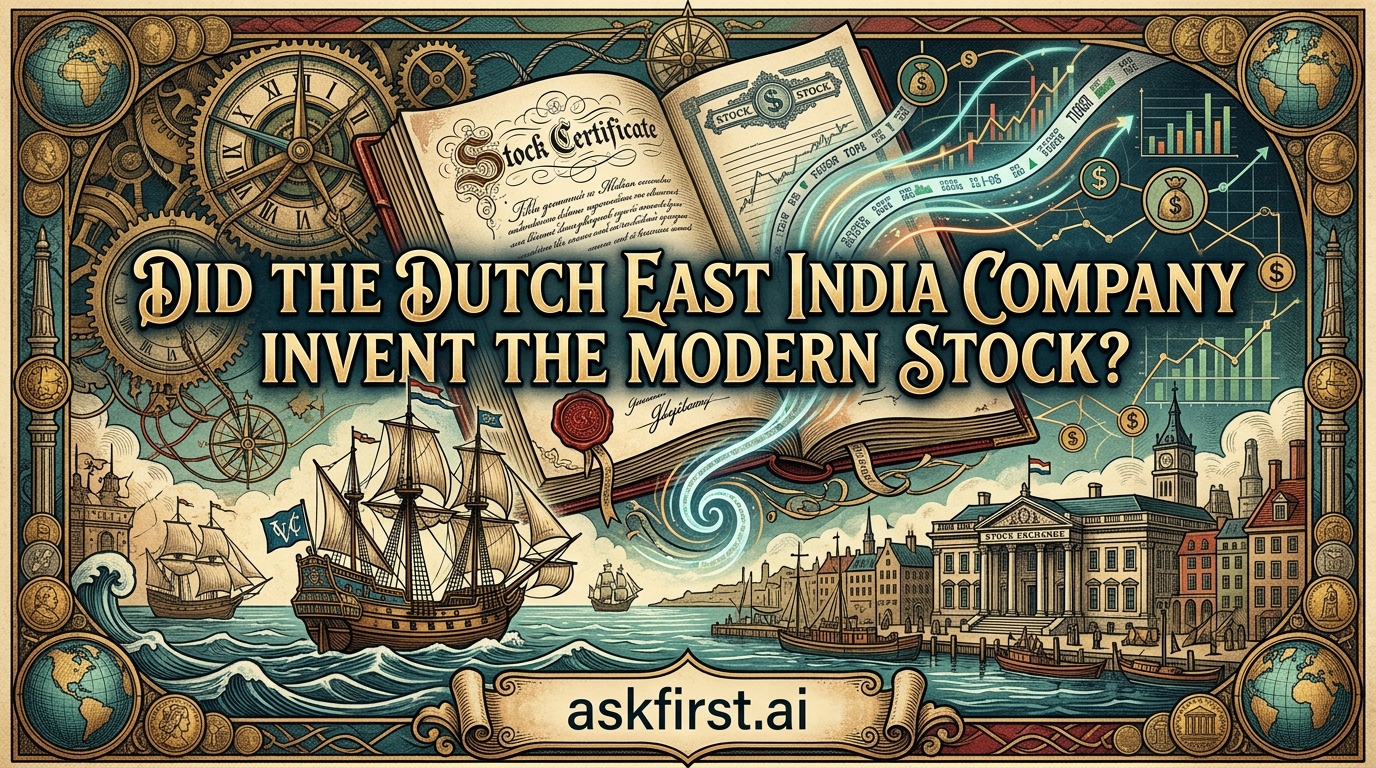
The short answer to whether the Dutch East India Company (Verenigde Oost-Indische Compagnie or VOC) invented the modern stock is a resounding 'yes.' While earlier forms of trade and partnership existed in medieval Italy and the Middle East, the VOC, established in 1602, fundamentally transformed the concept of corporate finance by introducing the world to the permanent, tradable share. This transition shifted global commerce from temporary, venture-based partnerships to enduring corporate entities.
The Historical Context: The Move Toward Permanence
Before 1602, most maritime expeditions were organized as 'voorcompagnieën'—temporary partnerships formed for a single journey. Investors would pool money to outfit a fleet, and once the ships returned with spices, the assets were liquidated, and the profits distributed. This model was highly inefficient and carried extreme risks. If a ship sank, the voyage was a total loss, and the capital was gone.
When the Dutch government forced the merger of various competing trading companies to form the VOC, they introduced a revolutionary structural change: permanent capital. Investors were no longer investing in a single voyage but in a company that would exist indefinitely. The capital provided by the shareholders remained within the company to fund future operations, infrastructure, and defensive capabilities, rather than being returned after every voyage.
The Invention of Liquidity: The Amsterdam Stock Exchange
Because the capital was locked into the company, investors needed a way to recoup their money if they desired liquidity. This necessity led to the birth of the Amsterdam Stock Exchange. Instead of demanding their original capital back from the VOC, investors sold their 'shares' to other prospective investors. This secondary market allowed the stock to fluctuate in price based on supply, demand, and news of the company's performance, effectively creating the first truly modern stock market.
Key Pillars of the VOC's Innovation
- Limited Liability: Perhaps the most critical innovation was the concept of limited liability. Shareholders were generally not held responsible for the company's massive debts beyond the value of their shares. This protected individual wealth and encouraged mass participation in capital markets.
- Transferability: By creating a formal registry of shareholders, the VOC allowed shares to be easily transferred between owners, facilitating a liquid, dynamic market.
- Dividend Policy: Even without the liquidation of the firm, the VOC began issuing regular dividends based on profits. This solidified the stock as an income-generating asset, a hallmark of modern equity investment.
- The Prospectus and Reporting: To encourage investment, the VOC provided early forms of financial disclosure, creating a culture of corporate transparency that continues to define public markets today.
The Societal Impact
This invention democratized wealth creation. Suddenly, it was not just the elite nobility or wealthy merchant princes who could engage in international trade finance. Middle-class citizens, such as artisans and tradespeople, began buying fractional shares in the VOC. This participation fostered a new economic class and set the stage for the rise of capitalism as we recognize it. The VOC’s ability to raise vast sums of money from the public enabled it to build fortified trading posts, maintain private navies, and exert geopolitical influence that rivaled sovereign nations. This was the first time in history that a private entity wielded the financial power of a state purely through the issuance of tradable equity.
Legacy: From Spice Traders to Modern Markets
The VOC’s model laid the architectural blueprint for the British East India Company, the South Sea Company, and eventually the entire global financial ecosystem we rely upon today. The principles established in 1602—permanent capital, share liquidity, dividend distribution, and limited liability—remain the core operational tenets of the New York Stock Exchange, the London Stock Exchange, and every other major bourse in existence.
While the VOC eventually collapsed under the weight of corruption and immense overhead in the late 18th century, its invention of the modern stock proved to be an immortal contribution to human progress. It transformed the way humanity organizes labor, capital, and risk. By allowing people to own a piece of a global enterprise without needing to manage the logistics of shipping themselves, the Dutch East India Company truly unlocked the door to the modern era of industrial and financial expansion. Today, when you check the price of a stock on your smartphone, you are interacting with a system that has its direct DNA in the trading floors of Amsterdam over four centuries ago.