The Great Automation Paradox: Will AI Reshape or Erase the Labor Market?
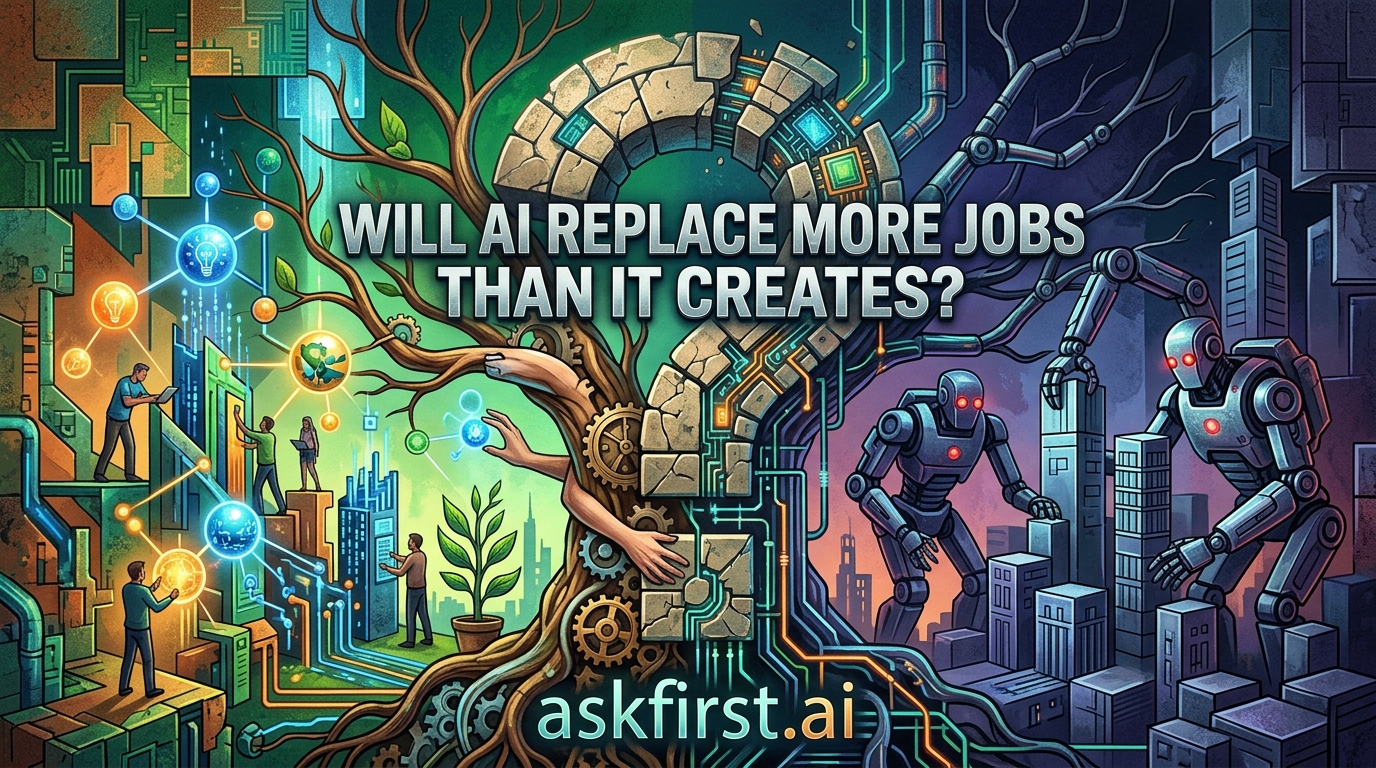
The discourse surrounding the impact of Artificial Intelligence (AI) on global labor markets has reached a fever pitch. On one side, techno-optimists argue that we are entering a new era of "super-productivity," while on the other, labor economists warn of a structural displacement of workers that could lead to unprecedented social instability. To understand whether AI will replace more jobs than it creates, one must move beyond binary predictions and examine the nuanced history of technological disruption, the nature of task-based labor, and the emergence of entirely new economic categories.
The Historical Precedent: The Luddite Fallacy vs. Structural Transformation
History provides a crucial lens through which to view current anxieties. In The Second Machine Age, authors Erik Brynjolfsson and Andrew McAfee of MIT argue that while technological revolutions—such as the Industrial Revolution or the advent of the personal computer—initially cause significant "frictional unemployment," they ultimately expand the total size of the economic pie.
For instance, when the ATM was introduced in the 1970s, many predicted the end of the bank teller. However, because the cost of operating a branch decreased, banks opened more locations, and the role of the teller shifted from simple cash handling to customer relationship management and sales. Consequently, the number of bank tellers actually increased. This phenomenon, known as "complementarity," suggests that AI will likely replace tasks rather than jobs. A job is a bundle of tasks; if AI automates the mundane, repetitive tasks (data entry, basic scheduling, preliminary research), the human worker is liberated to focus on high-value cognitive tasks like strategy, emotional intelligence, and complex problem-solving.
The "Task-Based" Shift and the Polarization of Labor
The primary challenge of the current AI wave, as noted by Daron Acemoglu and Simon Johnson in their seminal work Power and Progress: Our Thousand-Year Struggle Over Technology and Prosperity, is that modern automation is biased toward "so-called" cognitive automation. Unlike the mechanical automation of the 20th century, which replaced blue-collar manual labor, generative AI targets white-collar knowledge workers.
We are witnessing a "polarization of labor." On the high end, professionals who leverage AI tools (such as software engineers using GitHub Copilot or architects using generative design software) are seeing their output and value skyrocket. On the low end, manual service roles that require physical presence—nursing, plumbing, construction—remain difficult to automate. The "squeezed middle"—paralegals, middle managers, and data analysts—are the most vulnerable. The question is not whether the total number of jobs will fall, but whether the skills required for those jobs will evolve faster than the workforce can adapt.
New Economic Frontiers: The Jobs We Cannot Yet Imagine
A critical oversight in the "AI will replace us" narrative is the inability to forecast new job titles. According to a report by the World Economic Forum, "The Future of Jobs Report 2025," nearly 40% of the jobs that will exist in 2035 have not yet been invented.
Consider the "Prompt Engineer," the "AI Ethics Compliance Officer," or the "Human-Machine Interaction Designer." Just as the internet created industries like digital marketing, cybersecurity, and e-commerce, AI is creating a demand for:
- AI Trainers and Data Curators: Professionals tasked with refining the quality of datasets to prevent algorithmic bias.
- AI Governance Specialists: Legal and technical experts responsible for ensuring that autonomous systems comply with emerging global regulations, such as the EU AI Act.
- Personalized Experience Designers: Experts who use AI to tailor education, healthcare, and entertainment to individual human needs at scale.
These roles require a hybrid skill set—part technical, part creative, and part sociological. The creation of these roles is not merely additive; it is transformative, requiring a fundamental shift in our education systems from rote memorization to critical synthesis.
The Critical Role of Policy and Institutional Adaptation
Ultimately, whether AI creates more jobs than it destroys depends less on the technology itself and more on institutional responses. In his book The Age of AI, Henry Kissinger, Eric Schmidt, and Daniel Huttenlocher emphasize that the integration of AI requires a new social contract. If the gains from AI-driven productivity are captured solely by a handful of tech conglomerates, the resulting inequality will foster a backlash that stifles innovation.
However, if governments implement robust "reskilling" initiatives—similar to the GI Bill following World War II—and encourage the development of "human-complementary" AI rather than "human-replacement" AI, we may find that the net result is a more prosperous, albeit different, labor market. We must prioritize "augmentation" over "automation." By designing systems that keep the human in the loop, we ensure that the technology serves as a lever for human potential rather than a substitute for it.
Conclusion
The fear that AI will cause mass, permanent unemployment is likely exaggerated, fueled by a misunderstanding of how labor markets evolve. While the disruption will be profound and painful for those caught in the transition, the trajectory of human history suggests that we are remarkably adept at repurposing our labor toward new, higher-level needs. The future will not be a world of "AI vs. Humans," but rather a world of "Humans plus AI" vs. "Humans without AI." The competitive advantage will belong to those who treat AI as an extension of their own cognitive capabilities, ensuring that the next chapter of the global economy is defined by collaboration rather than obsolescence.