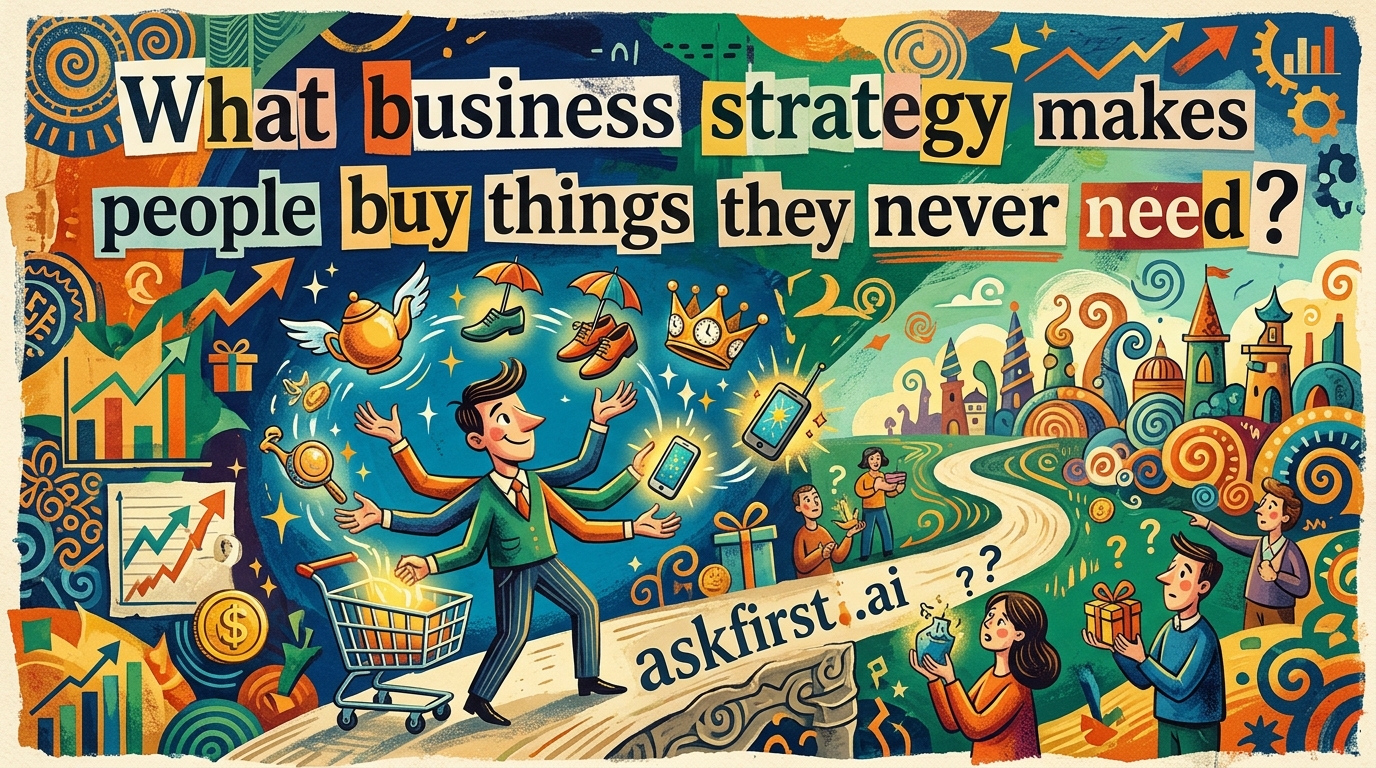
The strategy that drives consumers to purchase items they neither need nor initially desire is primarily rooted in Neuromarketing and the psychological manipulation of cognitive biases. At its core, this phenomenon relies on the intersection of behavioral economics and sensory branding, transforming simple commodities into vehicles for social identity and emotional satisfaction. This intricate system utilizes several proven methodologies that bypass logical deliberation.
1. The Power of Scarcity and Urgency
One of the most potent drivers of unnecessary consumption is the Scarcity Principle. Popularized by psychologist Robert Cialdini, this principle suggests that individuals place a higher value on items that are perceived to be limited. Marketers weaponize this through 'Limited Time Offers' (LTOs) and 'Low Stock Alerts'. When a product is framed as scarce, the brain shifts from a cost-benefit analysis to a fear-of-missing-out (FOMO) response. This triggers an immediate, reflexive purchase impulse designed to prevent the perceived loss of opportunity, rather than to acquire a utility-based asset.
2. The Anchoring Bias and Pricing Architecture
Companies frequently employ Anchoring Bias to make products appear like a bargain. By displaying an original, inflated price alongside a discounted price, the consumer anchors their expectations to the higher figure. Consequently, even if the item remains objectively unnecessary, the 'discount' makes the purchase feel like a victory against the market. Furthermore, decoy pricing—offering three tiers where the middle option makes the premium option seem like a better deal—systematically nudges buyers toward spending more money on features they do not require.
3. Hedonic Adaptation and Experiential Marketing
Human psychology is governed by Hedonic Adaptation, the tendency to return to a baseline level of happiness despite positive or negative life events. Marketers exploit this by continuously promising that a 'new' product will provide a permanent upgrade to the buyer's status or happiness. By branding products as lifestyle enhancements rather than utilitarian tools, companies ensure that customers seek the 'dopamine hit' of a new acquisition. This is often achieved through high-production-value advertising that associates products with specific social circles, aspirations, or sensory delights that the consumer desperately wants to embody.
4. Choice Architecture and Decision Fatigue
By curating the shopping environment, companies control the Choice Architecture. Through strategic product placement, personalized algorithmic recommendations, and 'add-to-cart' friction removal, businesses minimize the effort required to make a purchase. When a consumer experiences decision fatigue—the physiological exhaustion resulting from too many choices—the brain defaults to the path of least resistance. One-click checkout systems turn a complex decision into a single, effortless impulse, effectively bypassing the reflective processes that would typically categorize an item as 'unnecessary'.
5. Social Proof and Community Validation
Humans are inherently social creatures, and Social Proof is the silent engine of modern commerce. When an individual observes peers or influencers using specific products, the human need for belonging creates a pressure to conform. If a 'must-have' item becomes a signifier of status within a specific demographic, the utility of the product becomes irrelevant; its true function becomes social signaling. Owning the item grants membership to a desired group, turning a plastic or digital object into a symbol of identity.
6. Subliminal Priming and Sensory Branding
Businesses invest billions into Sensory Branding, which involves orchestrating the sight, sound, smell, and tactile feel of the buying environment to bypass conscious cognition. A specific color scheme or the subtle scent of vanilla in a retail space can induce a sense of comfort that primes the brain for impulsive behavior. By creating an atmosphere that feels 'safe' or 'prestigious,' corporations lower the natural psychological barriers that normally protect the consumer's wallet.
The Long-Term Perspective
To resist these strategies, one must cultivate Meta-Cognition—the ability to think about one's own thinking. By recognizing that desire is often manufactured by systemic triggers, the consumer regains autonomy. It is essential to understand that businesses are not merely selling products; they are selling solutions to psychological discomforts. Once the link between the product and the manufactured insecurity is broken, the 'need' for the item evaporates. Mastery over consumption begins with the simple practice of waiting 24 hours before any non-essential purchase, a simple pause that allows the amygdala-driven impulse to subside, letting the logical prefrontal cortex re-examine the necessity of the transaction.