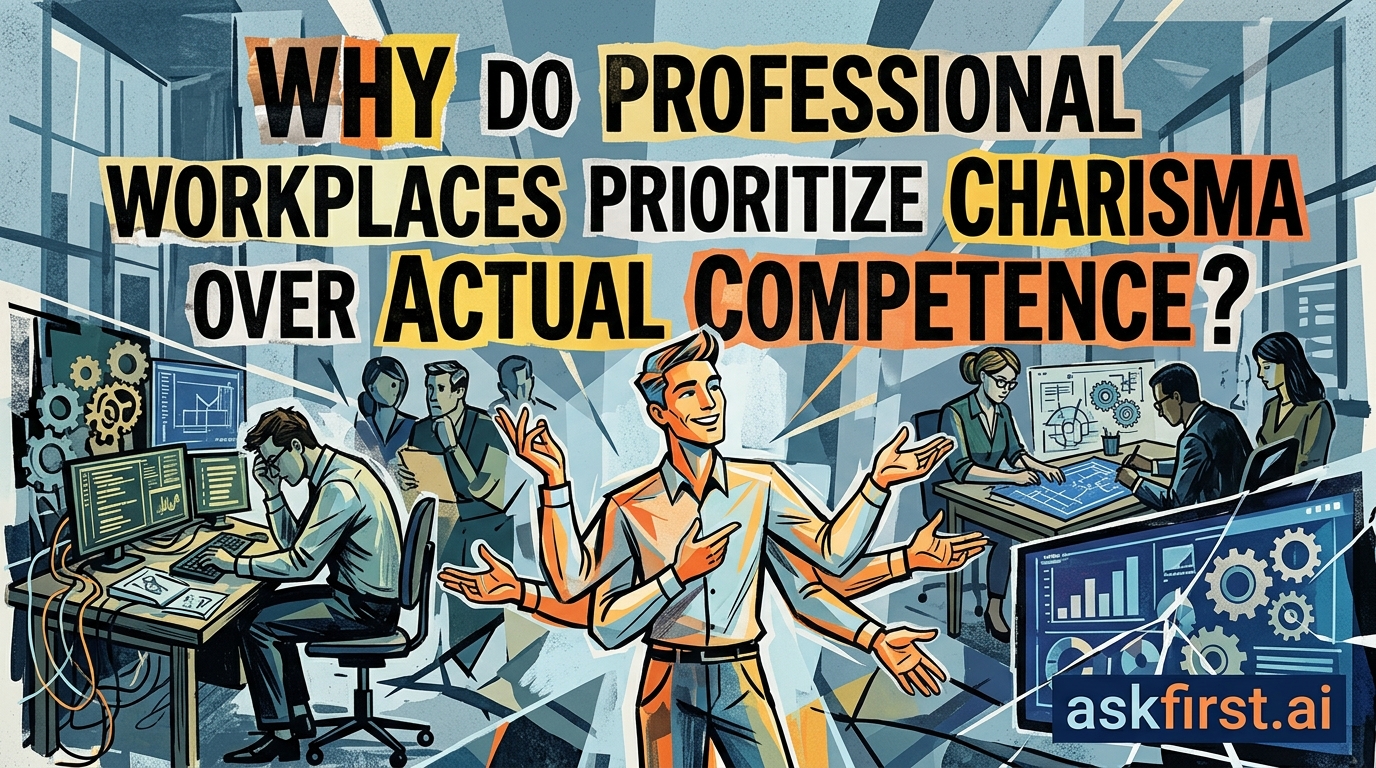
The phenomenon where charisma frequently overshadows technical competence in the professional landscape is a subject of extensive study in organizational psychology and management theory. While common sense suggests that the most capable individuals should naturally rise to the top, the reality of corporate hierarchy often favors those who possess "social magnetism." This preference is not merely a result of poor management, but rather a byproduct of human evolutionary psychology, organizational signaling, and the specific demands of leadership roles.
The Evolutionary Psychology of Leadership
To understand why charisma is prioritized, we must first look at our biological heritage. Evolutionary psychologists, such as Mark Van Vugt in his seminal work Naturally Selected: The Evolutionary Science of Leadership, argue that humans evolved in small, hunter-gatherer groups where survival depended on group cohesion. In these ancestral environments, a leader’s primary function was not necessarily technical expertise, but the ability to build consensus, maintain morale, and project confidence during crises.
We are hardwired to perceive confidence as a proxy for competence. When an individual speaks with unwavering conviction, our brains often bypass critical analysis and default to a heuristic that equates "authoritative delivery" with "correctness." This is known as the Confidence-Competence Heuristic. In a modern office, a charismatic leader who can articulate a vision with passion is often perceived as more "capable" than a quiet, highly skilled expert, simply because the former provides a sense of psychological safety and direction to the group.
The Signaling Theory in Corporate Hierarchies
In the realm of economics and management, Michael Spence’s concept of "Signaling Theory"—originally applied to education—explains why charisma acts as a high-value signal. In many professional environments, true technical competence is difficult and time-consuming to measure. If a senior executive needs to evaluate a manager, assessing the nuance of their technical coding ability or complex project management methodology takes significant effort.
Conversely, charisma is an "observable" trait. It is a high-bandwidth, low-latency signal. If an employee can influence stakeholders, charm clients, and command a room, they are signaling high social capital. Organizations often prioritize this because, at the executive level, the job description shifts from "doing the work" to "influencing people." As Jeffrey Pfeffer, a professor at the Stanford Graduate School of Business, argues in his book Power: Why Some People Have It—and Others Don't, power in organizations is rarely distributed based on meritocratic achievement alone. Instead, it is accumulated by those who master the "soft" arts of impression management, self-promotion, and strategic social networking.
The Dunning-Kruger Effect and Narcissism
A darker aspect of this preference involves the correlation between charisma and certain personality traits. Research published by Tomas Chamorro-Premuzic in Why Do So Many Incompetent Men Become Leaders? suggests that organizational hiring practices often mistake the confidence of narcissistic individuals for leadership potential.
Narcissists are often naturally charismatic; they are comfortable being the center of attention and are adept at self-promotion. Because they lack the self-doubt that often plagues highly competent experts (who suffer from the Dunning-Kruger Effect—where they overestimate the complexity of problems and thus appear less "sure" of themselves), they project an air of certainty. Organizations, desperate for leaders who can "sell" a strategy to investors or shareholders, often gravitate toward these individuals, failing to realize that their charisma masks a lack of depth or, in extreme cases, toxic leadership styles.
The Role of "Social Lubricant"
In highly collaborative, matrixed organizations, competence is a baseline requirement, but charisma is the "social lubricant" that prevents friction. A technically brilliant engineer who cannot communicate effectively or build rapport with cross-functional teams may be viewed as a bottleneck.
In The Charisma Myth by Olivia Fox Cabane, she explains that charisma is essentially the combination of presence, power, and warmth. In a professional setting, these three elements make it easier to navigate office politics, secure resources, and overcome bureaucratic hurdles. When a leader is charismatic, they can often "smooth over" technical failures or project delays that would otherwise destroy the credibility of a less charismatic, though equally competent, employee. Thus, charisma is prioritized because it is perceived as a tool that enhances organizational velocity.
Conclusion
The prioritization of charisma over competence is not necessarily a sign of a broken system, but rather an indication of what organizations value at different levels of the hierarchy. While technical competence is essential for execution, charisma is the currency of influence.
Organizations that fail to balance these two often suffer from the "Empty Suit" syndrome, where leadership is charismatic but lacks the foundational knowledge to steer the ship during turbulent times. To mitigate this, successful firms must implement objective assessment frameworks—such as 360-degree feedback, blind technical evaluations, and peer reviews—that decouple the "delivery" of an idea from the "substance" of the idea itself. Until such systems become the standard, however, the human tendency to follow the most confident and charismatic voice will remain a defining feature of the modern workplace.