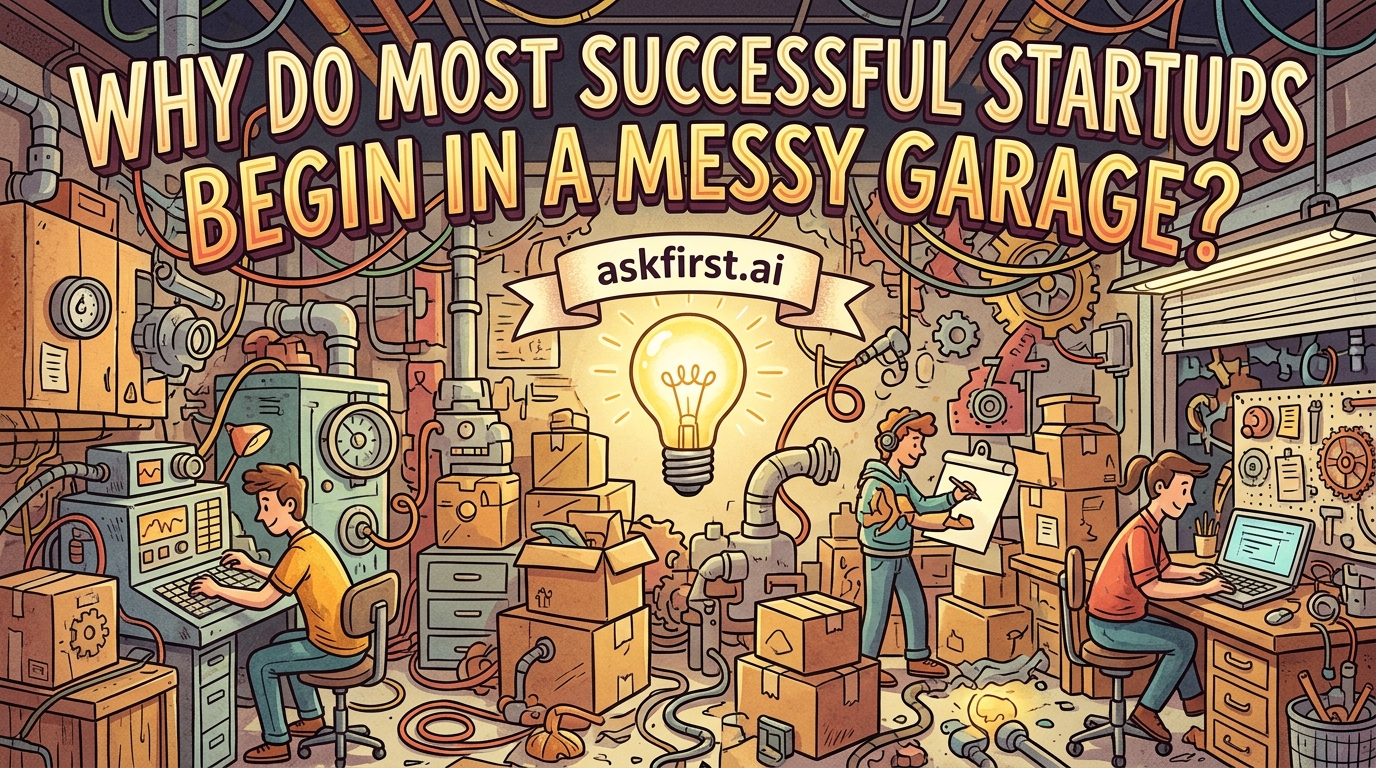
The Myth and Reality of the Garage Origin Story
The image of the humble garage as the birthplace of billion-dollar empires is one of the most enduring tropes in modern business history. From Hewlett-Packard to Apple and Amazon, the 'garage startup' has become a cultural shorthand for scrappy innovation, grit, and the democratization of success. However, the phenomenon goes far beyond romanticized folklore; it is rooted in specific economic, psychological, and operational advantages that foster high-growth environments.
1. The Power of Extreme Frugality
Starting in a garage is rarely a choice of aesthetics; it is a choice of necessity. Capital efficiency is the hallmark of the early-stage venture. When founders operate from a home-based environment, they eliminate the most significant fixed costs: office rent, utilities, and professional administrative overhead. This capital conservation allows the team to extend their 'runway'—the amount of time a company has before it runs out of cash. By redirecting funds away from expensive commercial leases and toward product development, talent acquisition, or customer acquisition, startups gain a competitive advantage in longevity.
2. High-Density Collaboration
Garages are inherently intimate spaces. Unlike sprawling corporate offices with cubicles and compartmentalized departments, the garage forces founders and early employees into a single, shared context. This physical proximity promotes 'osmotic communication,' where information flows naturally and instantaneously. When team members can overhear the technical hurdles being solved by their counterparts, they often contribute solutions before the problem escalates. This environment is an incubator for what scholars refer to as 'tacit knowledge exchange,' essential during the chaotic search for a repeatable, scalable business model.
3. Psychological Freedom and Intellectual Play
There is a profound psychological benefit to the garage setting. It is not an office, so it is not beholden to corporate norms, hierarchies, or office politics. This lack of formality fosters a culture of experimentation. When the workspace is messy—filled with wires, half-finished prototypes, and whiteboard scribbles—it signals that the space is reserved for building, not for posturing. This environment reduces the fear of failure. In a high-end office, failure feels like a professional liability; in a garage, it is simply a part of the process of rapid iteration.
4. Focus on the 'Minimal Viable Product' (MVP)
The garage serves as a constraint-based laboratory. Constraints are often the mother of invention. Without the resources to build a finished, polished product, garage founders are forced to focus strictly on the core value proposition. This focus on the Minimum Viable Product prevents 'feature creep'—the tendency to add unnecessary complexity that distracts from the core user need. Because the physical setting is unglamorous, the focus stays laser-sharp on the only thing that truly matters: the product-market fit.
5. Symbolism and Organizational Culture
The garage represents a narrative of 'underdog success.' For many startups, this mythos becomes part of the company's identity and culture. It serves as a reminder to current and future employees that the company was founded on sweat equity rather than venture capital glitz. Even as companies grow into global conglomerates, they often try to preserve this 'garage spirit.' Organizations like Amazon and Apple have frequently cited their early years as foundational to their current risk-taking culture. This narrative is a powerful tool for recruitment, attracting talent who are motivated by the mission and the challenge rather than the salary.
6. The Shift to Modern Digital Garages
It is important to note that the physical garage is increasingly becoming a metaphor for digital infrastructure. In the modern era, the 'garage' is often a distributed cloud network, a Slack channel, or a GitHub repository. The principles remain identical: low barrier to entry, lean resource usage, and a collaborative spirit. The rise of no-code platforms and cloud computing has effectively brought the 'garage experience' to every entrepreneur with a laptop and an internet connection. The location has changed, but the mindset of the garage—frugality, intimacy, and iterative focus—remains the blueprint for successful innovation across the globe. By embracing the constraints of limited space and resources, founders are not just saving money; they are actively engineering a culture of efficiency and relentless execution that separates lasting businesses from fleeting trends.