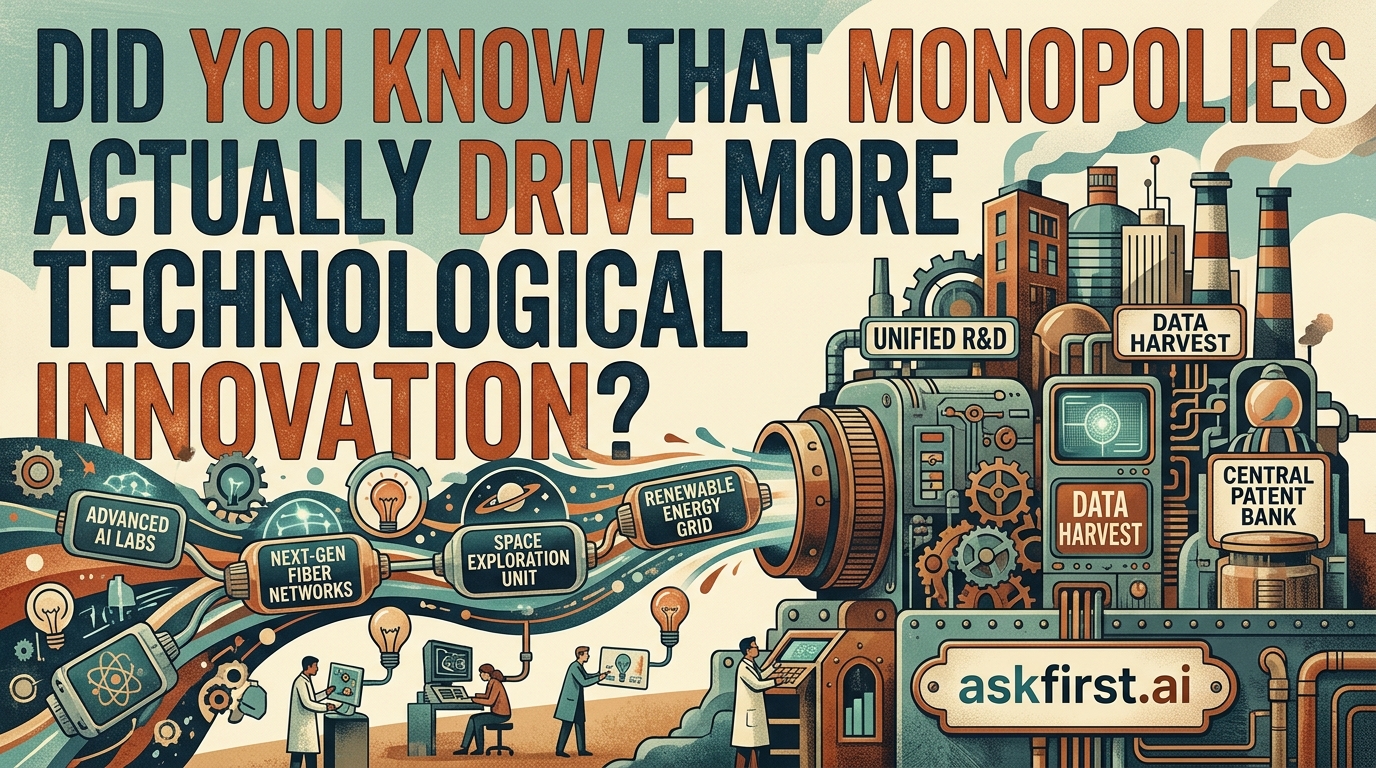
The Paradox of Monopolies and Technological Innovation
For decades, conventional wisdom in economic theory has painted monopolies as the silent killers of progress. The narrative suggests that without the "gale of creative destruction" spurred by fierce competition, large incumbents grow complacent, stifle nascent technologies, and bleed consumers dry through inflated pricing. However, a deeper examination reveals a counter-intuitive reality: under specific conditions, dominant market positions can serve as powerful engines for massive technological leaps that fragmented, hyper-competitive markets cannot achieve. This phenomenon is often rooted in the concept of the 'Schumpeterian Hypotheses,' which posits that market power provides the necessary capital and stability for long-term research and development.
The Capital Intensity Problem
Innovation is not cheap. In sectors such as semiconductor manufacturing, aerospace engineering, and pharmaceutical drug discovery, the barrier to entry is defined by immense capital requirements. A small startup, while agile and creative, rarely possesses the multi-billion dollar runway required to build advanced fabrication plants or conduct decade-long clinical trials. Monopolies—or, more accurately, 'oligopolies' with significant market share—can afford to take the 'long view.'
- Risk Mitigation: Dominant firms have the financial buffer to absorb the costs of failed experiments. An iterative failure in a small lab might lead to bankruptcy, whereas a major corporation treats R&D as a portfolio, offsetting localized losses with stable revenue streams.
- Infrastructure Investment: Significant innovations often require systemic changes rather than incremental product updates. Monopolies can dictate industry standards, build necessary infrastructure (such as fiber-optic networks or proprietary operating systems), and create an ecosystem that supports future growth.
Economies of Scale and Learning Curves
Economies of scale provide a unique advantage in innovation. When a firm produces at a massive scale, it gains access to empirical data that smaller competitors cannot access.
- The Feedback Loop: Large-scale operations generate massive telemetry data, allowing for refinement in machine learning algorithms and industrial efficiency. This continuous refinement is a form of innovation that scales with the size of the operation.
- Specialization: Market power allows for the hiring of top-tier talent in specialized fields. By aggregating the world's leading engineers and researchers under one roof, a company can solve interdisciplinary problems that require a level of collaboration unattainable in smaller, disconnected environments.
The Intellectual Property Moat
Critics argue that monopolies hoard patents. Proponents, however, note that these patents represent the 'intellectual rent' earned from risky, high-cost investment. In fields like biotechnology, the ability to protect a discovery for a set period allows a company to recoup the gargantuan costs of initial innovation. Without this protection, the incentive to invest in breakthroughs that take twenty years to come to market would evaporate.
Limitations and the Nuance of Regulation
It is vital to distinguish between a 'natural monopoly' (a firm that wins through superior product quality) and a 'coerced monopoly' (a firm that maintains power through anti-competitive litigation or government-protected entry barriers). The innovation-driving capacity of a monopoly is inherently linked to its internal commitment to R&D. When a monopoly becomes a purely extractive entity—focusing on stock buybacks rather than innovation—the technological stagnation predicted by critics becomes reality. Therefore, the most efficient systems are often those where a firm holds enough market power to invest heavily, yet faces just enough pressure from potential competition to remain perpetually paranoid about losing its position.
Conclusion: The Delicate Balance
In the grand scope of human history, the most transformational technologies—from the modern electric grid to advanced computing architecture—were often ushered into the mainstream by organizations that held significant, sometimes near-monopolistic, control over their domains. The goal of economic policy, therefore, should not be the total destruction of large-scale firms, but rather the creation of a framework that incentivizes these titans to remain competitive through invention. True technological progress often requires the immense, concentrated force that only a large, stable institution can muster, balanced by a regulatory environment that prevents that power from turning toward stagnation. The myth of the purely anti-innovative monopoly is just that—a myth—that ignores the heavy lifting required to push the boundaries of what is scientifically and technologically possible.