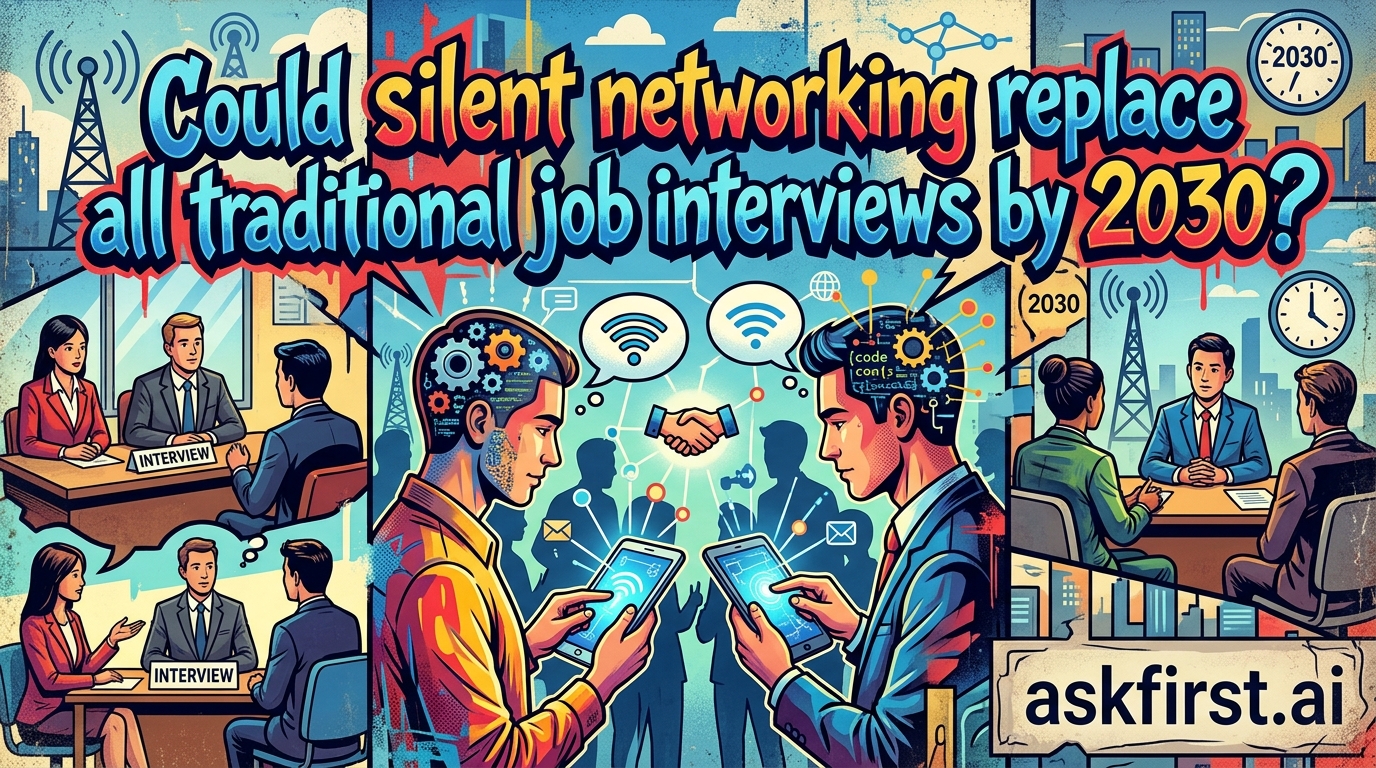
The Evolution of Professional Assessment: Silent Networking Explained
Silent networking, a practice where professional connections and recruitment decisions are driven by automated performance metrics, verifiable skill proofs, and latent digital exhaust rather than spoken interviews, is rapidly shifting from a futuristic concept to an industrial standard. As the global labor market becomes increasingly decentralized, the reliance on high-pressure, face-to-face dialogues is facing a structural crisis. By 2030, the traditional interview, often criticized for subjective bias and performance-based signaling, may find itself obsolete in favor of comprehensive, objective silent systems.
The Core Limitations of Traditional Interviews
Traditional interviews suffer from two critical flaws: interviewer bias and information asymmetry. Research in organizational psychology highlights that interviewers often form subconscious impressions within the first 60 seconds of interaction. This phenomenon, known as the 'halo effect' or 'affinity bias,' prioritizes charm and social dexterity over genuine professional aptitude. Furthermore, the interview format incentivizes candidates to master the 'art of the pitch'—a skill that is often entirely distinct from the actual day-to-day requirements of a specialized role.
How Silent Networking Operates
Silent networking functions on a model of continuous evaluation. Rather than staging a high-stakes performance in a boardroom, candidates build 'proof-of-work' portfolios. These are authenticated through distributed ledger technologies and automated talent platforms that monitor contributions to open-source projects, peer-reviewed collaborative successes, and objective output consistency.
- Automated Skill Verification: Platforms analyze a candidate's workflow, code commits, or design contributions, creating an immutable score of actual capability.
- Latency-Free Evaluation: Employers monitor potential talent through contribution heatmaps, identifying high-performers before a formal opening is even announced.
- Community-Led Vetting: Peer reputation scores, derived from thousands of small, successful interactions within professional networks, act as the primary filter for new talent.
Why the 2030 Timeline is Realistic
The trajectory of artificial intelligence and decentralized identity management suggests that the infrastructure for silent networking will be ubiquitous by 2030. The convergence of these technologies allows companies to bypass traditional hiring bottlenecks:
- Objective Algorithmic Filtering: AI models can ingest vast amounts of metadata—not just LinkedIn-style resumes, but verified repositories of work—to rank candidates against specific organizational needs.
- Psychometric Data Aggregation: Silent systems analyze problem-solving patterns in real-world scenarios rather than through hypothetical brain teasers, providing a far more accurate representation of how an individual processes information under pressure.
- Globalized Talent Access: Traditional interviews are geographically restrictive. Silent networking allows firms to tap into talent from diverse regions without the friction of scheduling, time-zone conflicts, or travel expenses, ensuring that meritocracy transcends local constraints.
The Human Impact: Beyond the 'Performance'
Critics argue that silent networking removes the 'human touch.' However, supporters point out that the human element is often a proxy for systemic discrimination. By removing the spoken component, silent networking prioritizes neurodiversity and non-traditional backgrounds. Individuals who excel at high-level technical tasks but experience severe anxiety in verbal social settings suddenly have a level playing field. The result is a more inclusive, output-driven economy where what one produces matters significantly more than how well one speaks.
Managing the Transition: The Future of Careers
By 2030, the career path will likely be defined by a shift from the 'resume' to the 'proof-stack.' Professionals will carry dynamic, verified profiles that show their evolution in real-time. Organizations will engage in 'continuous recruiting,' where the act of applying for a job becomes a relic of the past, replaced by automated matching algorithms that alert employers and candidates when a perfect, data-driven synthesis of skill sets aligns.
Conclusion: The New Meritocracy
Is the traditional interview dead? Not entirely, but its utility as a primary gatekeeper is diminishing. The silent networking revolution is not merely about changing the format of an interview; it is about redefining professional worth. When the signal of competence becomes fully transparent and verifiable through automated history and peer endorsement, the need for the 'theatrical' interview evaporates. As society moves toward 2030, the most successful professionals will be those who curate their 'digital legacy'—the silent trail of accomplishments that speaks far louder than any boardroom pitch ever could.