The Foundation of Modern Trade: The Secret of Double-Entry Bookkeeping
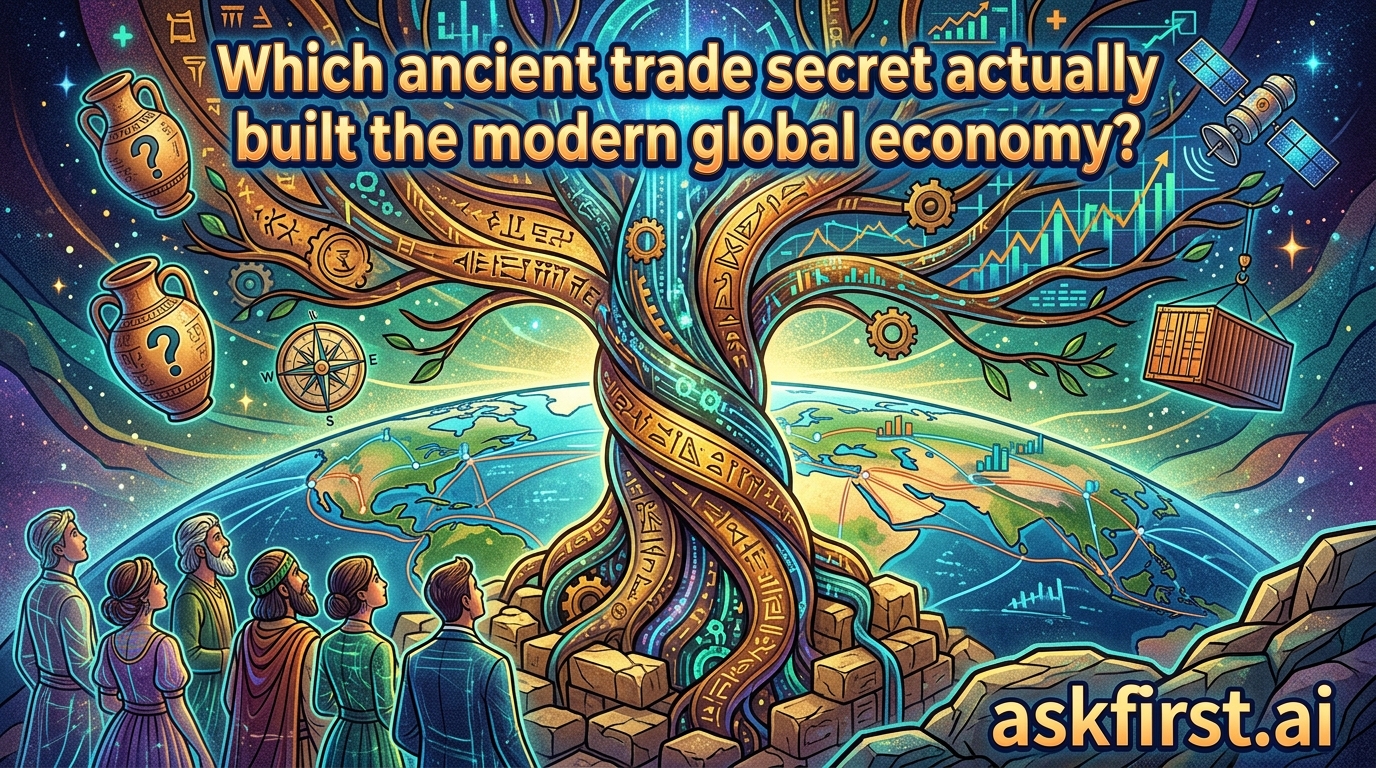
While many believe the modern economy was built on steam engines, electricity, or digital code, the true architectural secret behind global wealth is a mathematical system developed in the medieval Italian city-states: double-entry bookkeeping. This accounting framework, formally codified by the Franciscan friar Luca Pacioli in 1494, served as the "operating system" of capitalism, allowing merchants to track assets, liabilities, and equity with absolute precision.
What Is Double-Entry Bookkeeping?
At its core, double-entry bookkeeping operates on a simple yet revolutionary logic: every financial transaction must affect at least two accounts. For every debit, there must be a corresponding credit. This system acts as a perfect self-balancing mechanism. Before its adoption, accounting was rudimentary—often merely a list of "what I owe" and "what is owed to me." Pacioli's method introduced the concept of the Accounting Equation:
- Assets = Liabilities + Owner's Equity
This balance provided a structural guarantee that no money could vanish without a trace. It turned business from a guesswork endeavor into a verifiable, scalable science.
The Historical Impact: From Local Markets to Global Empires
Before the widespread adoption of double-entry bookkeeping, international trade was fraught with risk and asymmetry. Merchants had no reliable way to assess the solvency of distant partners. By creating a standardized language of finance, this secret allowed for the following developments:
- Capital Accumulation: Businesses could accurately measure profitability, enabling them to reinvest capital into expansion rather than simply spending profits as they arrived.
- The Rise of Joint-Stock Companies: Investors felt safe funding ventures like the East India Company because the books could be audited. Investors could see exactly how their capital was being deployed.
- Credit Systems: Trust was no longer based solely on reputation; it was based on transparent ledger entries. This catalyzed the growth of modern banking, as banks could now calculate risk with mathematical certainty.
Why This Secret Still Rules the World
Even in the era of artificial intelligence and high-frequency trading, the fundamental logic of double-entry bookkeeping remains the backbone of the global economy. Every financial statement issued by a Fortune 500 company, every tax return filed by a multinational corporation, and every balance sheet generated by a government treasury relies on the exact same principles Pacioli documented over five centuries ago.
The Psychological and Practical Advantages:
- Accountability: The symmetry of the system makes fraud inherently more difficult to hide. If a number is moved from one ledger, it must appear in another, creating an audit trail.
- Scalability: Because the system is logical and predictable, a firm can grow from a local shop to a global conglomerate while maintaining a unified view of its health.
- Standardization: It created a "common tongue" for trade. A merchant in Venice, a banker in London, and an investor in Amsterdam could all communicate through the universal language of the ledger.
The Legacy of Luca Pacioli
Luca Pacioli, often referred to as the "Father of Accounting," did not necessarily invent the system—it had been evolving among Venetian merchants for decades. However, by formalizing it in his book Summa de Arithmetica, Geometria, Proportioni et Proportionalita, he spread the knowledge across Europe. This act of knowledge dissemination is arguably the most important intellectual contribution to business history.
Without this rigorous mathematical structure, the complexities of the Industrial Revolution, the rise of the modern corporation, and the intricacies of international trade finance would have been impossible to manage. The system created a form of "financial reality" that allowed humans to trust one another across vast geographical distances. It turned commerce from a local activity into a systematic, global pursuit. Today, as we move into an era of blockchain technology and decentralized finance, we find that the fundamental design remains unchanged: a ledger of transactions that must balance perfectly, proving that the most ancient secrets are often the ones that stand the test of time the longest.
In essence, the secret isn't just about accounting; it is about the systematization of human trust. It provided the clarity necessary for individuals to cooperate, innovate, and build the infrastructure of a world connected by trade, finance, and mutual dependency. It remains, without question, the most influential "trade secret" in history.