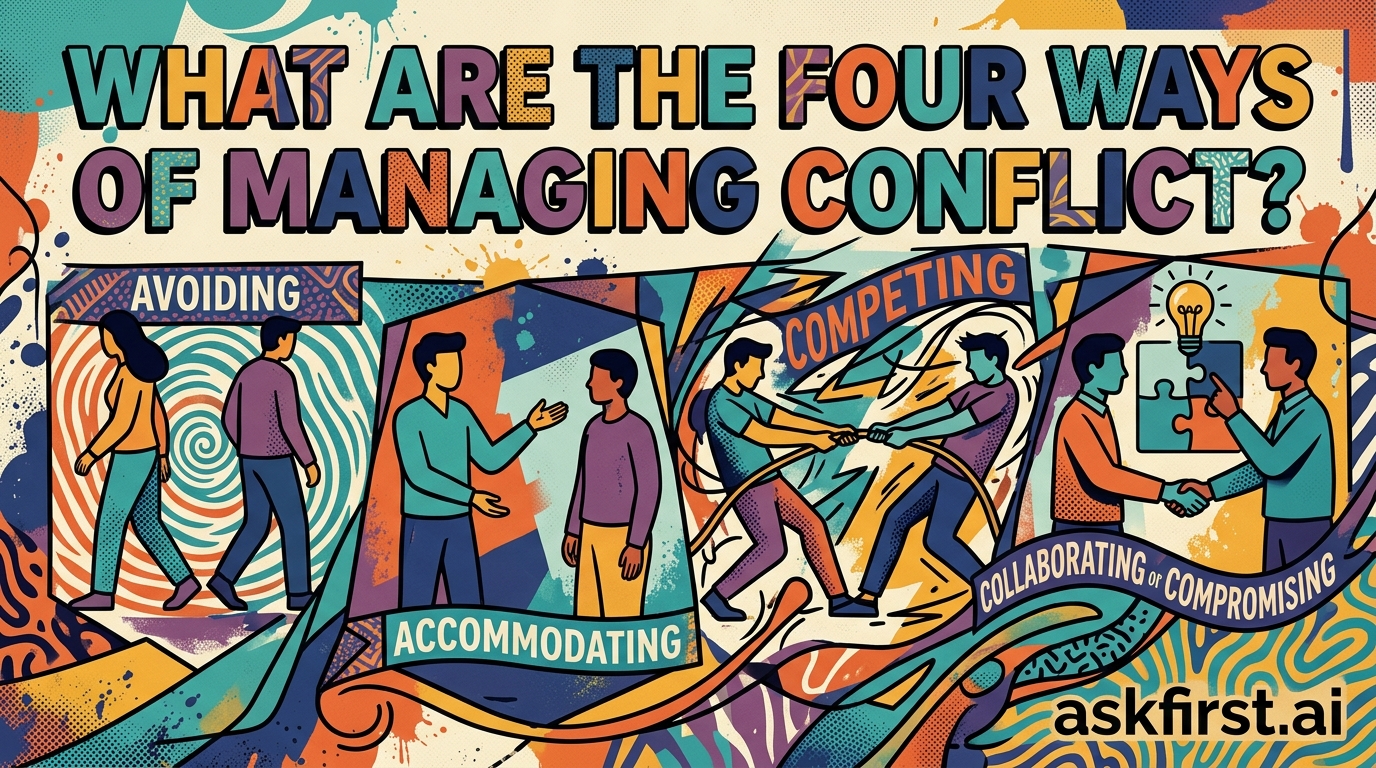
Conflict is an inevitable component of the human experience, whether in a high-stakes corporate boardroom, a diplomatic negotiation, or the daily dynamics of a household. Because conflict arises from the intersection of differing values, goals, and communication styles, the ability to manage it effectively is not merely a soft skill; it is a fundamental leadership competency. While many organizational psychologists suggest a five-part model (the Thomas-Kilmann Conflict Mode Instrument), the core framework for understanding conflict management typically distills into four primary strategic approaches: Avoidance, Accommodation, Competition, and Collaboration.
Understanding these four levers allows individuals to assess the stakes of a situation and choose the most effective path toward resolution.
1. The Strategy of Avoidance (The "Lose-Lose" Approach)
Avoidance occurs when an individual chooses to ignore the conflict or withdraw from the situation entirely. This strategy is often criticized as being ineffective, yet it possesses strategic value in specific contexts. According to Kenneth Thomas and Ralph Kilmann in their seminal work, Thomas-Kilmann Conflict Mode Instrument (Xicom, 1974), avoidance is the appropriate choice when the issue at hand is trivial, when potential damage from a confrontation outweighs the benefits of resolution, or when one needs to "cool down" to gain perspective.
For example, if a team member makes a minor, one-time error in a low-stakes meeting, addressing it immediately might cause unnecessary tension. By avoiding the conflict, the leader preserves social capital. However, chronic avoidance is detrimental; it allows resentment to fester and prevents the underlying structural problems from being resolved.
2. The Strategy of Accommodation (The "Lose-Win" Approach)
Accommodation, or "yielding," involves putting the needs of the other party above one’s own. This is essentially an act of self-sacrifice. It is highly effective when the relationship is more important than the specific issue at hand, or when one party realizes they are factually incorrect.
In the book Crucial Conversations: Tools for Talking When Stakes Are High by Patterson, Grenny, McMillan, and Switzler (McGraw-Hill, 2002), the authors emphasize that accommodation can be a strategic move to build "emotional bank accounts" with colleagues. By yielding on a point that matters little to you but significantly to your counterpart, you foster a sense of goodwill. The danger, of course, is the "doormat effect," where a person consistently accommodates to the point of losing their own influence and credibility.
3. The Strategy of Competition (The "Win-Lose" Approach)
Competition is an assertive, uncooperative mode where an individual pursues their own concerns at the other person’s expense. This approach is rooted in power dynamics and is often used in situations where a quick, decisive action is required—such as during an emergency or when unpopular decisions must be implemented for the survival of an organization.
Drawing from the research of Morton Deutsch, a pioneer in conflict resolution theory in The Resolution of Conflict (Yale University Press, 1973), competition is characterized by a "zero-sum" mentality. While often viewed negatively due to its aggressive nature, competition is essential for protecting against exploitation. For instance, if a company is negotiating a contract and the other party is acting in bad faith, a firm, competitive stance is necessary to prevent financial loss. The risk, however, is the erosion of trust and the creation of long-term organizational toxicity if used as a default management style.
4. The Strategy of Collaboration (The "Win-Win" Approach)
Collaboration is widely considered the "gold standard" of conflict management. It involves digging into the underlying needs of both parties to find a solution that satisfies everyone involved. Unlike the other strategies, collaboration requires high levels of transparency, active listening, and a willingness to invest significant time.
In Getting to Yes: Negotiating Agreement Without Giving In by Roger Fisher and William Ury (Penguin Books, 1981), the authors argue for "principled negotiation." They suggest that instead of arguing over positions ("I want this"), parties should focus on interests ("I need this to ensure my team meets their quarterly quota"). By identifying the shared interest, parties can brainstorm creative solutions that neither could have achieved alone. For example, if two departments are fighting over a budget, a collaborative approach might involve restructuring the project workflow to eliminate the need for the extra funds entirely, rather than simply splitting the difference.
Conclusion
Effective conflict management is not about choosing one "superior" style, but rather about possessing the versatility to apply the right style to the right situation. The expert communicator knows when to be assertive (Competition), when to be selfless (Accommodation), when to step back (Avoidance), and when to invest the labor required for a joint solution (Collaboration). By moving away from reactive behaviors and toward conscious selection of these strategies, individuals can transform conflict from a source of destruction into a catalyst for innovation and stronger interpersonal relationships. As noted by the history of organizational theory, the most successful leaders are those who treat conflict as a diagnostic tool, revealing the gaps in communication and strategy that, when bridged, lead to higher levels of organizational health.