The Blueprint for Scaling: Transforming a Small Business into a Market Powerhouse
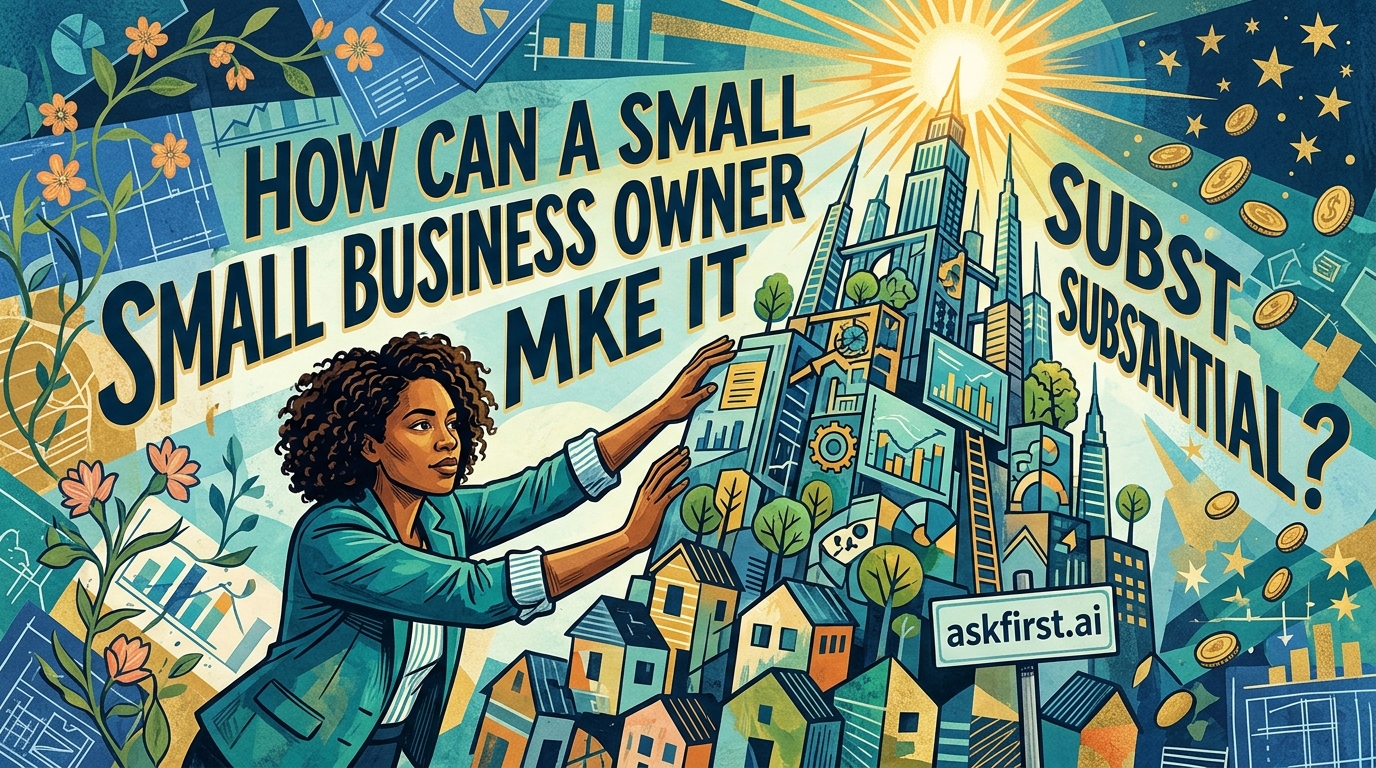
Transitioning a small business from a "side hustle" or a localized operation into a substantial, scalable enterprise is the ultimate challenge of entrepreneurship. It requires a fundamental shift in mindset: moving from being the person who does the work to being the architect of the system that produces the work. Many entrepreneurs fall into the "self-employed trap," where the business cannot function without their constant oversight. To break this cycle and achieve substantial growth, one must master the disciplines of operational efficiency, strategic financial management, and market positioning.
1. The Power of Systems and Scalability
In his seminal work, The E-Myth Revisited, Michael Gerber argues that the primary reason most small businesses fail is that the owner acts like a technician rather than a business developer. To make your business substantial, you must stop focusing on the product and start focusing on the franchise prototype.
This means documenting every single process—from how you answer the phone to how you reconcile your accounts receivable. By creating a comprehensive "Operations Manual," you ensure that the business is predictable and repeatable. When a business relies on the genius of a single individual, it remains fragile. When it relies on robust systems, it becomes scalable. For instance, consider the success of McDonald’s; Ray Kroc did not invent the best hamburger, but he invented the best system for producing them consistently, which allowed for global expansion.
2. Mastering the Financial Engine
Scaling requires capital, but more importantly, it requires financial literacy. Many small business owners confuse cash flow with profit. You must transition from reactive bookkeeping to proactive financial strategy.
- Understand Unit Economics: You must know the Lifetime Value (LTV) of your customer versus the Customer Acquisition Cost (CAC). If you are spending $50 to acquire a customer who only spends $40 with you, your growth will only accelerate your bankruptcy.
- Cash Flow Management: As noted by Mike Michalowicz in Profit First, the traditional accounting formula (Sales - Expenses = Profit) is flawed because it treats profit as an afterthought. Instead, prioritize profit by taking a percentage of every sale off the top. This forces the business to become leaner and more efficient.
- Reinvestment Strategy: A substantial business does not hoard cash; it deploys it into high-ROI activities, such as hiring key talent or investing in technology that replaces manual labor.
3. Strategic Delegation and the "Who" Mentality
One of the most significant barriers to growth is the owner’s inability to let go. Dr. Benjamin Hardy and Dan Sullivan, in their book Who Not How, posit that the question should never be "How can I do this?" but rather "Who can do this for me?"
To reach a substantial level, you must identify your "Unique Ability." If you are a founder who is great at vision and sales but terrible at administrative detail, your time spent doing admin is costing the company money. Hire people who are better than you at the tasks that drain your energy. A substantial business is built on a team of specialists who feel ownership over their respective domains. When you hire for culture and aptitude rather than just basic skill, you create an organization that can solve problems without your intervention.
4. Establishing a Defensible Moat
A small business becomes substantial when it moves from being a commodity to being a brand with a "moat." In 7 Powers: The Foundations of Business Strategy, Hamilton Helmer explains that sustainable growth comes from competitive advantages—such as network effects, economies of scale, or brand loyalty.
How do you build this? You stop competing on price. If you are the cheapest option, you are vulnerable to anyone willing to lose more money than you. Instead, focus on a niche where you can become the dominant player. Whether it is through superior customer service, proprietary technology, or an unmatched community, your brand must offer something that cannot be easily replicated by a competitor. Look at companies like Apple or Tesla; they don't sell products; they sell an identity and an ecosystem that makes it difficult for a customer to switch to a competitor.
5. Long-Term Vision and Resilience
The journey to a substantial enterprise is rarely linear. It is characterized by "the messy middle," a term coined by Scott Belsky in his book of the same name. During this phase, the novelty of the startup has worn off, but the stability of the enterprise has not yet been achieved.
Resilience is your most valuable asset here. You must be willing to pivot when the data suggests your current model is flawed, but also stubborn enough to stick to your long-term vision when faced with temporary setbacks. Substantial businesses are those that survive the "Valley of Death"—the period where expenses are high and revenue is inconsistent—by maintaining a disciplined focus on customer retention and iterative improvement.
Conclusion: The Path Forward
Making a business substantial is not about working harder; it is about working with greater leverage. It requires the courage to replace yourself in the daily operations, the discipline to manage your finances with surgical precision, and the vision to build a brand that stands for something unique in the marketplace. By shifting your focus from "doing" to "designing," you transform your business from a job into an asset—a vehicle that produces value, generates wealth, and provides the freedom you originally sought when you first decided to become an entrepreneur. Start by documenting your processes, hiring your first key replacement, and relentlessly protecting your profit margins. The transition from small to substantial is a deliberate choice, not an accident.