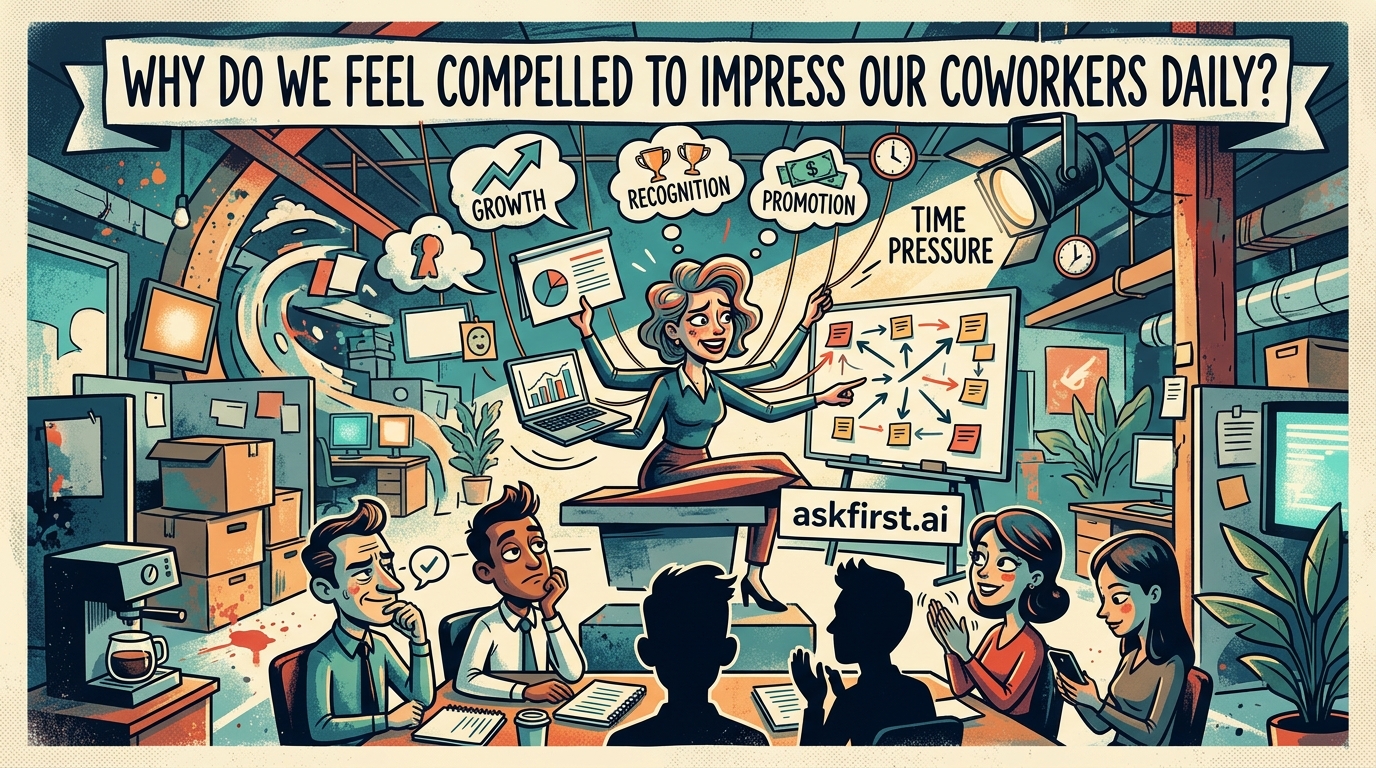
The Evolutionary Roots of Professional Validation
The phenomenon of constantly seeking to impress coworkers is deeply rooted in human evolutionary psychology. For early humans, belonging to a tribe was synonymous with survival; being cast out meant certain death. In the modern workplace, this ancient drive has been repurposed. Coworkers represent a contemporary 'tribe' or social circle, and our desire to prove our value is essentially a modern manifestation of the innate need for social standing and status within a community.
Psychological Drivers: The Imposter Phenomenon and Social Comparison
One of the primary engines behind this compulsion is the Imposter Phenomenon, a psychological pattern where individuals doubt their skills or achievements despite evidence of their success. Fearful that they will be exposed as 'frauds,' employees often overcompensate by working harder, speaking up more frequently, and engaging in performative behaviors meant to project competence.
Furthermore, Social Comparison Theory, proposed by Leon Festinger in 1954, explains that individuals determine their own personal and social worth based on how they stack up against others. In an office setting, these comparisons are constant. When an employee perceives a peer achieving success, a psychological trigger activates the competitive instinct, leading the individual to seek ways to gain recognition and affirm their worth in the eyes of their peers.
The Impact of Organizational Culture
While internal psychological drivers are significant, external factors play an equally pivotal role. Organizational structures often incentivize this behavior. If a workplace fosters a zero-sum environment—where recognition, promotions, and bonuses are limited—employees naturally feel compelled to stand out. This 'performative work' is often misinterpreted as high productivity. Leadership teams that explicitly reward visibility over actual objective output inadvertently create a culture where workers are perpetually running a race for 'employee of the month' status.
Negative Consequences of 'Impression Management'
While striving to improve is healthy, the constant compulsion to impress leads to significant drawbacks:
- Burnout and Emotional Exhaustion: Maintaining a 'perfect' professional persona requires a significant amount of cognitive energy. Eventually, this leads to emotional fatigue.
- Stifled Innovation: When employees are overly concerned with how they are perceived, they become risk-averse. They stop suggesting bold ideas for fear of public failure.
- Authenticity Deficit: A workplace saturated with impression management lacks psychological safety. Teams become collections of individuals acting a part rather than collaborating as human beings.
Breaking the Cycle: Cultivating Authenticity
To transcend the need for daily validation, individuals and organizations must shift their focus toward intrinsic motivation and collective success. Here are strategies to reduce this compulsion:
- Reframing Success: Focus on the 'Why' behind the work rather than the 'Who' is watching. When the objective becomes mastery and service to the team, the pressure to impress diminishes.
- Cultivating Psychological Safety: As identified by Amy Edmondson of Harvard Business School, psychological safety is the belief that one will not be punished or humiliated for speaking up with ideas, questions, concerns, or mistakes. Organizations that foster this environment naturally lower the 'impression management' anxiety of their staff.
- Practice Vulnerability: Being open about challenges or knowledge gaps is often seen as a sign of weakness, yet studies show that it builds trust. When leaders model vulnerability, it gives team members permission to stop 'performing' and start working authentically.
Conclusion
The drive to impress coworkers is a byproduct of human history, evolutionary biology, and organizational systems that value visibility over substance. While it serves an adaptive purpose in small doses, the excessive need for daily external validation is a barrier to genuine professional growth and personal well-being. By fostering a culture centered on collaborative problem-solving and psychological safety rather than individual prestige, professionals can shed the weight of this compulsion, leading to more sustainable success and genuine team integration.