The Psychology of Calculated Risk-Taking
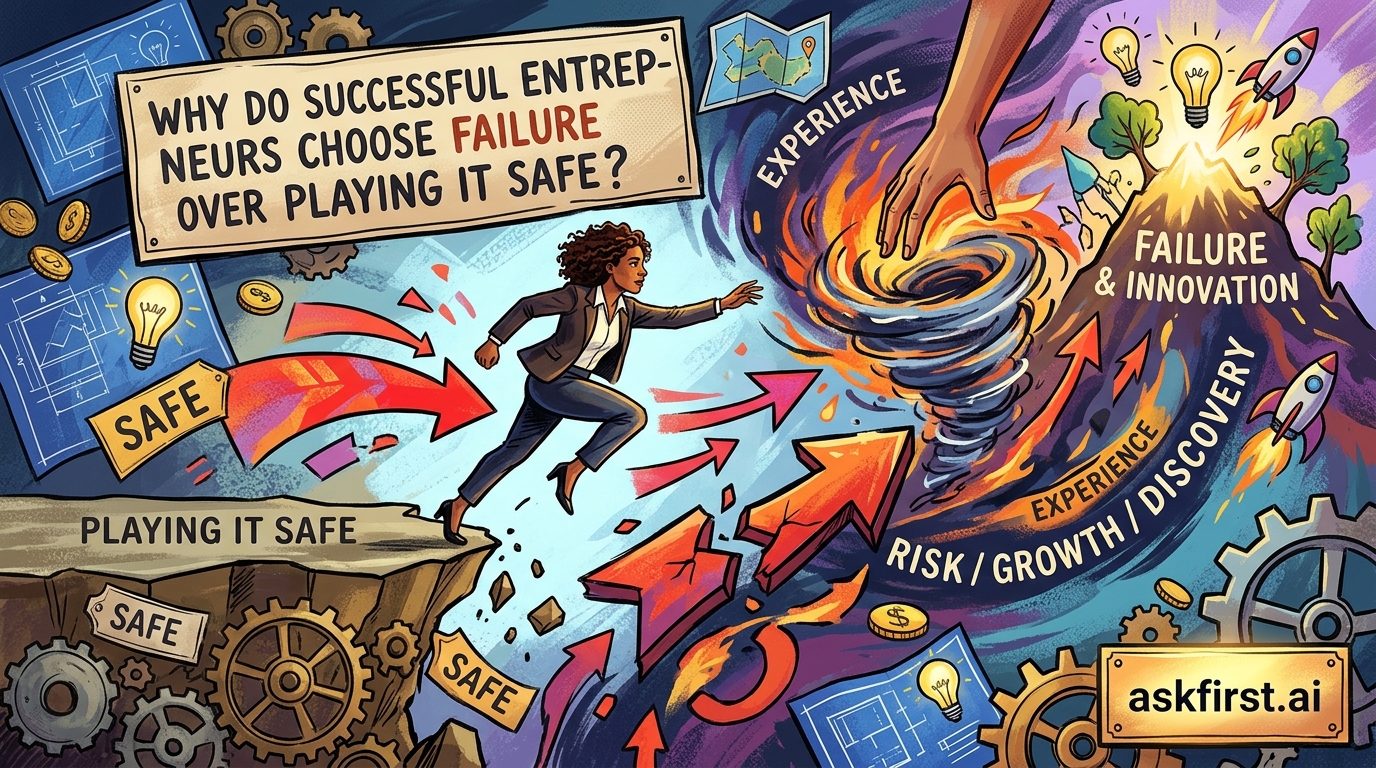
Successful entrepreneurs operate under a fundamentally different cognitive framework than the average risk-averse individual. While conventional wisdom suggests that playing it safe preserves capital and reputation, the entrepreneurial mindset views safety as the ultimate risk. By stagnating in a comfort zone, one risks obsolescence, whereas failure is perceived as a high-velocity learning event. The choice to embrace potential failure is rooted in the pursuit of asymmetric upside, where the consequences of success far outweigh the temporary costs of a setback.
1. The Myth of Safety
Many professionals believe that maintaining a traditional career path is the safest route to prosperity. However, global market dynamics prove that job security is a declining asset. In a rapidly evolving economy, staying within the boundaries of a 'safe' job often leads to skill stagnation. Entrepreneurs understand that by choosing to build something new, they are actively participating in market creation. This active participation provides them with agency, a critical psychological need that directly correlates with long-term mental well-being and professional mastery.
2. Failure as Data Acquisition
To the seasoned founder, failure is not a terminal event; it is a rapid data acquisition tool. Each iteration that does not gain traction provides clear evidence of what the market does not want. By leaning into potential failure, entrepreneurs conduct real-world experiments that a risk-averse competitor would never attempt. This allows them to iterate faster than any corporate entity that relies on traditional, slow-moving market research.
- Iterative Learning: Every failed prototype provides empirical evidence for the next development cycle.
- Network Resilience: The process of failing publicly often builds a stronger professional network, as peers respect the courage required to attempt the impossible.
- Psychological Immunity: Repeated exposure to small failures desensitizes the brain to the fear of rejection, fostering an ironclad resilience.
3. The Asymmetry of Risk
Mathematically, the entrepreneur seeks scenarios where the downside is capped, but the upside is potentially infinite. This is often referred to as 'Antifragility,' a concept popularized by Nassim Taleb. By starting a business, an individual might lose their initial investment—a finite, capped loss—but they gain the possibility of changing an entire industry or generating generational wealth. Playing it safe, by contrast, involves the 'invisible' cost of opportunity: the loss of the potential life one could have built had they taken the leap.
4. Vision-Driven Motivation
Successful founders are rarely motivated solely by monetary gain. Instead, they are fueled by a vision of how the world ought to be. When a person is deeply committed to a mission, the potential for failure becomes secondary to the necessity of solving a problem. This vision-driven approach provides an internal compass that allows entrepreneurs to endure the 'trough of sorrow'—the period between starting a venture and achieving market traction. Without the willingness to fail, that vision could never leave the conceptual stage.
5. Cultural Signaling and Legacy
Society tends to celebrate those who take bold risks, even when they fail. This cultural phenomenon rewards the 'attempt.' In the eyes of investors and collaborators, a history of failure—provided it was pursued with integrity—is often seen as a badge of honor. It signals that an individual has been in the arena and understands the nuances of operation, competition, and market adaptation. Over time, this builds a legacy of being a person who acts rather than one who merely observes.
The Final Paradigm Shift
To play it safe is to bet against one's own growth. Successful entrepreneurs choose the path of potential failure because they understand that progress is not a straight line. It is a series of loops, failures, and recalibrations. By choosing to embrace the possibility of collapse, they open themselves up to the possibility of transcendence. The most successful ventures are often born from the ashes of earlier attempts, proving that failure is not the opposite of success—it is the bedrock upon which success is constructed.
Ultimately, the choice is between a life of predictable outcomes and a life of profound discovery. Entrepreneurs choose the latter because they realize that the regret of never trying is far more painful than the lessons learned from failing.