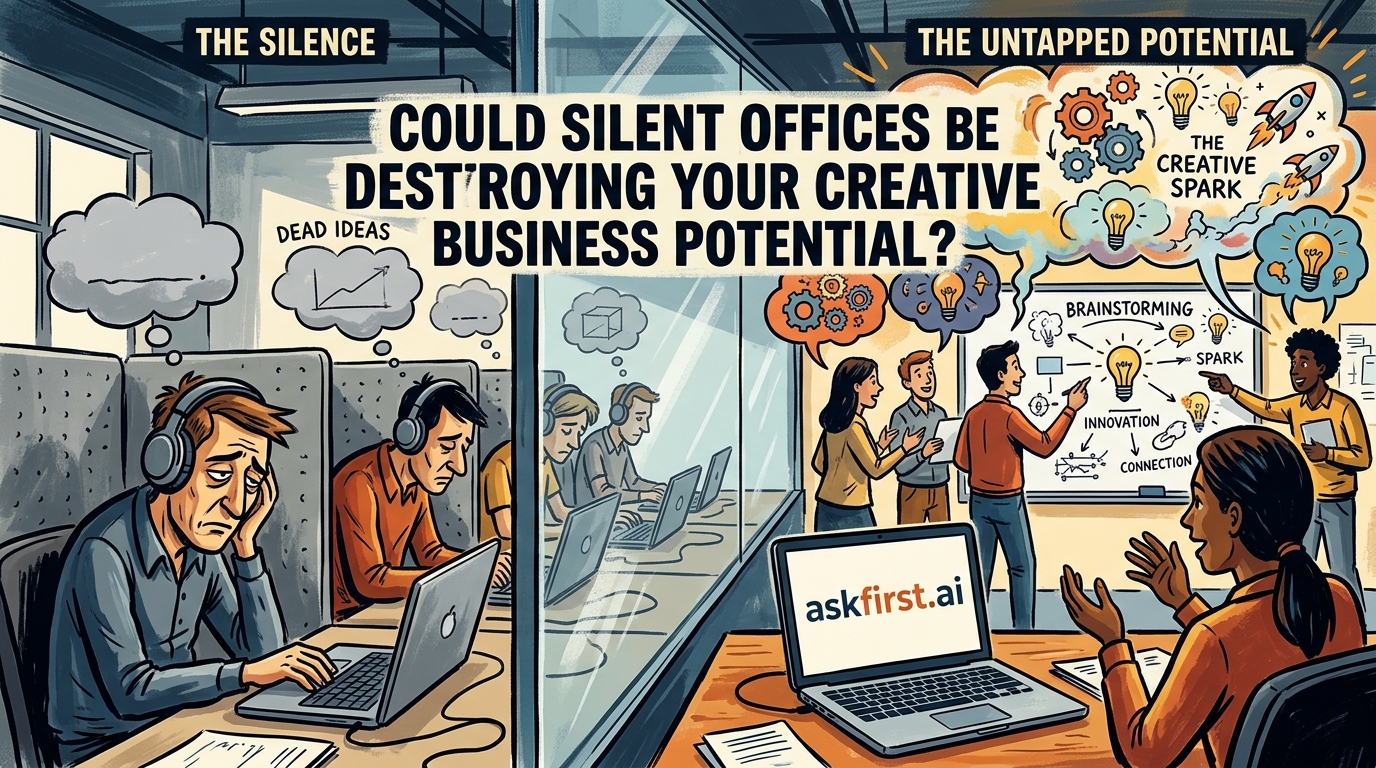
The Paradox of Silence: Is Productivity Stifling Innovation?
For decades, the architectural evolution of the modern workspace has favored open-plan layouts or extreme quietude, driven by the belief that concentration requires an absence of sound. However, emerging research in cognitive psychology and organizational behavior suggests a radical counter-intuitive truth: absolute silence may be the silent killer of creative business potential. While quiet environments are conducive to repetitive, linear tasks—such as data entry or formal report writing—they often fail to support the non-linear, associative thinking required for true innovation and high-level problem solving.
The Neuroscience of Ambient Noise
To understand why silence might be detrimental, one must look at the Stochastic Resonance theory. This theory posits that a moderate level of ambient background noise can actually enhance cognitive performance by providing a stochastic interference that helps the brain focus. When an environment is deathly silent, the brain is hyper-alert to even the smallest disruption, such as a pen clicking or a distant cough, which acts as a major interruptor. In contrast, a moderate ambient hum—often referred to as 'pink noise' or coffee-shop chatter—masks these sharp, distracting sounds and keeps the subconscious mind in a relaxed, flowing state.
Studies, such as those published in the Journal of Consumer Research, have demonstrated that moderate noise levels (around 70 decibels) stimulate abstract processing. When the brain is slightly challenged by background environmental stimuli, it is forced to move away from rigid, literal interpretations and embrace more creative, global thinking strategies.
The Social Cost of Forced Quiet
Beyond individual brain function, silence in an office often correlates with a culture of isolation. Creative breakthroughs are rarely the result of solitary genius; they are typically the byproduct of serendipitous friction. When employees are conditioned to maintain silence, they are effectively discouraged from engaging in spontaneous 'water-cooler' conversations. These informal interactions are where organizational silos break down.
- Information Cross-Pollination: Innovation thrives when diverse skill sets collide. A quiet office prevents the accidental discovery of a colleague's current hurdle.
- Psychological Safety: A rigid atmosphere of silence can feel punitive or highly regulated, which suppresses the vulnerability required for brainstorming and 'crazy' idea sharing.
- Energy and Rhythm: Silence creates a stagnant environment. Dynamic, moderately noisy environments reflect the urgency and pace of a living, breathing marketplace.
Re-evaluating the 'Deep Work' Myth
Cal Newport’s concept of 'Deep Work' has gained massive traction, suggesting that intense, uninterrupted focus is the only path to high-value output. While this is true for deep coding or intense research phases, applying this to a whole organization as a constant state can lead to 'intellectual malnutrition.' If every team member is perpetually tucked into a silent bunker, the creative output shifts toward consistency at the expense of discovery. A balanced business must oscillate between phases of intense, silent focus and phases of high-energy, collaborative ambient noise.
Practical Strategies for Cultivating Creative Friction
Organizations must intentionally design spaces that support both ends of the spectrum. The goal is not to fill an office with chaos, but to engineer 'productive friction.'
- Zone-Based Architecture: Designate areas specifically for 'hushed' deep work, but ensure there are central hubs where noise is encouraged. Do not mandate silence across the floor plate.
- Soundscapes as a Tool: Implement high-quality audio systems that play ambient sounds or low-fidelity instrumental music in collaborative zones to foster a 'creative buzz' without the need for constant verbal chatter.
- Mandated Spontaneity: If a workplace is quiet, leadership must physically move throughout the office to invite conversation. Managers must model that talking is work, not a distraction from it.
- Flexible Environment Shifts: Allow teams to decide the 'noise budget' for their project phase. A team in the brainstorming phase needs a loud, collaborative space; the same team might need a library setting for the final execution phase.
Conclusion: The Future of Creative Business
The most successful businesses of the next decade will not be those that perfected the quiet office, but those that mastered the balance of sound and silence. Innovation is a biological process that requires stimulation. By stripping the office of its hum, companies might be inadvertently stripping their workforce of the random, associative connections that lead to the next great breakthrough. Embrace the buzz; it is often the sound of a business evolving.