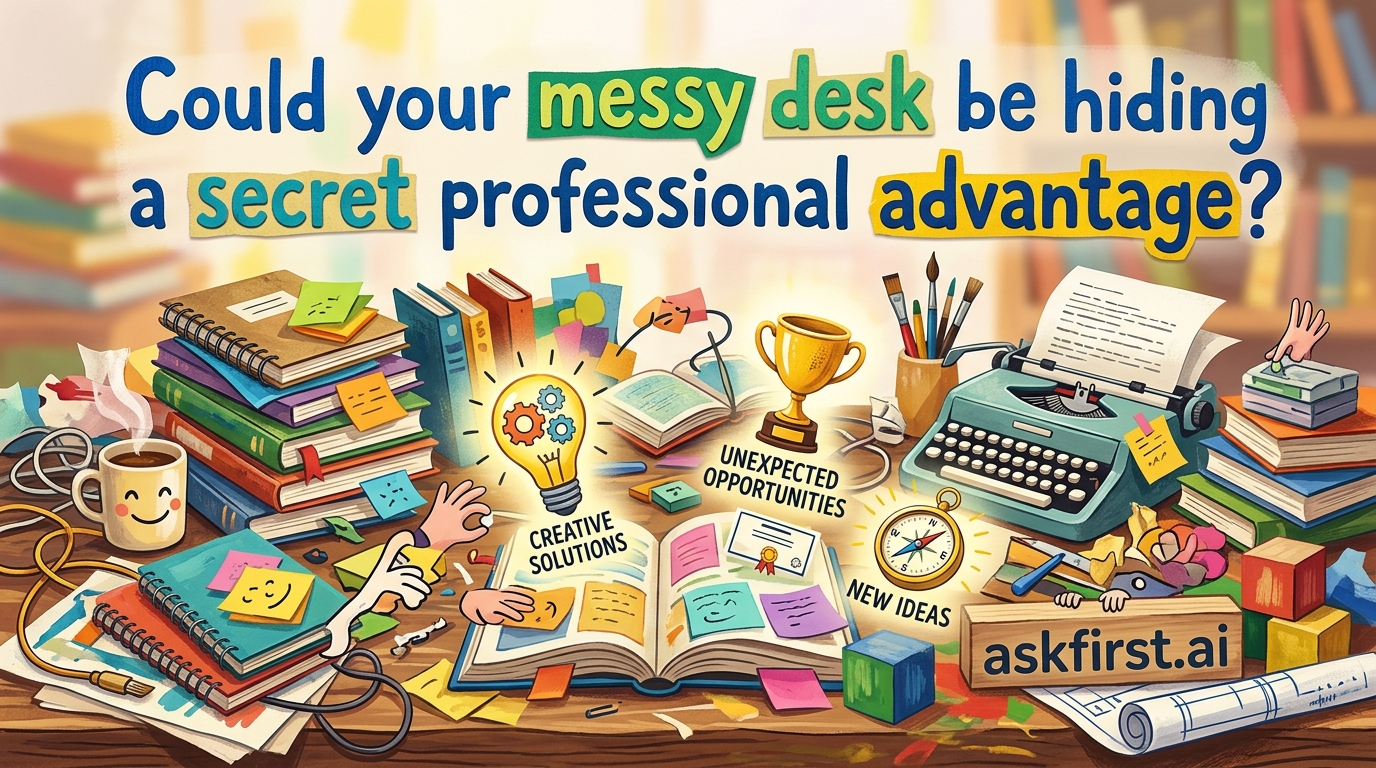
The Surprising Science of Clutter
For generations, the pristine, minimalist desk has been heralded as the hallmark of a high-achiever. Management gurus and office productivity experts have long preached that a clean space equals a clear mind. However, a growing body of psychological research suggests that the chaotic, paper-strewn desk of the 'disorganized' professional may actually be a fertile ground for innovation and complex problem-solving. This phenomenon, often referred to as the 'messy desk paradox,' challenges deeply held assumptions about productivity and creativity.
The Vohs Study and Creative Divergence
One of the most pivotal studies on this topic was conducted by Kathleen Vohs and her team at the University of Minnesota. In a controlled experiment, participants were placed in either neat or messy rooms and asked to brainstorm new uses for ping-pong balls. The results were striking: while individuals in the neat room were more generous and adhered to structured tasks, the participants in the messy room generated significantly more creative and innovative ideas. This suggests that while a clean environment may foster adherence to norms and focus on specific tasks, a messy environment may break the psychological chains of traditional thinking, encouraging the brain to explore unconventional paths.
Why Chaos Feeds Creativity
Clutter is not merely a sign of neglect; for many, it functions as an externalization of the mind. This process, known as 'distributed cognition,' allows an individual to use their environment to track multiple projects simultaneously. When visual cues—such as a stack of project notes, a prototype, or a reference book—remain visible, the brain is constantly reminded of context, facilitating 'interleaving.' Interleaving involves mixing subjects or topics to improve memory and creative output, a technique often discouraged by those who favor linear, one-task-at-a-time workflows.
- Reduced Cognitive Load: For some, constantly cleaning away papers and tools increases the 'startup cost' of returning to a task. Keeping materials visible lowers the activation energy required to dive back into a creative flow.
- The Serendipity Effect: Unexpected visual connections can occur when disparate objects sit near each other on a desk. This can trigger mental synthesis, where two unrelated concepts merge to form a unique, original solution.
- Tolerance for Ambiguity: High-functioning individuals with 'messy' habits often possess a higher threshold for ambiguity. Rather than being distressed by clutter, they utilize it as a dynamic workspace where they can toggle between priorities without the friction of a digital-only filing system.
The Myth of the Universal Workspace
It is essential to recognize that workspace preference is not a one-size-fits-all paradigm. Personality traits, specifically those outlined in the Big Five model, play a significant role. Individuals who score lower on the 'conscientiousness' spectrum often find that rigid organizational systems actually stifle their energy, leading to frustration and burnout. Conversely, those who score high on conscientiousness may feel genuinely anxious in a disorganized environment, leading to impaired performance. The professional advantage is not found in the mess itself, but in the alignment between an individual's cognitive style and their physical workspace.
When is Messiness Actually Detrimental?
While the creative benefits of a messy desk are well-documented, there is a clear distinction between 'productive chaos' and 'dysfunctional clutter.' Productive mess is generally task-related; it consists of documents, tools, and ideas that are currently being processed or synthesized. Dysfunctional clutter, by contrast, is characterized by trash, long-obsolete files, and an accumulation of items that impede physical movement or digital access to critical information. To maintain an advantage, the workspace must be organized enough to be functional and search-efficient, even if it is not visually minimalist.
Designing Your Advantage
To leverage this phenomenon, individuals should move away from the pressure of total minimalism and toward the concept of 'organized mess.'
- Define Your Boundaries: Maintain a 'workspace zone' where your most critical active projects reside. This allows for the visual cues of messy creativity while preventing the clutter from overwhelming the ability to execute tasks.
- Curate the Chaos: Periodically purge items that are no longer part of active workflows. This ensures that the mess is composed of materials that serve a purpose rather than mere stagnation.
- Assess Your Goals: If the primary goal is high-precision execution (e.g., accounting or surgery), a cleaner space is statistically safer. If the goal is ideation, design, or strategic thinking, allow the environment to reflect the complexity of the problems being solved.
Ultimately, the professional advantage is hidden in the ability to understand how one’s brain processes information. If a desk littered with post-it notes and reference books acts as a catalyst for breakthrough thinking, then that clutter is not a lack of discipline—it is a sophisticated tool for innovation. The most successful professionals are those who master their environment rather than becoming a slave to it, recognizing that the ideal office is one that fuels the specific type of output they are paid to produce.