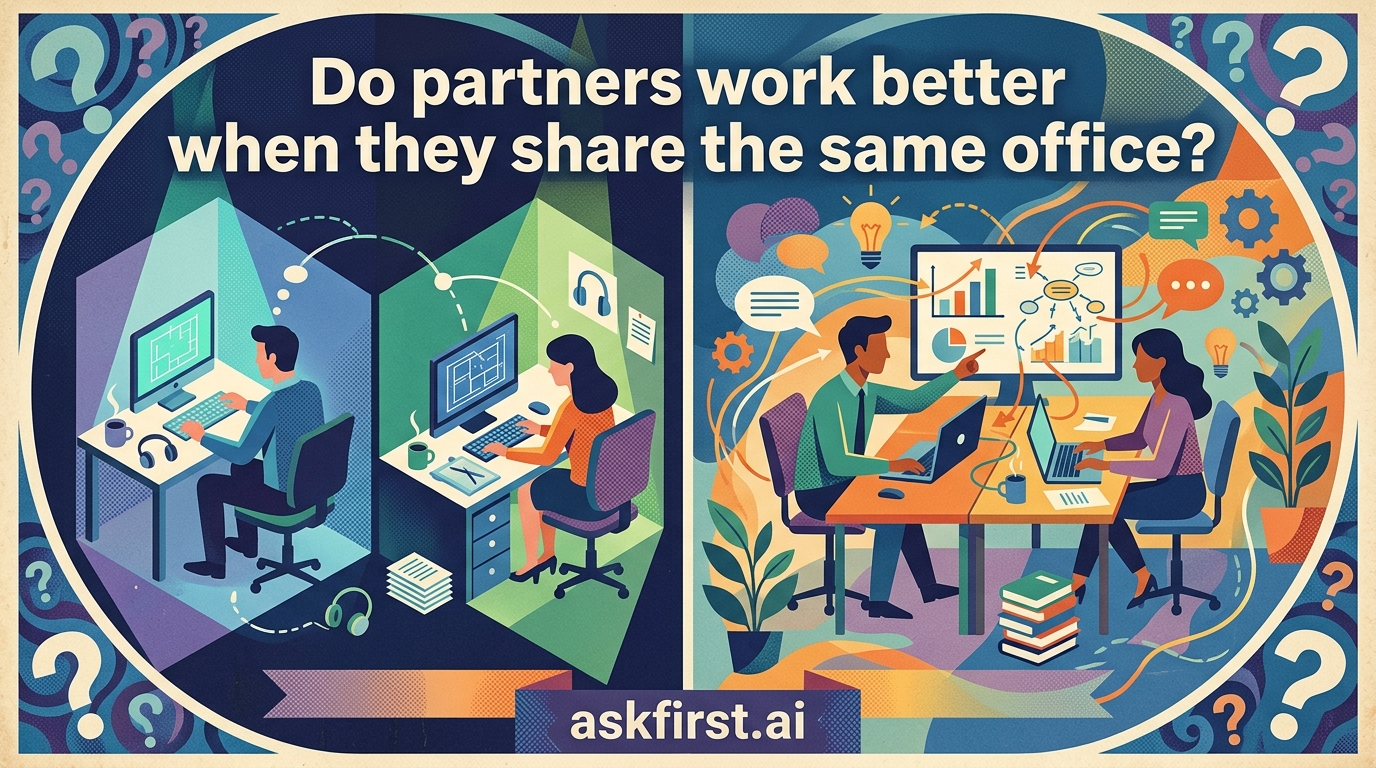
The Architectural Psychology of Shared Workspace
The debate over whether romantic or business partners should occupy the same office space is as old as the modern corporate landscape itself. While the prospect of constant collaboration and shared professional intensity seems romantic, organizational psychology suggests a more nuanced reality. Research into spatial dynamics and interpersonal boundaries indicates that the decision to share an office involves a delicate balance between increased synergy and the erosion of individual psychological autonomy.
The Allure of Proximity: The Synergy Hypothesis
Advocates for shared offices often point to the concept of 'osmotic communication.' In shared environments, information flow is near-instantaneous. Decisions that might otherwise require scheduled meetings or lengthy email chains are resolved through brief verbal exchanges. This constant availability can accelerate project timelines significantly. Furthermore, there is the undeniable benefit of shared motivation. Working alongside a trusted partner can act as a buffer against workplace stress, fostering a sense of mutual support that is difficult to replicate in isolated environments.
- Enhanced Alignment: Partners in the same office often develop a 'shorthand' for communication, leading to higher efficiency.
- Emotional Support: The ability to vent frustration or celebrate small wins in real-time reinforces the interpersonal bond.
- Resource Pooling: Shared hardware, research materials, and operational tools reduce overhead and foster a unified workflow.
The Danger of Over-Saturation: The Boundary Erosion Myth
Conversely, environmental psychology warns against the 'hyper-proximity effect.' When partners share a space, the boundaries between the 'professional self' and the 'personal self' begin to blur. Human beings require periods of solitude to process complex information and regulate emotional responses. A shared office environment effectively eliminates the 'commute buffer'—the physical transition period where one mentally shifts gears. When partners spend eight hours together in a confined space, followed by time at home, the lack of spatial variety can lead to cognitive fatigue and social satiety.
Psychologists emphasize the importance of psychological safety, which requires a degree of independence. Constant surveillance—even from a loved one or a close partner—can inadvertently trigger a subconscious performance anxiety, hindering creative risk-taking.
Strategies for Successful Co-Working
For partners who choose or are required to work in the same office, the key lies in the deliberate construction of artificial boundaries. Without these, the risk of interpersonal combustion increases significantly.
- Visual Zoning: Use physical dividers or disparate desk orientations. If individuals sit face-to-face, the intensity of eye contact alone can be exhausting. Side-by-side or L-shaped configurations often offer a better balance between connection and personal space.
- Temporal Segregation: Implement 'Focus Hours' where verbal communication is strictly prohibited. This allows for deep work and mimics the solitude of separate offices.
- Environmental Customization: Ensure that each partner has distinct control over their immediate environment, such as lighting, temperature preference, or noise levels (via noise-canceling headphones).
- Scheduled Decompression: Commit to spending at least one hour of the workday physically apart. A brief walk or lunch in separate areas helps reset the nervous system.
The Impact of Neurodiversity and Work Styles
It is essential to recognize that work styles are not monolithic. One partner may thrive on external stimulus and high-energy interaction, while the other might require complete sensory silence to execute complex tasks. Placing two different temperaments in a shared office can create friction that has little to do with the strength of the relationship and everything to do with neurological compatibility.
If one partner operates on a 'fluid' schedule—characterized by frequent calls and multi-tasking—and the other requires 'immersion' work, the shared space becomes a battleground of competing needs. In such cases, the architectural design of the office must include a secondary space, such as a 'phone booth' or a library-style quiet zone, to allow for individual work styles to coexist without conflict.
Conclusion: Defining Success Through Intentionality
The consensus among organizational experts is that sharing an office is not inherently good or bad; its success is entirely dependent on the level of intentionality the partners bring to the arrangement. When handled with mutual respect for each other's need for solitude, a shared office can be a powerhouse of productivity. However, ignoring the necessity of mental and spatial boundaries is a precursor to burnout. By treating the workspace as a dynamic entity that must be managed rather than a static environment, partners can maximize their professional output while maintaining the health of their relationship.