The Anatomy of Unearned Virality: Understanding the Psychological Trigger
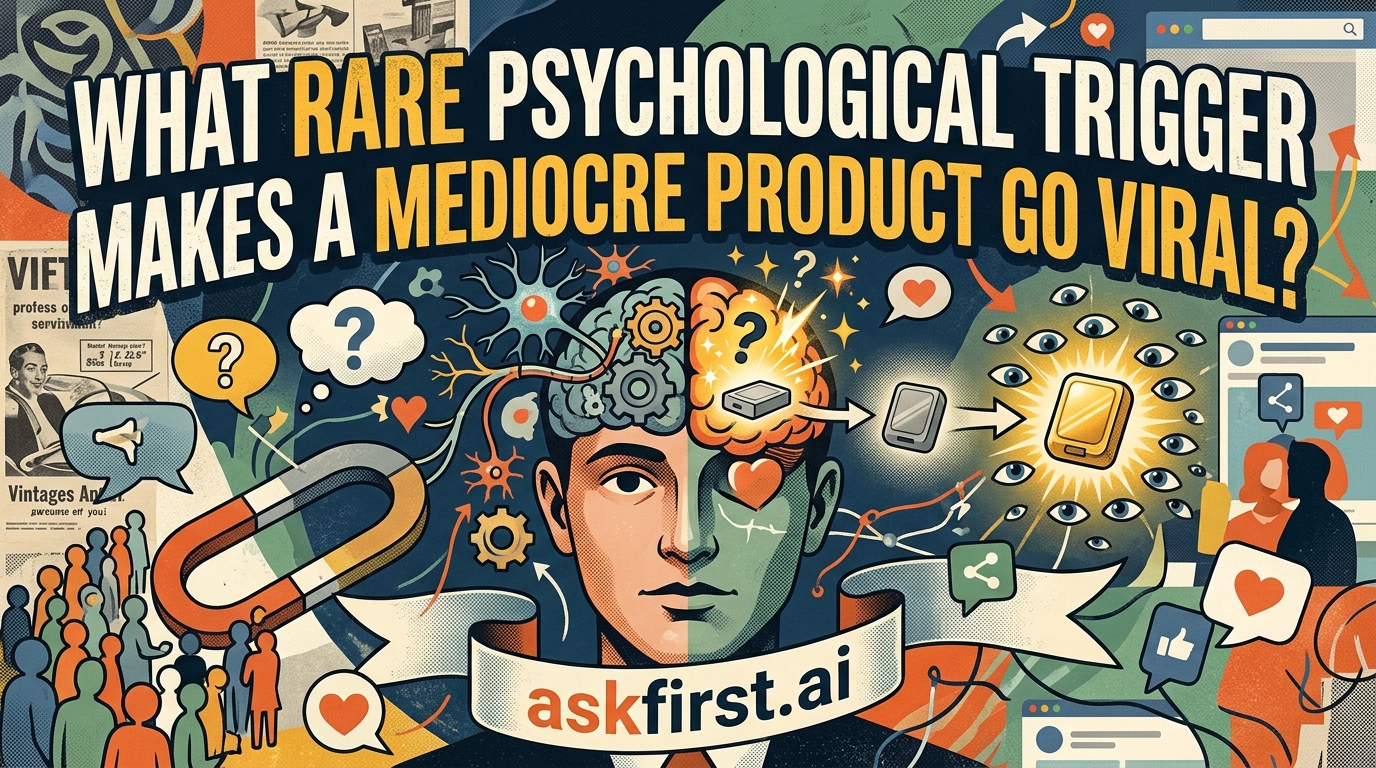
In the competitive landscape of digital commerce, the success of a mediocre product often seems like a statistical anomaly. While high-quality goods rely on utility, mediocre products that achieve massive virality often do so by tapping into a specific psychological mechanism: The Social Identity Signal through Ironic Consumption. This phenomenon occurs when consumers adopt an objectively 'bad' or underwhelming product not for its inherent value, but for the status or social capital it provides when shared.
The Mechanics of the Ironic Loop
When a product is unremarkable or slightly flawed, it creates a unique curiosity gap. This is not about functional failure, but about 'cringe' or 'quirk' factors that invite ridicule and playful mockery. Humans are social creatures who seek alignment with their peer groups; participating in a viral trend—even one centered on a mediocre product—acts as a shared language. By sharing a mediocre product, the user signals they are 'in on the joke,' which creates a powerful, self-reinforcing community.
- The Shared Secret: People feel clever when they recognize why a product is 'bad' while others might take it seriously. This validates their own intelligence.
- Low Barrier to Entry: Because the product is mediocre and perhaps inexpensive, the risk to the consumer is low, making it easy for the masses to purchase it simply to participate in the conversation.
- Performative Authenticity: In an age of polished marketing, a flawed or mediocre product feels 'real.' It represents a break from the hyper-curated aesthetic of modern branding.
The Role of Cognitive Dissonance and Social Currency
Psychologically, users often experience a form of cognitive dissonance when a mediocre product trends. When they see a product being mocked yet used by thousands, they experience a FOMO-driven urge to purchase it themselves. This is known as the Bandwagon Effect, but with an ironic twist. The consumer is not buying the product to solve a problem; they are buying it to solve a social anxiety—the fear of being excluded from the viral moment.
Furthermore, the concept of Social Currency plays a massive role. Jonah Berger’s research into virality highlights that people share things that make them look good. Paradoxically, sharing an 'ironically bad' product makes one appear culturally savvy. It suggests the person possesses a refined sense of humor and is not easily 'tricked' by traditional advertising.
Case Study: The Cultural Lifecycle of 'Bad' Virality
- The Catalyst: An early adopter identifies an imperfection in a product and frames it humorously on social media.
- The Spread: Peer groups latch onto the content, viewing the mockery as a bonding exercise.
- The Normalization: The product becomes a meme. It is no longer just a mediocre object; it is a symbol of a specific subculture.
- The Decline: Eventually, the product becomes 'too mainstream,' and the novelty fades as the irony becomes exhausted.
Why Utility is Secondary in Viral Media
It is essential to understand that virality and market longevity are distinct entities. A mediocre product might achieve 15 minutes of fame through this psychological trigger, but it rarely sustains a business model without eventually evolving. However, the trigger remains consistent: people are more likely to share content that evokes high-arousal emotions. Anger, amusement, and surprise are high-arousal. A perfectly fine, high-quality product is often perceived as 'low-arousal' because it meets expectations without sparking curiosity or debate.
To manufacture this trigger, companies often accidentally stumble into 'Friction by Design.' By being slightly off-center—whether through strange packaging, unusual naming conventions, or a perceived lack of polish—they provide the perfect raw material for the internet to analyze, categorize, and transform into a viral phenomenon.
Conclusion
The rare psychological trigger for mediocre products is the transmutation of disappointment into social status. When a product fails to be 'good' in the conventional sense, it provides the internet with the one thing it craves most: raw, unpolished content to dissect. By understanding that virality is often driven by emotional engagement rather than utility, businesses can better grasp why the world periodically falls in love with the ordinary, the strange, and the profoundly mediocre. The key takeaway for any observer of digital trends is that in the theater of social media, the audience often prefers the showman who trips on stage over the one who performs perfectly.