The Architecture of Efficiency: How Time Management Transforms Workplace Performance
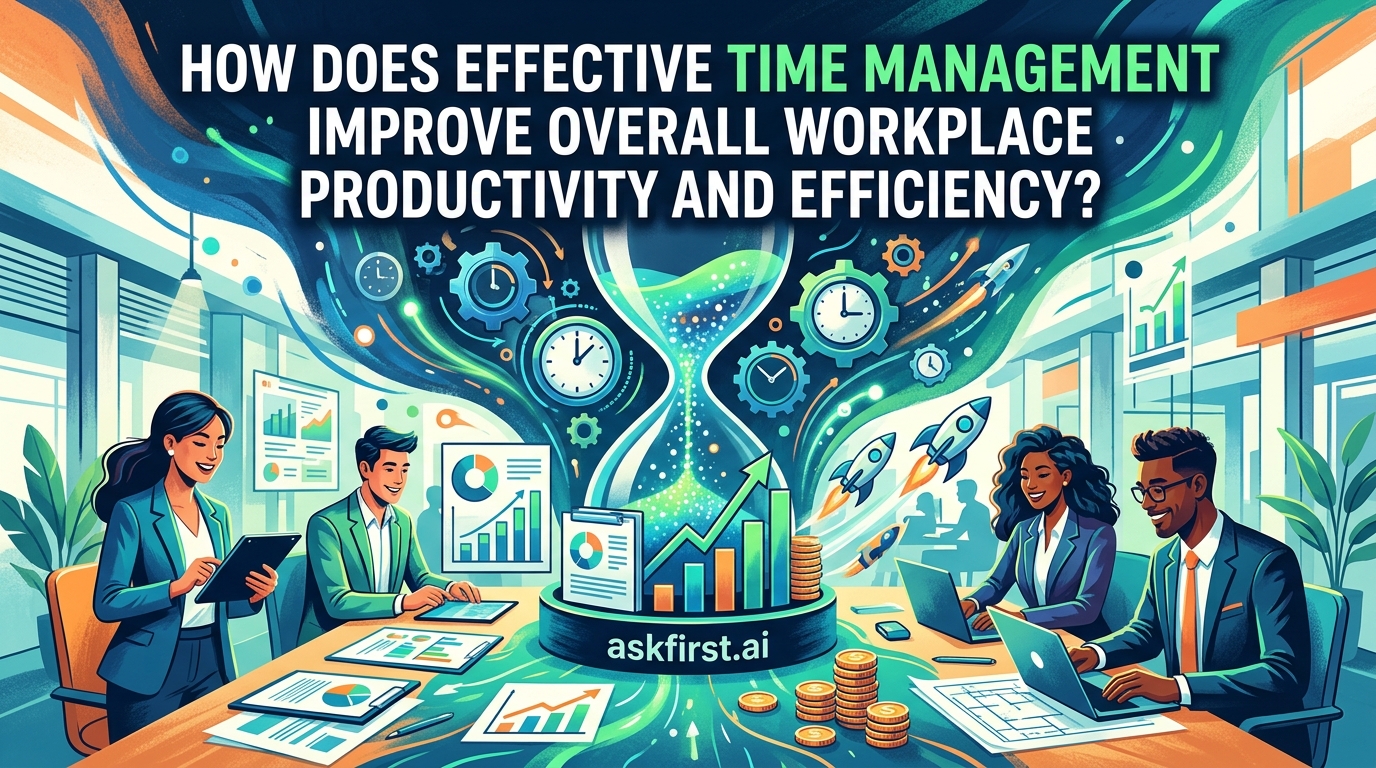
In the modern professional landscape, time is the only truly non-renewable resource. While capital, technology, and human talent can be scaled, the temporal window in which these assets must be deployed remains stubbornly fixed at twenty-four hours per day. Effective time management is not merely about "staying busy"; it is the strategic orchestration of tasks to maximize output while minimizing the cognitive and physical friction that leads to burnout. When an organization or an individual masters the art of time allocation, the result is a profound shift from reactive firefighting to proactive value creation.
The Cognitive Mechanics of Focus
The primary reason effective time management boosts productivity is rooted in the neuroscience of focus. In his seminal work, Deep Work: Rules for Focused Success in a Distracted World, Georgetown professor Cal Newport argues that the ability to perform "deep work"—distraction-free concentration that pushes cognitive capabilities to their limit—is the "superpower" of the 21st-century economy.
When employees lack time management structures, they succumb to "context switching." Research conducted by Gloria Mark at the University of California, Irvine, indicates that it takes an average of 23 minutes and 15 seconds to regain deep focus after a single interruption. By implementing time-blocking techniques—where specific intervals are reserved for high-priority tasks—workers can create "flow states." This state, popularized by psychologist Mihaly Csikszentmihalyi in his book Flow: The Psychology of Optimal Experience, is characterized by total immersion in a task, which leads to higher quality output and significantly increased efficiency.
Reducing Decision Fatigue and Parkinson’s Law
Effective time management serves as a structural safeguard against two major productivity killers: decision fatigue and Parkinson’s Law. Decision fatigue, a concept extensively detailed by Roy Baumeister and John Tierney in their book Willpower: Rediscovering the Greatest Human Strength, posits that the quality of our choices deteriorates as the number of decisions we make throughout the day increases. By utilizing time-management frameworks—such as the Eisenhower Matrix, which categorizes tasks by urgency and importance—employees reduce the cognitive load of deciding what to work on next.
Furthermore, Cyril Northcote Parkinson’s 1955 observation, known as Parkinson’s Law, states that "work expands so as to fill the time available for its completion." Without deadlines or time-constrained goals, tasks naturally bloat, consuming excessive company resources. By setting aggressive, realistic time limits for projects, managers force a prioritization of essential features over "gold-plating," ensuring that efficiency remains the primary driver of project completion.
The Multiplier Effect on Workplace Culture
When time management is adopted at an organizational level, the benefits transcend individual output and begin to reshape workplace culture.
- Reduction in Meeting Bloat: Organizations that prioritize time management often adopt the "Amazon approach"—famously championed by Jeff Bezos, where meetings are kept to a minimum and require rigorous preparation. This prevents the "death by meeting" phenomenon that plagues many corporate environments.
- Enhanced Autonomy and Morale: When employees are given the tools to manage their own time (such as through the Pomodoro Technique or Kanban boards), they report higher levels of job satisfaction. Autonomy is a key pillar of intrinsic motivation, as outlined by Daniel Pink in his influential book Drive: The Surprising Truth About What Motivates Us.
- Proactive Problem Solving: When time is managed effectively, employees are no longer trapped in a cycle of immediate-term reactive work. This "headroom" allows for strategic planning, process improvement, and innovation—the activities that actually move the needle for a business.
Concrete Implementation: The Example of Agile Workflows
Consider the implementation of Agile methodology, specifically the "Sprint" model used in software development. In this framework, teams commit to a specific set of tasks within a fixed two-week window. This time-boxed approach forces the team to clarify goals, estimate complexity accurately, and communicate frequently. The result is a consistent rhythm of delivery. By applying these principles to non-technical roles—such as marketing campaigns or administrative workflows—companies can achieve a similar predictability in output, ensuring that resources are always aligned with the highest-priority business objectives.
Conclusion: The Strategic Imperative
Time management is not a soft skill; it is a hard operational requirement for any entity aiming to remain competitive. It is the bridge between intention and execution. By mitigating the costs of context switching, preventing the bloating of projects, and fostering a culture of focused autonomy, organizations can unlock levels of efficiency that were previously inaccessible.
The evidence is clear: those who master their time do not just work faster; they work with greater intention. As the pace of global business continues to accelerate, the ability to curate one’s own focus—and by extension, the focus of an entire team—will remain the ultimate competitive advantage. To ignore the discipline of time management is to leave productivity to chance, whereas to embrace it is to design the architecture of success.