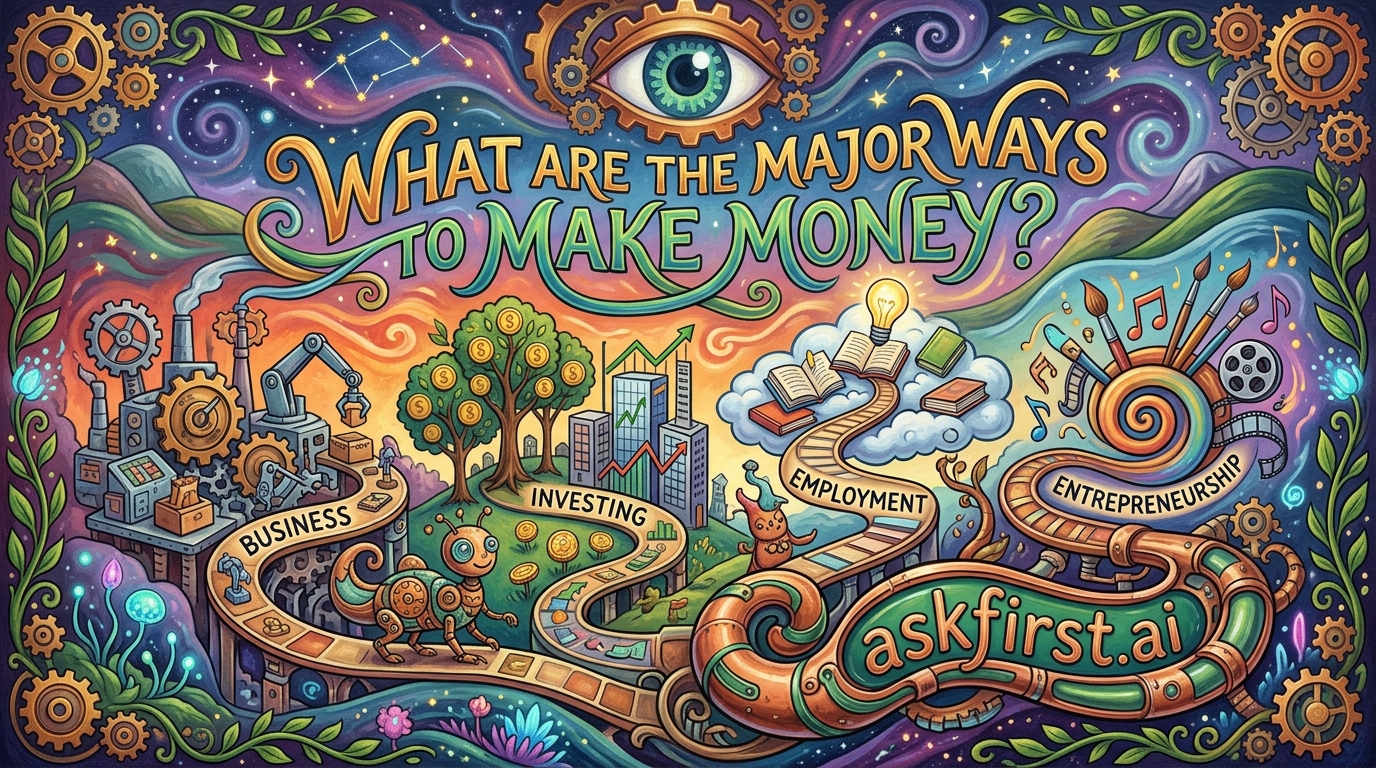
The pursuit of financial independence and wealth accumulation is a multifaceted endeavor that has evolved significantly throughout history. While there is no singular "magic bullet" for generating wealth, financial experts, economists, and successful entrepreneurs generally categorize income generation into four distinct quadrants, as famously popularized by Robert Kiyosaki in his seminal work, Rich Dad Poor Dad. Understanding these mechanisms is the first step toward mastering your financial destiny.
1. The Employee Quadrant: Trading Time for Capital
The most common way to make money is through employment. In this model, an individual sells their labor, skills, and time to an employer in exchange for a fixed salary or hourly wage. This is the foundation of the global workforce.
- The Mechanism: You provide value to a company, and they compensate you for that value. The primary constraint here is the "time-money trap"—you only earn as long as you are physically or mentally working.
- Maximizing Potential: To increase income in this quadrant, one must focus on "human capital development." By acquiring specialized certifications, advanced degrees (such as an MBA from institutions like Harvard or INSEAD), or rare technical skills (like cybersecurity or artificial intelligence engineering), you increase your market value, allowing you to command a higher salary.
- Limitations: The ceiling for income is often dictated by the market rate for your position, and your tax burden is typically the highest among all wealth-building methods.
2. The Self-Employed and Freelance Path
Moving beyond traditional employment, many individuals choose to work for themselves. This includes freelancers, consultants, and small business owners. Unlike the employee, the self-employed individual is the engine of their own income.
- The Mechanism: You provide a direct service or product to clients. If you are a graphic designer, a freelance copywriter, or a private consultant, your income is directly tied to your output and your ability to market your services.
- The Expert Edge: In his book The 4-Hour Workweek, Timothy Ferriss emphasizes the importance of outsourcing and automation even for the self-employed. By building systems, you can move from being a "job owner" to a "business owner."
- Concrete Example: A freelance software developer who charges $150 per hour is maximizing their time efficiency. However, to scale, they must eventually transition to a model where they sell a product (like a software-as-a-service platform) rather than just their hourly labor.
3. Business Ownership and Scalable Systems
True wealth is rarely built by working in a business, but rather by working on a business. This involves creating a system—a company—that generates value even when the owner is not physically present.
- The Mechanism: This involves hiring people, building processes, and leveraging intellectual property. When you own a business, your income is not tied to your time; it is tied to the profitability of the entity.
- Scalability: As noted by Peter Thiel in Zero to One, the goal of a successful startup is to create a monopoly in a specific niche. By solving a unique problem, you can scale operations globally without a linear increase in your personal labor hours.
- Key Consideration: This route carries the highest risk. The failure rate for new businesses is statistically high, requiring significant capital, management acumen, and resilience.
4. Investing: Making Money Work for You
The final and most critical stage of wealth generation is investing. This is where your accumulated capital is deployed to generate passive income or capital appreciation.
- Asset Classes:
- Equities (Stocks): By purchasing shares in public companies, you become a partial owner, entitled to a portion of profits via dividends and share price growth. As Benjamin Graham explains in The Intelligent Investor, the key is to adopt a "value investing" mindset—buying assets for less than their intrinsic value.
- Real Estate: This is a classic method for generating cash flow through rental income and long-term appreciation. Real estate also offers tax advantages, such as depreciation, which can significantly improve your net yield.
- Debt Instruments: Investing in bonds or lending money allows you to act as the bank, collecting interest payments.
- The Power of Compound Interest: Albert Einstein reportedly called compound interest the "eighth wonder of the world." By reinvesting your returns, you create a snowball effect where your money grows exponentially over time, eventually reaching a point where passive income exceeds your living expenses—the definition of financial freedom.
Conclusion
Making money is not a mystery; it is a transition from linear income (trading time for money) to exponential income (owning systems and assets that generate money). Most wealthy individuals utilize a hybrid approach: they use a high-income skill to generate initial capital, which is then aggressively funneled into assets like index funds, real estate, or private businesses.
To succeed, one must remain disciplined, continuously educate themselves on financial literacy, and—most importantly—understand that money is merely a tool. Whether you start as an employee or a freelancer, the ultimate objective should always be to transition your capital into investments that provide security and growth, ensuring that your wealth works for you, rather than you working for it. By mastering these four pathways, you position yourself to build a robust and sustainable financial future.