The Cognitive Science Behind Friday Fatigue
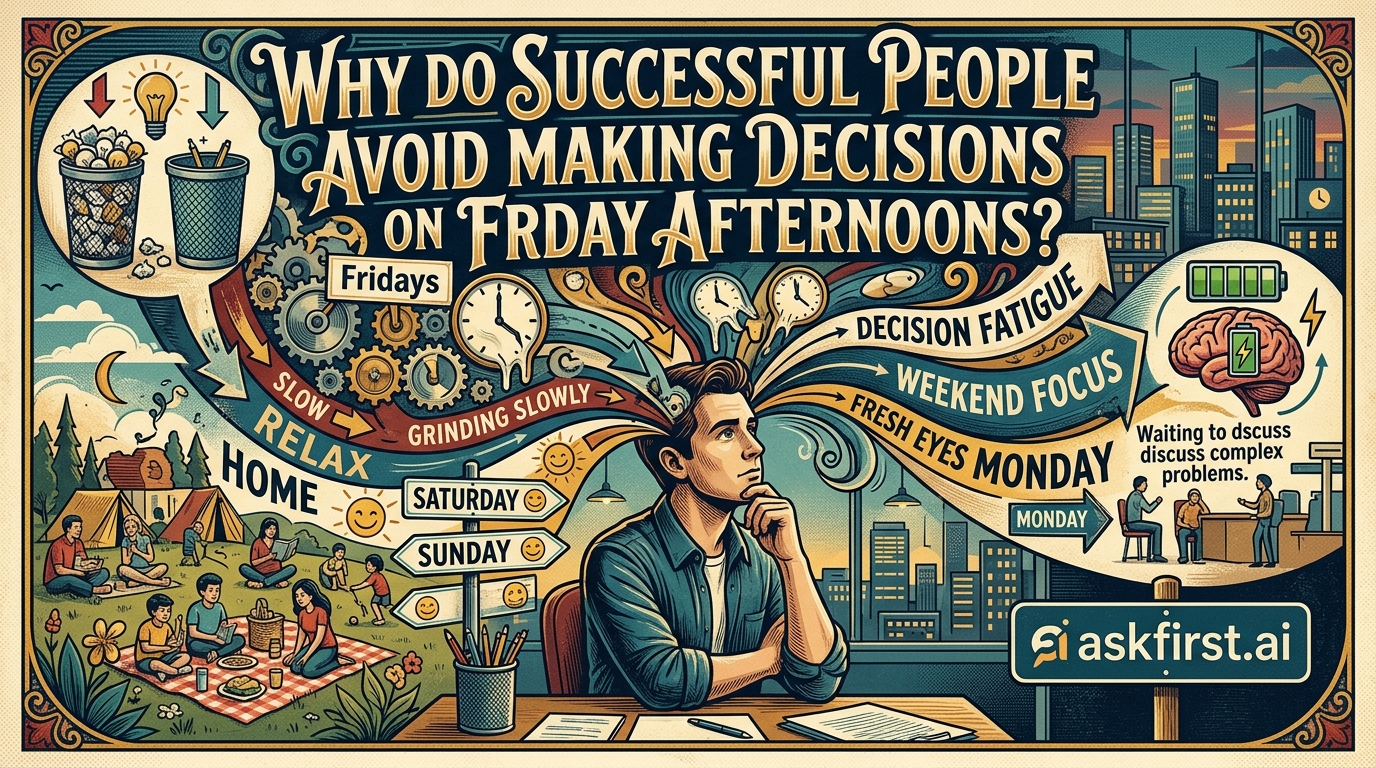
The phenomenon of decision fatigue is a well-documented psychological state where the quality of choices deteriorates after a long period of decision-making. By the time Friday afternoon arrives, the human brain—having navigated a week of complex negotiations, prioritization, and analytical problem-solving—often experiences a significant depletion of executive function. Successful individuals treat their cognitive energy as a finite, precious resource, much like capital in a bank account. Making high-stakes decisions when this resource is near zero is considered a high-risk liability.
The Science of Willpower Depletion
Research popularized by psychologists like Roy Baumeister suggests that willpower is a limited resource. Known as ego depletion, this theory proposes that the energy required for self-control and complex judgment is finite. Throughout a five-day work week, the prefrontal cortex—the part of the brain responsible for high-level decision making—becomes strained. As the weekend approaches, the brain shifts into a naturally restorative state, prioritizing relaxation and disengagement over critical analysis. Attempting to force complex logical processing during this phase often leads to the 'path of least resistance' bias, where individuals select the easiest option rather than the optimal one.
The Perils of Friday Decision-Making
There are several strategic reasons why high achievers postpone major choices until early in the following week:
- Emotional Volatility: Friday afternoons are often characterized by a mixture of pre-weekend relief and lingering stress from unresolved tasks. This emotional cocktail can cloud judgment, leading to impulsive choices that lack the objective rigor of a rested mind.
- Reduced Availability of Stakeholders: Decision-making often requires collaboration. By Friday, key team members may be distracted, unavailable, or mentally checked out. This limits the feedback loop and prevents the thorough vetting required for major decisions.
- Risk of Unintended Consequences: Decisions made under the pressure of the 'Friday deadline' often suffer from inadequate contingency planning. Without the time to troubleshoot potential pitfalls, a Friday decision can create 'firefighting' scenarios that disrupt the following Monday.
The Strategic Advantage of The Weekend Reset
Successful people utilize the weekend not just for leisure, but for subconscious incubation. Neuroscience indicates that the brain continues to process problems even when not consciously focused on them. This process, known as the 'incubation effect,' allows the subconscious mind to form connections that the tired, overworked conscious mind might miss. By postponing a decision, the individual grants their brain the time to arrive at a more creative and comprehensive solution. Many executives report that clarity comes to them on a Sunday evening or Monday morning, essentially proving that the problem was solved while they were doing something completely unrelated to work.
Best Practices for High-Performance Decision Cycles
To optimize decision-making workflows, industry leaders often follow these structured habits:
- The Thursday Deadline: Aim to finalize major strategic decisions by Thursday afternoon. This allows for a 'buffer period' where the impact of these choices can be monitored before the weekend break.
- The Friday Audit: Use Friday afternoons for low-cognitive tasks, such as reviewing weekly progress, archiving files, or planning the upcoming week's calendar. This keeps the momentum going without exhausting remaining mental fuel.
- Intentional Deferral: If a request comes in late on Friday, develop the habit of saying, 'Let’s review this fresh on Monday morning.' This creates a professional boundary and ensures the best outcome for the organization.
- Context Switching: Recognize that different times of the week are optimized for different types of work. Use peak energy times (typically mornings) for complex problem solving and lower energy periods (like Friday afternoons) for administrative upkeep and creative brainstorming that doesn't require immediate finality.
Conclusion: The Wisdom of Patience
Choosing not to decide is, in itself, a decision. Successful people understand that quality of output is inextricably linked to the state of the mind that produces it. By respecting the biological limits of the brain, they ensure that every major choice they make is backed by the full weight of their intelligence and capacity for analysis. Ultimately, the choice to wait for a Monday morning ensures that the decision-maker enters the process from a position of strength, rest, and absolute clarity rather than fatigue and urgency.