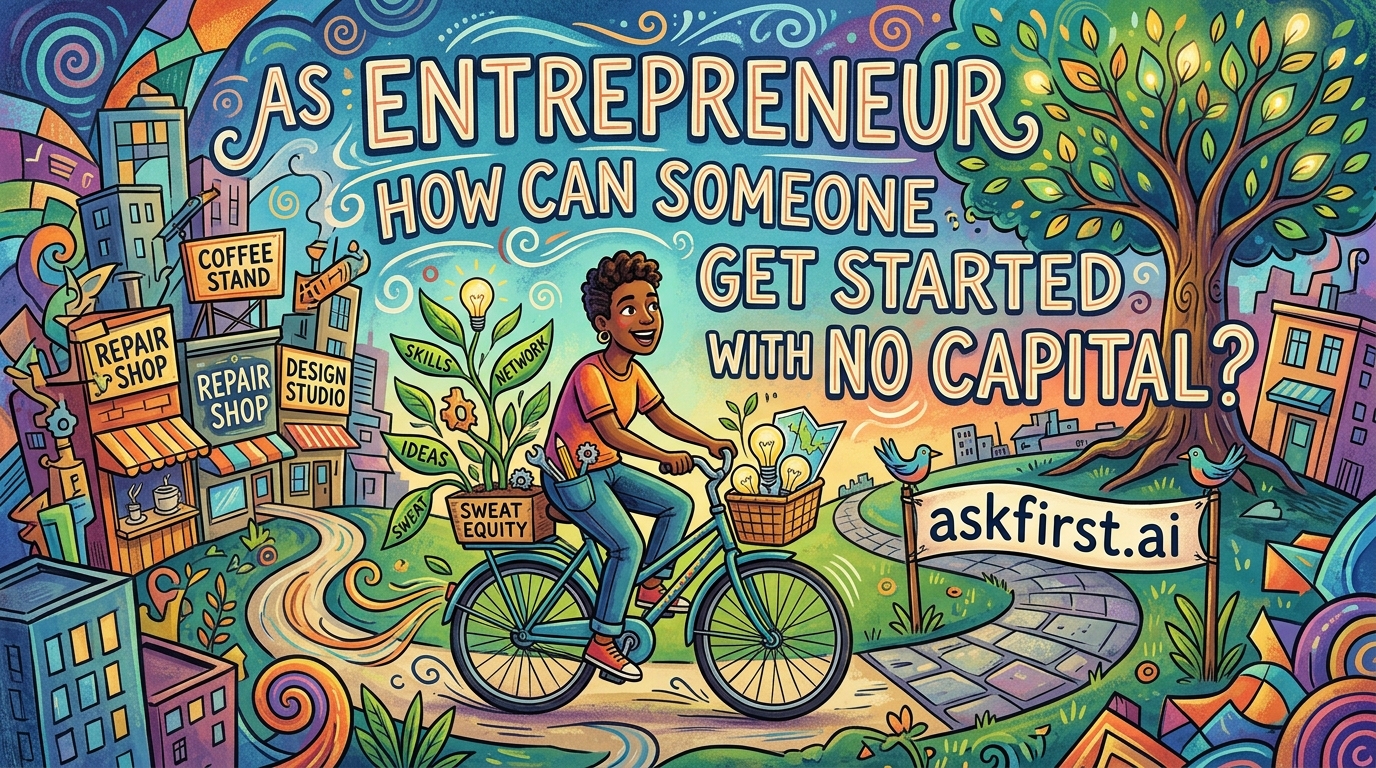
Starting a business without capital is not merely a theoretical possibility; it is a proven path taken by thousands of successful founders who prioritized sweat equity over external funding. In the modern digital economy, the barriers to entry have plummeted, allowing individuals to trade time, skill, and creative energy for initial revenue. When you lack financial resources, your primary asset is your ability to solve a specific problem for a specific group of people better than anyone else.
The Philosophy of Bootstrapping and Lean Methodology
To begin with zero capital, you must adopt the "Lean Startup" methodology popularized by Eric Ries in his seminal work, The Lean Startup. The core principle here is to build a "Minimum Viable Product" (MVP)—the simplest version of your offering that provides value to a customer. Instead of spending months and thousands of dollars on product development, you focus on validating your business model through real-world feedback.
By focusing on service-based businesses initially, you eliminate the need for inventory, manufacturing, or expensive software development. Services are the ultimate "zero-cost" startup model because your only investment is your time and your existing skill set.
Phase 1: Audit Your Skill Stack and Market Demand
Before you launch, you must conduct a rigorous audit of your capabilities. What can you do that others are willing to pay for? This could be copywriting, social media management, technical consulting, graphic design, or even specialized manual labor.
According to Chris Guillebeau in his book The $100 Startup, the most successful low-cost businesses sit at the intersection of three things:
- A skill you possess.
- A passion you enjoy.
- A market need that people are already paying for.
Do not try to invent a new market. Look for existing markets where customers are already spending money, and position yourself as a more efficient, personalized, or accessible alternative. For example, if you are a skilled writer, do not just offer "writing"; offer "high-converting email sequences for boutique e-commerce brands." Specialization allows you to command higher prices immediately.
Phase 2: The Art of Service Arbitrage and Freelancing
If you have no capital, you must become a freelancer to generate "seed money." Platforms like Upwork, LinkedIn, and direct cold-outreach emails are your storefront. Your goal is to acquire your first three clients as quickly as possible.
The strategy here is "Cold Outreach." Do not wait for clients to find you. Use a tool like Hunter.io to find the email addresses of decision-makers in your target niche. Craft a personalized, value-driven pitch that addresses a specific pain point they have. For instance: "I noticed your company’s recent blog posts aren't being repurposed for LinkedIn; I can turn your existing content into a weekly LinkedIn strategy that drives traffic to your site."
By keeping your overhead at zero—using free tools like Google Workspace, Trello for project management, and Canva for design—every dollar you earn is pure profit. This profit becomes the capital you eventually use to scale into more complex business models.
Phase 3: Building a "Minimum Viable Brand"
You do not need a logo designed by an agency or an expensive website to start. You need a reputation. In the digital age, your "brand" is your portfolio and your social proof.
- Document your process: Share what you are learning and doing on platforms like X (Twitter) or LinkedIn. This builds authority.
- Collect Testimonials: Even if you have to do your first project for a discount or for free in exchange for a glowing video testimonial, do it. Social proof is the currency of the modern internet.
- Focus on Retention: It is significantly cheaper to keep an existing client than to find a new one. By providing exceptional service, you turn clients into recurring revenue sources, which provides the stability needed to grow.
Phase 4: Reinvesting for Scale
Once you have generated a small amount of cash, resist the urge to spend it on "vanity" business expenses like business cards or expensive office space. Reinvest that money into leverage.
Leverage comes in two forms:
- Tools: Investing in software that automates your manual tasks (e.g., email automation tools or CRM systems).
- Talent: Hiring an assistant to handle the administrative work so you can spend your time on high-value, revenue-generating activities.
Conclusion
Starting with no capital is an exercise in discipline, resourcefulness, and psychological resilience. It forces you to focus on what actually matters—revenue and customer satisfaction—rather than the distractions of traditional business planning. By starting as a service provider, validating your skills in the open market, and relentlessly reinvesting your profits into systems and leverage, you can build a sustainable, profitable business from scratch. The barrier is not a lack of money; it is a lack of the willingness to do the unglamorous, foundational work required to get your first customer. Start today, start small, and let the market dictate your growth.