The Great Talent Dilemma: Friends vs. Strangers
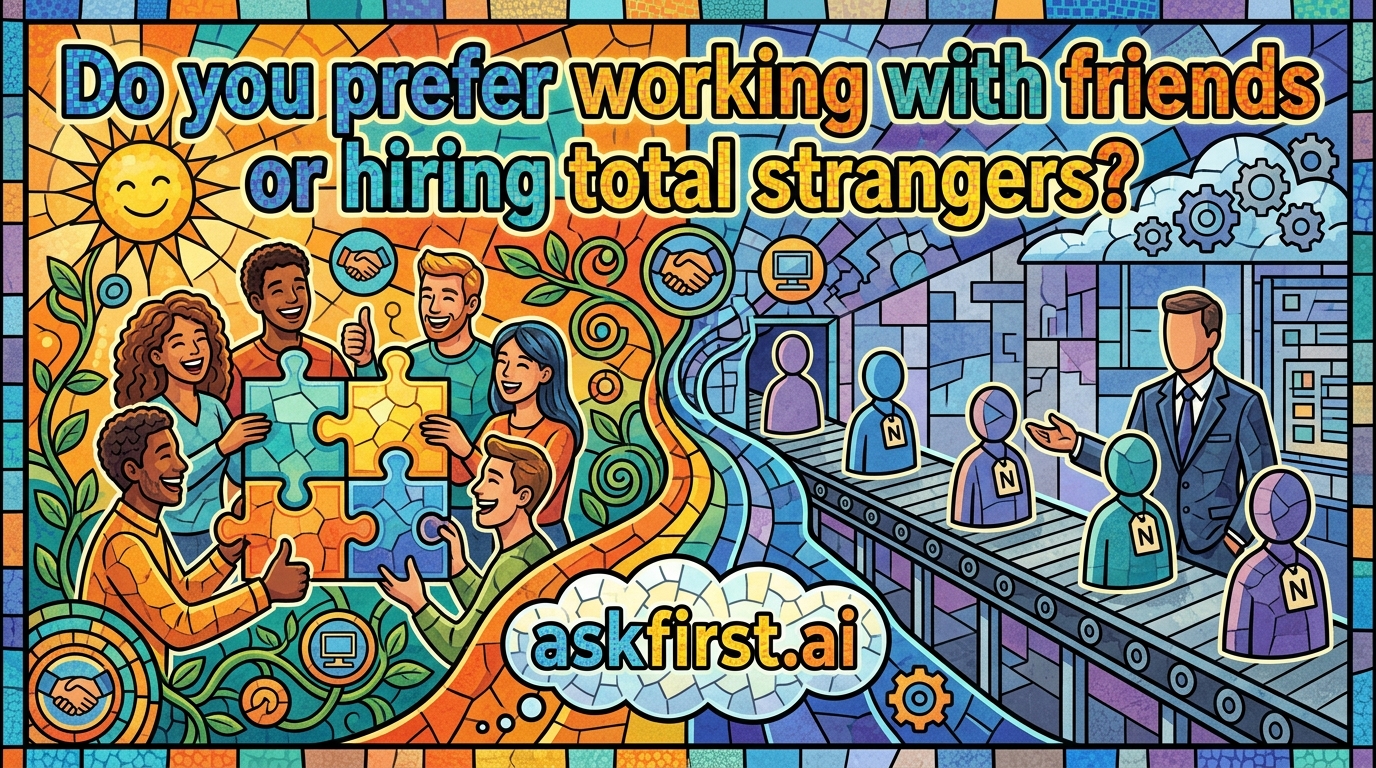
The age-old debate regarding whether to build a professional team from an existing network of friends or to cast a wider net toward total strangers touches upon the very core of organizational psychology. Each approach brings distinct structural advantages and systemic risks. Understanding these dynamics is essential for sustainable business growth.
The Case for Hiring Friends: Psychological Safety and Alignment
1. High-Trust Environments
Working with friends often facilitates immediate high-trust collaboration. Because social capital has already been accumulated, the time required to establish psychological safety—a term coined by Amy Edmondson describing an environment where team members feel safe to take risks—is significantly reduced. This allows for faster decision-making.
2. Shared Values
Friends usually share similar worldviews, ethical frameworks, and communication styles. According to studies on organizational behavior, value alignment is one of the strongest predictors of long-term employee retention. When teammates share deep-rooted values, conflicts are less likely to escalate into destructive interpersonal disputes.
3. Enhanced Motivation
Working with friends creates a powerful feedback loop of mutual accountability. The desire to avoid letting down a person one cares about personally provides a unique layer of professional motivation that is difficult to replicate with cold, formal contracts alone.
The Risks of Friend-Centric Hiring
Despite the benefits, relying solely on a friend-network introduces significant hazards:
- Homogeneity Bias: Friendship circles tend to share the same background, education, and perspective. This lack of cognitive diversity can lead to 'groupthink,' where the team fails to identify innovative solutions or potential risks because everyone thinks exactly the same way.
- The Conflict Avoidance Trap: Leaders may find it difficult to provide critical, corrective feedback to a friend. When personal relationships are entangled with professional hierarchy, performance management becomes emotionally charged and potentially damaging to the business.
- Limits of Competence: Relying on friends often ignores the objective truth that the most qualified person for a specific technical role may not exist within the immediate social circle. Prioritizing comfort over raw skill sets is a primary cause of organizational failure.
The Case for Hiring Total Strangers: Objective Excellence
1. Meritocratic Selection
When hiring a stranger, the assessment process is typically anchored in objective performance metrics, skill verification, and standardized interviews. This depersonalized approach ensures that the most capable individual, rather than the most available or agreeable one, occupies the role.
2. Cognitive Diversity
Bringing in individuals from outside existing social circles introduces 'productive friction.' Research consistently shows that teams composed of diverse individuals—diverse not only in demographics but in work history and problem-solving styles—consistently outperform homogenous teams in complex problem-solving environments.
3. Professional Boundaries
Engaging with strangers allows for clear, defined professional boundaries from day one. Expectation setting is far easier when the relationship is purely commercial, as there is no prior emotional debt or social baggage to navigate.
How to Balance the Scale
Modern management experts suggest that the most successful organizations employ a hybrid strategy:
- The 'Strangers for Skills, Friends for Values' Framework: Identify the specific hard skills needed for a project and use structured, blinded interviews to vet candidates for those skills. However, once the technical criteria are met, evaluate whether the stranger fits the company culture, which often requires a trial project.
- Implementation of Formal Feedback Systems: Regardless of whether the hire is a friend or a stranger, organizations must mandate regular, objective performance reviews. This institutionalizes feedback and prevents personal dynamics from clouding the assessment of professional contribution.
- Actively Seeking Dissent: If a team is comprised of friends, it is the leader's responsibility to play devil's advocate. Deliberately seeking outside perspectives to challenge the internal consensus is essential to break the echo chamber effect.
Conclusion: The Strategic Choice
Choosing between friends and strangers is not about picking a side; it is about choosing the right tool for the right stage of the organization. Early-stage startups often benefit from the speed and trust of friends, whereas scaling enterprises require the objective, diverse expertise provided by strangers. By understanding the psychological underpinnings of these choices, leaders can build high-performance teams that are both cohesive and capable of rigorous, independent thought.