The Paradox of Pricing: Economic Resilience and Consumer Behavior
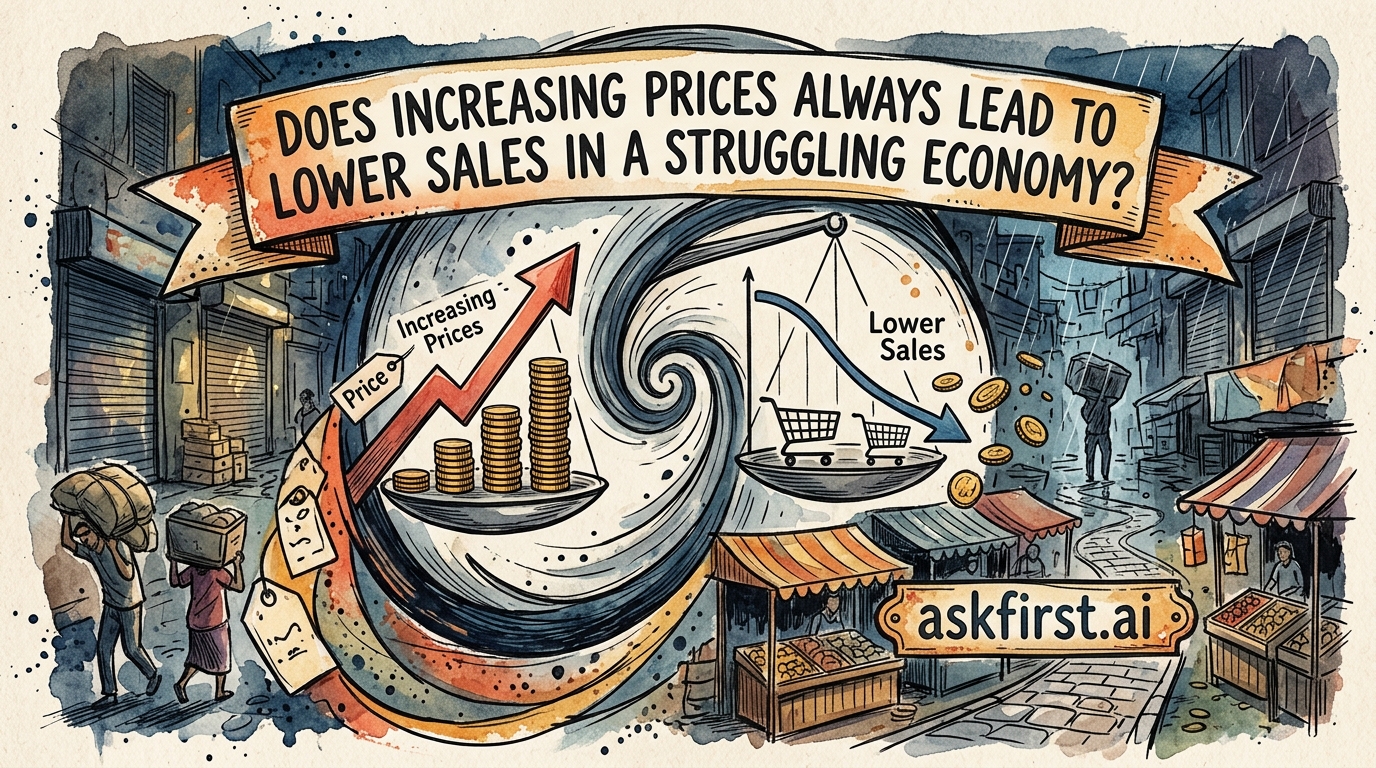
In the study of microeconomics, the relationship between price and quantity demanded is typically governed by the Law of Demand, which posits that, all else being equal, as the price of a good increases, the quantity demanded decreases. However, in a struggling economy—characterized by high inflation, stagnant wage growth, and reduced consumer confidence—this relationship becomes significantly more complex. It is a common misconception that raising prices will inevitably lead to a decline in sales. In reality, the impact of price adjustments depends on a constellation of factors, including price elasticity, brand equity, and the nature of the product itself.
Understanding Price Elasticity of Demand
To determine whether a price hike will cause a drop in sales, one must first calculate the Price Elasticity of Demand (PED). As defined by economist Alfred Marshall in his seminal work Principles of Economics (1890), elasticity measures how sensitive the quantity demanded is to a change in price.
- Inelastic Demand: For essential goods—such as medication, basic food staples, or utilities—consumers will continue to purchase the product even if prices rise, because they have no viable alternatives. During a recession, demand for these items remains relatively stable.
- Elastic Demand: For luxury items or non-essential services, a small increase in price can lead to a disproportionate drop in sales. In a struggling economy, consumers are hyper-aware of their discretionary spending, making these products highly vulnerable to price hikes.
If a company sells a product with inelastic demand, they can often raise prices during an economic downturn to maintain profit margins without suffering a catastrophic loss in sales volume.
The Veblen and Giffen Good Exceptions
There are fascinating economic anomalies where the traditional rules of demand are inverted. The Veblen Effect, named after sociologist Thorstein Veblen in his book The Theory of the Leisure Class (1899), describes luxury goods for which demand increases as the price rises. This is driven by "conspicuous consumption," where the high price itself serves as a signal of status and exclusivity. Even in a struggling economy, the ultra-wealthy segment may continue to purchase these goods, and paradoxically, a price increase might even enhance the product's desirability.
Conversely, Giffen Goods are low-income, non-luxury products that defy standard demand curves. As described in studies by Sir Robert Giffen, when the price of a staple food (like rice or bread) rises, impoverished consumers may actually buy more of it. Because their budget is so restricted, they can no longer afford more expensive proteins, forcing them to rely entirely on the cheaper staple, even as its price climbs.
Pricing as a Signal of Quality
In a struggling economy, consumers often experience high levels of uncertainty. When information is asymmetric—meaning the buyer doesn't know the true quality of a product—they often use price as a heuristic, or a shortcut, to judge value. This phenomenon is extensively documented in "The Psychology of Pricing" by Dr. Robert Cialdini.
If a business lowers prices during a recession to "chase" customers, they risk signaling that their quality has diminished. Conversely, maintaining or slightly increasing prices while improving the perceived value or service can actually build trust. A consumer might reason: "This brand is more expensive, but it is reliable, and I cannot afford a product that breaks or fails during these tough times." This is known as the "Quality Signaling Effect."
Strategic Pricing and Brand Loyalty
Brand equity acts as a buffer against economic headwinds. Companies that have cultivated deep emotional connections with their customers—often through superior customer service or community engagement—find that their base is less sensitive to price changes.
Consider the example of premium coffee chains or specialty electronics. During the 2008 financial crisis, many of these brands maintained their pricing strategies. Instead of lowering prices and diluting their brand, they focused on "value-added" propositions. By offering loyalty rewards or bundle pricing, they kept their sales volume steady while keeping their price points high. As noted in "Strategy Beyond the Hockey Stick" by Chris Bradley and Martin Hirt, companies that prioritize long-term brand health over short-term volume discounts tend to emerge from recessions with stronger market share.
Conclusion: The Contextual Reality
Increasing prices in a struggling economy does not automatically lead to lower sales. It is a strategic lever that requires a precise understanding of the target demographic and the product category. While a business selling luxury items might find that a price hike alienates budget-conscious consumers, a business selling essential goods or high-status items may find that their sales remain resilient—or in the case of Giffen goods, even increase.
Ultimately, the most successful firms in a downturn are those that do not rely on price alone. They combine intelligent pricing with clear communication, demonstrating why their product remains an essential or high-value investment despite the broader economic climate. By moving beyond the simplistic assumption that price is the only variable, businesses can navigate economic turbulence with confidence and precision.