The Paradox of Professional Presence: Is Small Talk a Career Killer or a Hidden Asset?
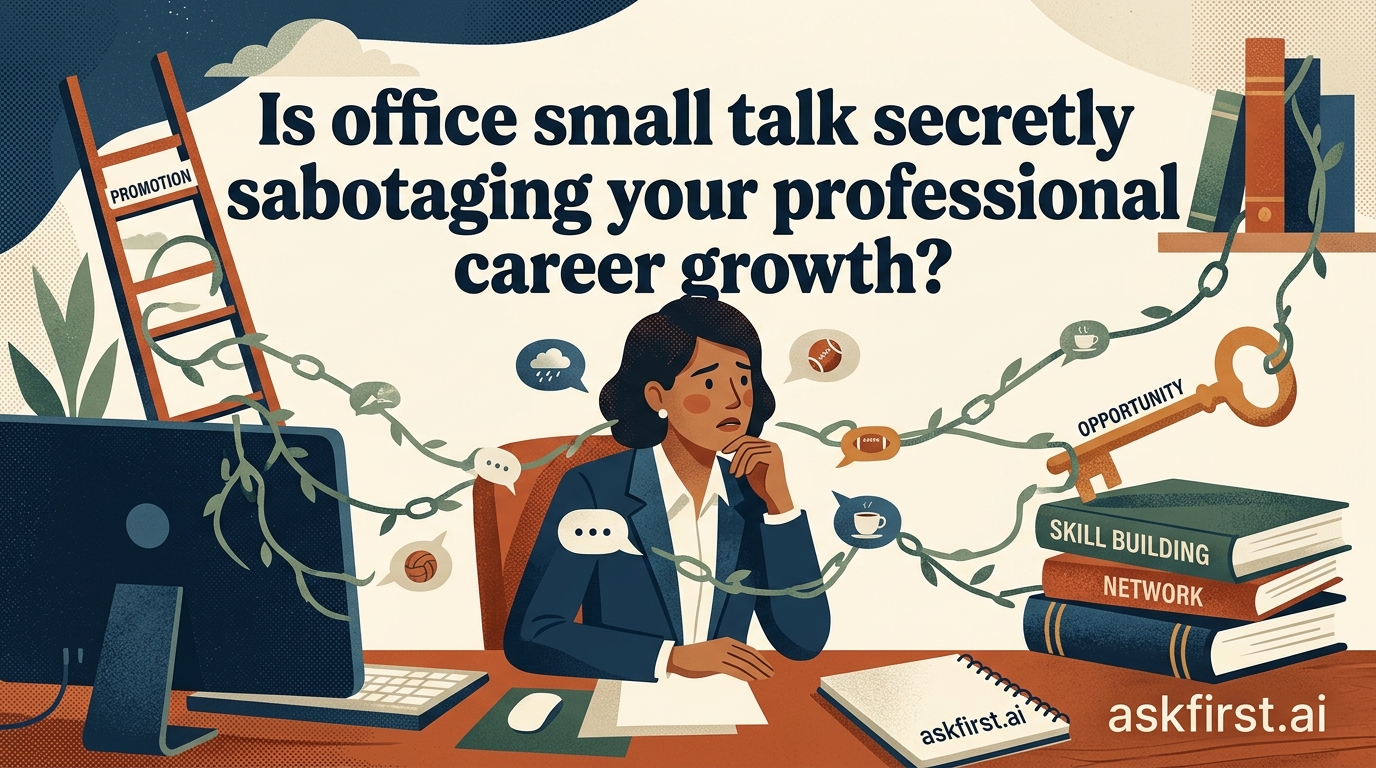
In the modern corporate landscape, the concept of "water cooler chat"—the seemingly trivial exchanges about weekend plans, local sports, or the weather—is often viewed through a polarized lens. For some, it is the bedrock of organizational culture; for others, it is a superficial drain on productivity that masks a deeper, more sinister potential: the slow erosion of professional credibility. If you have ever wondered whether those five-minute conversations about your neighbor’s landscaping or the latest streaming series are quietly sabotaging your upward trajectory, you are not alone. The answer, however, is not a binary "yes" or "no," but rather a complex study in strategic social intelligence.
The "Competence-Likability" Trade-off
The primary danger of excessive small talk is the "Competence-Likability Trade-off," a phenomenon extensively explored by Dr. Sylvia Ann Hewlett, author of Executive Presence: The Missing Link Between Merit and Success. Hewlett argues that while being "likable" is a core component of executive presence, it can inadvertently signal that you are a social butterfly rather than a strategic heavyweight.
When you spend the majority of your office interactions discussing non-professional topics, you risk being typecast. Colleagues and superiors begin to associate your presence with leisure rather than labor. If your persona in the office is defined by your ability to chat about the local news rather than your ability to solve complex operational bottlenecks, you are essentially training your peers to overlook your technical expertise. In the eyes of decision-makers, you become "great to have around" but "not quite ready for the next level." This is a career-limiting trap that disguises itself as social harmony.
The Currency of Social Capital
Conversely, dismissing small talk entirely is equally perilous. In Give and Take: A Revolutionary Approach to Success, organizational psychologist Adam Grant highlights the necessity of "prosocial behavior." Grant notes that those who fail to build rapport—often by appearing cold or hyper-focused on tasks—often find themselves isolated from the informal networks where critical information flows.
Small talk is the "grease" of the organizational machine. It builds the psychological safety required for high-stakes collaboration. If you ignore the social rituals of your team, you may find yourself excluded from "off-the-record" conversations where project scopes are defined and alliances are formed. The key to avoiding sabotage is not to eliminate small talk, but to transition it from frivolous filler to strategic connection.
Mastering the Art of "High-Stakes Small Talk"
To ensure that your social interactions bolster rather than undermine your career, you must adopt a framework of "purposeful engagement." Consider these three strategies:
- The 80/20 Rule of Conversation: Aim for 80% professional relevance and 20% personal rapport. When you engage in small talk, use it as a bridge to professional topics. For example, if a colleague mentions their weekend hiking trip, transition by saying, "That sounds refreshing. I find that disconnecting completely helps me tackle the Q3 reports on Monday. Speaking of which, how are you feeling about the data migration timeline?" This anchors your social persona to your professional output.
- The "Expert-Advisor" Framing: Use your casual conversations to subtly broadcast your expertise. Instead of complaining about a project, share a "win" or a piece of industry insight. "I saw a fascinating white paper on [Industry Trend] this morning; it made me realize we might be approaching our current client problem from the wrong angle." This transforms the water cooler into a stage for your thought leadership.
- Active Observation: In How to Win Friends and Influence People, Dale Carnegie emphasizes the power of active listening. Use small talk to gather intelligence. Ask questions about your colleagues' pain points or organizational priorities. By positioning yourself as the person who listens to the "pulse" of the office, you become an indispensable hub of internal information.
The Dangers of "Over-Sharing"
A critical, often overlooked aspect of office sabotage is the content of the talk itself. Vulnerability is a buzzword in modern leadership, but there is a distinct line between being authentic and being a liability. Over-sharing personal grievances, financial stressors, or office gossip can permanently tarnish your professional brand. As stated in The Charisma Myth by Olivia Fox Cabane, perceived power and warmth must be balanced. If your small talk leans toward the overly personal or the negative, you lose the "power" element of your charisma, making you seem unstable or untrustworthy to those in leadership positions.
Conclusion: The Strategic Pivot
Small talk is not inherently sabotaging; it is a tool. Like any tool, its impact depends entirely on the hand that wields it. If you use it to hide from work or to avoid the discomfort of high-performance expectations, you are indeed sabotaging your career. However, if you use it to weave yourself into the fabric of the organization, to demonstrate active interest in your peers, and to subtly reinforce your reputation as a forward-thinking expert, it becomes a powerful catalyst for growth.
The goal is to cultivate a reputation as someone who is both approachable and formidable. Do not abandon the water cooler; instead, command it. By shifting your approach from passive participant to strategic conversationalist, you ensure that every interaction serves as a building block for your professional future, rather than an anchor holding you in place.